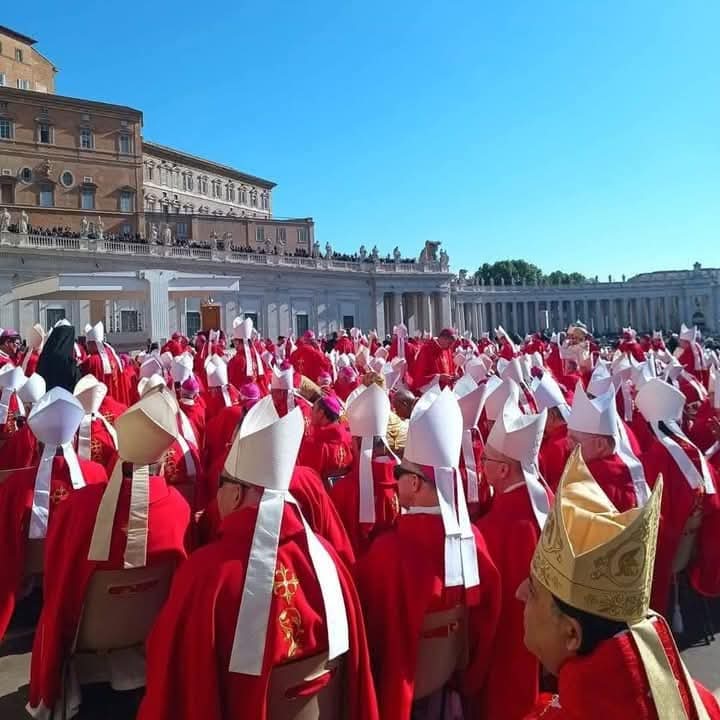

On Wednesday, cardinals from across five continents gathered at St. Peter’s Basilica in the Vatican for a final public mass before entering seclusion to elect a new leader for the world’s 1.4 billion Catholics.
A total of 133 cardinal electors, all under the age of 80, are expected to take part in the sacred conclave, the traditional voting process that will determine the successor to Pope Francis, who passed away last month after serving for 12 years.
With no clear favourite emerging among the candidates, the conclave promises to be an open and potentially prolonged decision-making process.
The cardinals represent a broad spectrum of theological views and cultural backgrounds, reflecting the global character of the Catholic Church.
Presided over by the Dean of the College of Cardinals, Giovanni Battista Re, the mass marked the final open liturgical event before the cardinals retreat into the Sistine Chapel to begin voting.
It is from the balcony of St. Peter’s Basilica, several days from now, that the 267th pope will eventually be introduced to the world.
Historically, recent conclaves have concluded swiftly, both Francis and Benedict XVI were elected within two days.
Yet, the Church’s longest papal election stretched over 1,006 days in the 13th century.
This conclave will be the largest in history, with participants from roughly 70 nations.
To be elected, a candidate must receive at least 89 votes, a two-thirds majority.
The cardinals are housed at the Vatican’s Santa Marta guesthouse and the adjacent Santa Marta Vecchia.
They will proceed from there Wednesday afternoon to the Pauline Chapel in the Apostolic Palace for a time of prayer before officially entering the conclave.
The solemn process takes place under the Michelangelo frescoes of the Sistine Chapel, an environment steeped in tradition and secrecy.
During the ceremony, Italian Cardinal Pietro Parolin, one of the key figures and considered a frontrunner, will call upon the Holy Spirit to guide their decision.
In keeping with Vatican protocol, mobile phones have been surrendered.
The cardinals will swear an oath of secrecy and commit to faithfully serving if chosen as pontiff. Upon the command “Extra omnes” (“Everyone out”), the doors will close, and the world’s most secretive election will begin.
Votes will be cast on slips bearing the Latin phrase “Eligo in Summum Pontificem” (“I elect as Supreme Pontiff”), placed on a silver plate and tipped into an urn beneath Michelangelo’s Last Judgment.
The first round of voting is expected Wednesday evening, followed by the symbolic smoke signal: black for no decision, white for a new pope.
Outside in St. Peter’s Square, hundreds of faithful have already gathered, eyes fixed on the chimney, awaiting the first sign from the conclave.
Among the pressing issues facing the next pope are declining numbers of clergy, Church finances, the role of women, and reconciling traditional doctrine with contemporary challenges.
While about 80% of the cardinal electors were appointed by Francis, known for his populist and reformist stance, opinions are divided over whether to preserve his legacy or steer the Church in a more conservative direction.
Names being speculated include Pierbattista Pizzaballa of Italy, Peter Erdo of Hungary, and Malcolm Ranjith of Sri Lanka, but the final outcome remains uncertain.