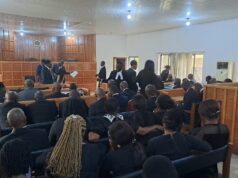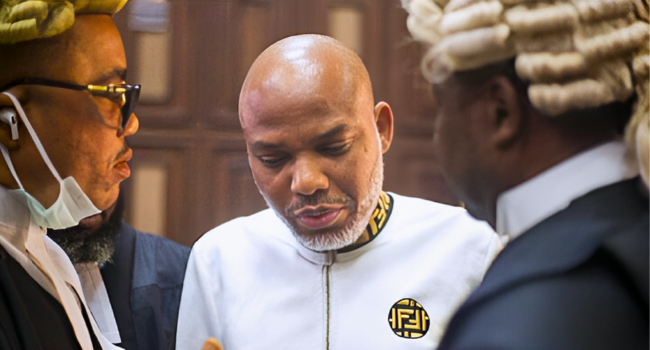

At a Federal High Court sitting on Wednesday, the Department of State Services (DSS) firmly denied any involvement in the arrest of Nnamdi Kanu, leader of the proscribed Indigenous People of Biafra (IPOB), in Kenya.
This was revealed during the cross-examination of a prosecution witness known only as BBB, a DSS intelligence operative.
Kanu is currently facing terrorism-related charges filed by the Federal Government.
Prior to the cross-examination, defense lead counsel Chief Kanu Agabi (SAN), represented by Paul Erokoro (SAN), took a moment to address a series of media reports that had been attributed to the defense team.
“We are not part of those negative reports,” Agabi clarified. In response, Chief Adegboyega Awomolo (SAN), lead prosecutor, expressed agreement and disclosed that he had sent a formal complaint to the defense on the matter.
He urged the court to issue directives to curb such reports.
“It is important we caution ourselves, especially those of us who are lawyers. This is a sensitive national matter, and professionalism must guide our conduct,” Awomolo noted.
Justice Omotoso, presiding over the case, also cautioned against media sensationalism and unethical conduct by legal practitioners.
“Lawyers must not be involved in leaking court proceedings or confidential communication to generate traffic or sympathy,” he warned.
“We must act in the interest of justice, not personal popularity. We must refrain from using the life of parties to promote traffic on our social media platforms.”
During his testimony, the DSS operative acknowledged he had not personally monitored Radio Biafra but said other intelligence officers had done so and that their reports were deemed reliable.
When questioned about the legality of Kanu’s arrest in Kenya, the witness stated unequivocally: “We are a domestic intelligence agency. We do not operate outside Nigeria. If he were arrested in Kenya, we are not responsible.”
Pressed further on Kanu’s allegation that he was abducted and forcibly repatriated, the officer responded that such claims were outside his investigative scope.
The defense submitted certified court judgments from Abia, Umuahia, and Enugu declaring Kanu’s arrest and home invasion illegal. These were admitted into evidence without objection.
Erokoro also challenged the classification of Kanu’s advocacy for self-determination as terrorism.
“Not all agitators are terrorists,” the DSS officer conceded, but maintained that Kanu’s actions involved incitement to violence.
The defense raised the issue of inconsistent treatment of similar security groups such as Amotekun, questioning whether IPOB was being singled out.
On the impact of Kanu’s detention on national security, the witness admitted that while violence linked to IPOB had not stopped entirely, incidents had decreased.
A sharp exchange arose when the defense requested a pause in proceedings to secure a video exhibit. The prosecution opposed, accusing the defense of delaying tactics.
Justice Omotoso allowed the adjournment “in the interest of justice” and rescheduled the matter to May 22, cautioning the defense that it must conclude its case on that date or risk closure.