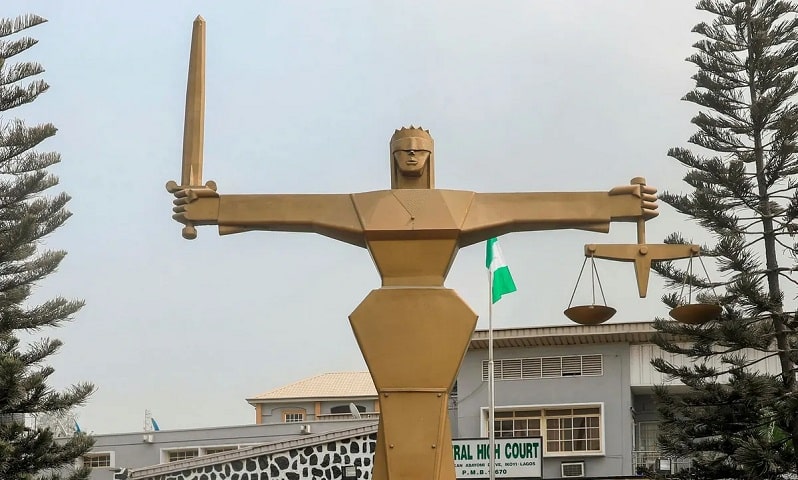

The Supreme Court has struck out a lawsuit filed by all 36 state governments and the Nigeria Governors’ Forum (NGF) challenging the federal government’s management and allocation of recovered looted assets.
In a unanimous decision delivered on Friday by a seven-member panel, the apex court ruled that the case was filed in the wrong court.
While Justice Chidiebere Uwa prepared the judgment, it was read by Justice Mohammed Idris.
The court found that the states had “wrongly invoked its jurisdiction,” ruling that the subject of the suit falls under the Federal High Court’s purview rather than the Supreme Court’s original jurisdiction. The case had been filed under suit number SC/CV/395/2021.
The states contended that “between 2015 and 2021 when the suit was filed, the FG has secured both international and municipal forfeiture, recovery and repatriation of ‘stolen assets’ in the sum of ₦1,836,906,543,658.73, about 167 properties, 450 cars, 300 trucks and cargoes, and 20,000,000 barrels of crude oil worth over ₦450 million,” alleging that these were not properly remitted.
They accused the Federal Government of diverting the recovered assets into accounts not recognised by the Constitution, particularly the Consolidated Revenue Accounts (CRA), instead of the Federation Account, which they argued is the only constitutionally valid repository.
The plaintiffs claimed that “the CRA is the account into which FG’s share from the Federation Account, other federal earnings and funds belonging to specific state governments are paid.”
They emphasized that other revenues payable to the CRA include “receipts from federal government licenses and land revenue, administrative fees, earnings and sales, rent of government property, interests from federal government investments, repayments from state governments, Personal Income Tax of Armed Forces and others.”
According to them, the creation of the Asset Recovery Account and Interim Forfeiture Recovery Account through which recovered assets were allegedly channeled contradicted constitutional provisions.
They said: “By establishing the Asset Recovery Account and Interim Forfeiture Recovery Account, into which revenue from recovered assets was to be paid, the Asset Recovery Regulation contradicts the provisions of the Constitution.”
The plaintiffs maintained that “numerous recoveries of illegally acquired assets have been secured through anti-corruption and law enforcement agencies,” referencing institutions such as the Economic and Financial Crimes Commission (EFCC), Independent Corrupt Practices and Other Related Offences Commission (ICPC), the Nigerian Police Force, and the Office of the Attorney General of the Federation.
They cited sections 162(1), 162(10), and 80 of the Constitution as well as section 2 of the Finance (Control and Management) Act, 1958, to support their claim that all such funds should be deposited into the Federation Account.
“It is unconstitutional to remit or divert revenue payable into the Federation Account to the Consolidated Revenue Account of the Federal Government or any other account whatsoever, or to apply the said revenue to any other purpose,” they argued.
In their prayers to the court, the states requested a declaration “that by the provisions of Section 162(1) and Section 162(10) of the Constitution of all income, returns, proceeds or receipts howsoever described derived from confiscated, forfeited and/or recovered assets constitute revenue of the federal republic of Nigeria, must be remitted to the Federation Account for the collective benefit of the federal, state and local governments.”
They also asked for an order compelling the Federal Government to return ₦1.8 trillion in cash and ₦450 billion in non-cash assets recovered since 2015 to the Federation Account.
Additionally, the plaintiffs sought a court order mandating the President and other relevant federal agencies to provide “a detailed account of the recovered assets that are not remitted into the Federation Account.”
Finally, they urged the Supreme Court to compel the Revenue Mobilisation and Fiscal Commission (RMFAC) to establish “modalities for distributing recovered assets among the federating units.”