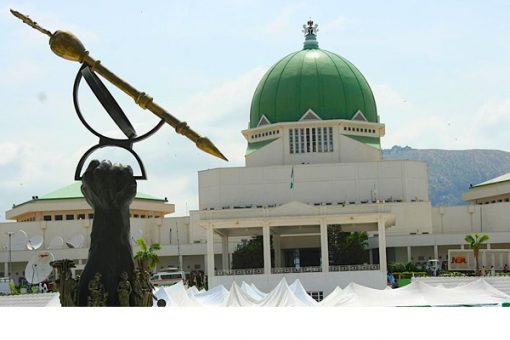

In a landmark decision aligning with the spirit of Nigeria’s Democracy Day, the National Assembly has formally adopted June 12 as the annual date for the President to address a joint session of the legislature.
The resolution was reached during a special sitting at the National Assembly Complex in Abuja on Thursday, where President Bola Tinubu delivered a commemorative address to mark the day.
Presiding over the joint session, Senate President Godswill Akpabio affirmed the motion, which was introduced by Speaker of the House of Representatives, Tajudeen Abbas.
“Mr President, in the eloquent speech by the Honourable Speaker Tajudeen Abbas, he raised a motion that June 12 should be formalised as the Presidential Day of Address to the joint session of the National Assembly. I hereby put the question,” Akpabio announced.
“Those in support of the motion, moved and seconded, say ‘Aye’; those against say ‘Nay’. The ‘Ayes’ have it.”
Following the decision, Akpabio directly addressed President Tinubu, expressing satisfaction with the day’s proceedings.
“Mr President, that is the motion of the National Assembly, done in your presence. Mr Speaker, the statistics do not lie, we are quite happy with the data you rolled out and the House that we all run.”
The move to institutionalise June 12 as the official date for the presidential address had been anticipated.
On Tuesday, Senate Leader Opeyemi Bamidele disclosed to journalists that a bill was being drafted to make the practice permanent.
“We are hoping to bring a bill soon to institutionalise the President’s address on June 12 because of its historical importance.”
“There can’t be a better time to address the nation through the Parliament than on June 12, especially since it is a joint sitting of the National Assembly,” he stated.
Bamidele also revealed that the forthcoming legislation would propose the National Assembly complex as the designated location for future presidential inaugurations.
“In that bill, we are hoping to ensure that the swearing-in ceremony of the next President and Commander-in-Chief of Nigeria, whom we believe will be President Bola Ahmed Tinubu, will be held within the arcade of the National Assembly.”
As part of the Democracy Day activities, President Tinubu also awarded national honours to several key figures in Nigeria’s democratic history.
Among them was the late Kudirat Abiola, wife of MKO Abiola, the presumed winner of the annulled June 12, 1993 election.
Honours were also conferred on Professor Humphrey Nwosu, former chairman of the defunct National Electoral Commission (NEC), and the late Vice President Shehu Musa Yar’Adua.
The date of June 12 holds a special place in Nigeria’s political evolution.
It marks the anniversary of the 1993 general election, which was widely hailed as Nigeria’s fairest but controversially annulled by then-military ruler General Ibrahim Babangida.
This triggered a wave of civil unrest and decades of democratic activism.
Recognising its significance, former President Muhammadu Buhari in 2018 designated June 12 as Nigeria’s official Democracy Day, replacing May 29.
In a major admission earlier this year, Babangida acknowledged in his February 2025 memoir that MKO Abiola had indeed won the 1993 presidential election.
The statement reignited conversations on Nigeria’s democratic trajectory and the price paid for its preservation.
The adoption of June 12 as the formal day for presidential addresses now adds another layer of institutional recognition to the legacy of Nigeria’s pro-democracy heroes.