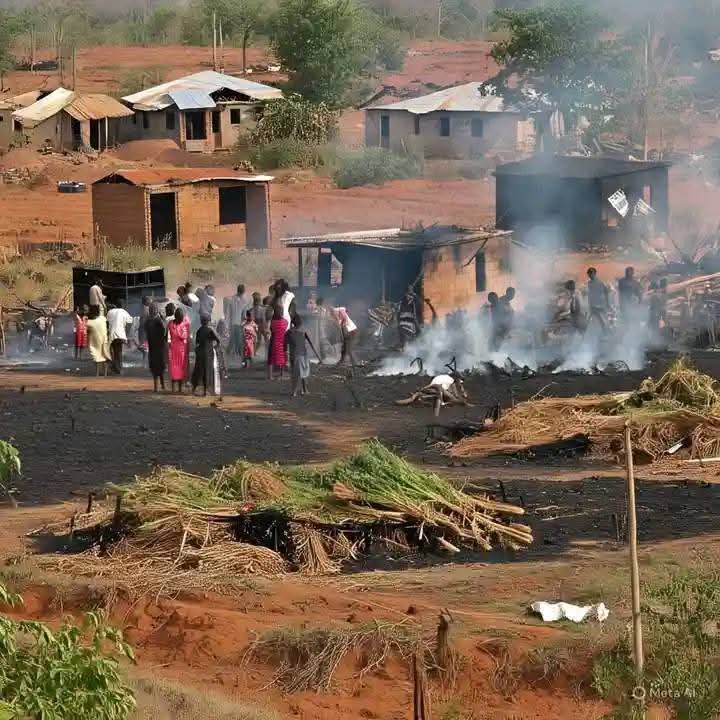

Tsegba Gbam Ayua is among the many devastated residents still coming to terms with the brutal attack on Yelewata community in Guma Local Government Area of Benue State.
The assault by armed invaders claimed the lives of scores, including Ayua’s wife and four children.
Still grappling with the overwhelming loss, Ayua shared his harrowing experience and fears of never fully recovering from the trauma.
“I had been displaced from Ayua in Nasarawa State for over two years and was taking refuge with my family in Yelewata. A few days before the incident, I travelled back to Nasarawa to do menial jobs so I could support my family,” he recounted.
He explained the tragic moment he learned about the attack.
“Then, around 11 pm on Friday, I got a call that our host community was under attack. I rushed back early Saturday morning, only to find the worst nightmare of my life. My wife and four children had been burned to ashes inside the market stalls where they were sleeping. Over 100 corpses were recovered in the area.” Ayua said he buried his family the same day and is struggling to accept the tragedy.
Prince Aondona Isaka Ornguga also spoke emotionally about his devastating loss of at least 23 family members during the attack.
Fighting back tears, Ornguga, a former Senior Special Assistant to ex-Governor Samuel Ortom on Local Government Administration, described the scale of devastation on the Internally Displaced Persons (IDPs) in Yelewata, a rural border town between Benue and Nasarawa States.
He said the 23 victims were related to him through his maternal lineage, sharing a poignant recollection
“I spoke with two of the victims, Victor Utim and Mathew Iormba, about three weeks ago. They are my first cousins from Tse Tarbee, my mother’s village. While Utim just wrote JAMB, and we were working on getting admission for him. Iormba told me he went to check his business around there.”
Ornguga lamented the cruel manner of their deaths, “Iormba was a pharmacist.
He had a tall dream, but look at how it all ended for them. And for Utim, this is not what we discussed.”
Mama Victoria Tyobee, a survivor, described her narrow escape.
“We were sleeping when, about midnight, I heard a gunshot, and looking through the window, I saw one of the attackers with a weapon standing right by my house. As I was wondering what to do next, there were sporadic gunshots, and the man fled into the nearby bushes,” she recounted.
“It was after a while that I mustered the courage to step out of the house. I later discovered that my relatives were not so fortunate. We lost three of them. It’s indeed a very sad experience.”
Besides these personal stories, many others remain untold from the horrific event, which began on Friday night and extended into early Saturday morning.
Reports indicate at least 107 people were killed, with many others wounded and receiving treatment in hospitals.
“They burnt people alive, entire families: husbands, wives, and children. It’s already about 107 dead bodies recovered and still counting. Some of the victims had fled previous attacks, only to be slaughtered here,” said one local resident.
Multiple sources confirmed that the attackers doused roadside stalls and makeshift shelters with petrol before setting them ablaze.
The victims were mainly IDPs from communities like Antsa, Dooka, Kadarko, Udei, and Giza, who had sought refuge in Yelewata, trusting the presence of nearby security checkpoints would offer protection.
Matthew Mnyan, a community leader in Yelewata and former acting Chairman of the Benue State Universal Basic Education Board (SUBEB), shared a grim account.
“A single family of 15 was wiped out. Children had their throats slit. Toddlers were killed like animals. It’s heartbreaking.”
Mnyan warned the death toll could surpass 200 as they continued cataloging bodies, including those who died en route to medical care.
Chief Dennis Denen Gbongbon, a prominent farmers’ leader, confirmed that most victims were Tiv farmers and displaced persons.
“These people were already living on the margins. Now they’ve been reduced to ashes. I saw the bodies—many of them burnt beyond recognition,” he lamented.
Eyewitnesses described a terrifying two-hour siege that overwhelmed local youth and police who tried to resist the attackers.
“They came in two groups. While we tried to hold off those advancing from the west, another group attacked from the east and overran us,” one resident revealed.
Meanwhile, a separate attack was reported in Daudu, about a 20-minute drive from Makurdi, where armed herders ambushed military personnel responding to the invasion threat.
The ambush claimed the lives of two soldiers, including a captain, and one Civil Defence personnel. A policeman remains missing.
A Daudu resident, identified only as Ikyott, said security personnel and local youths mounted a timely defense.
“Our youths and soldiers under Operation Whirl Stroke (OPWS) mounted a strong resistance, killing some of the attackers. Unfortunately, some security personnel also lost their lives in the process,” he said.
Guma LGA Chairman Maurice Orwough confirmed the attacks without disclosing fatality numbers, stating many were killed and over 26 hospitalized.
The Special Adviser to the Governor on Security and Internal Affairs, Chief Joseph Har, confirmed the incidents but noted that full details were still being gathered.
“It’s true. I’m aware of the attacks in Yelewata and Daudu. But I’m not on the ground to give the complete picture yet.”
Similarly, Benue police spokesperson DSP Udeme Edet acknowledged the Yelewata attack, confirming tactical teams had been deployed and some attackers neutralised.
“Unfortunately, lives were lost. We are still pursuing the perpetrators,” she said without casualty figures.
Lt. Zubair Ahmad, Public Relations Officer of OPWS, has remained silent on the deaths of security operatives.
The massacre sparked mass protests from youths and civil groups demanding government action.
The first wave of protests began on Saturday evening in Daudu, where demonstrators blocked the Lafia–Makurdi highway for hours.
Security forces, led by OPWS Commander Major General Moses Gara, eventually persuaded them to clear the road.
On Sunday morning, protests escalated as more demonstrators gathered at the Wurukum Roundabout in Makurdi despite heavy security presence, including police, army, NSCDC, and NDLEA operatives, with an Armoured Personnel Carrier stationed at the junction.
By 9:30 am, protesters occupied the roundabout to demand justice, but police fired teargas to disperse them around 11 am, causing chaos with shattered vehicle windows near the new bridge linking North Bank to the city center.
Despite this, protests regained momentum at other Makurdi locations such as Gyado villa and along George Akume Road. Social media activist #VeryDarkMan joined the demonstrations calling for accountability.
Benue State Commissioner of Police Ifeanyi Emenari appealed for calm, urging youths to suspend protests given renewed federal security intervention.
“The Inspector General of Police has taken over the security of Benue State,” he said, adding that special forces had arrived and were actively pursuing bandits.
“We have already made some arrests. The governor has given us all the necessary support.”
However, protests continued as residents demanded lasting solutions to recurring attacks.
Governor Hyacinth Alia condemned the massacre, stating that “nothing should warrant the taking of life.”
His deputy, Barr. Sam Ode, visited the attack site under his directives to assure the community that the government is committed to peace.
Alia, through his Chief Press Secretary Tersoo Kula, emphasized that the state government is engaging federal security agencies, traditional rulers, and stakeholders to strengthen security interventions and provide lasting solutions.
Retired DSS Senior Intelligence Officer John Noah advised a gradual approach to ending insecurity, stressing the importance of traditional institutions engaging youths for sensitization and intelligence gathering.
Following the attack, Benue State Emergency Management Agency (SEMA) Executive Secretary Sir James Iorpuu led efforts to relocate victims to Makurdi.
He credited collaborative support from the Commissioner for Trade and Investment, the Peace Commission’s Director-General, Benue Links, and UNHCR for the evacuation.
“It is with a heavy heart that I welcome you to the International Market emergency camp, established by Benue SEMA to accommodate victims of last night’s brutal assault on Yelewata community,” Iorpuu said.
Operation Whirl Stroke Commander Major General Moses Gara described the attacks as “barbaric and unacceptable,” and outlined plans to reassess troop deployment and develop decisive strategies to stop the violence.
During visits to affected communities, General Gara engaged leaders and stakeholders, assuring them of the military’s commitment.
“Today, I stand not just as a commander, but as a fellow Nigerian who understands your pain and suffering. The Nigerian security establishment is with you. We are not here to observe; we are here to act. We will pursue the perpetrators of these heinous crimes and ensure they face justice,” he stated.
In a statement, OPWS spokesman Lt. Zubairu Ahmad affirmed intensified intelligence gathering, additional troop deployments, and robust operational strategies to prevent further incursions.
Community representative Iorkyaa Emmanuel expressed confidence in the military and pledged the community’s support for sustained security presence to deter future attacks.
President Bola Ahmed Tinubu has directed security chiefs to enforce his earlier mandate to restore peace in Benue State, calling on Governor Alia to initiate reconciliation efforts among communities.
His Special Adviser on Information and Strategy, Bayo Onanuga, said security agencies are now directing operations on the ground.
Describing the massacre as “inhuman and anti-progress,” President Tinubu urged political and community leaders to avoid inflammatory statements that worsen tensions.
Former Vice President Atiku Abubakar condemned the killings as a national emergency and called for immediate investigations by federal and state governments.
Former Senate President Bukola Saraki also decried the attacks, highlighting the tragedy that many victims were already displaced persons living in camps.
Pope Leo also prayed for the victims during the Sunday’s holy mass.