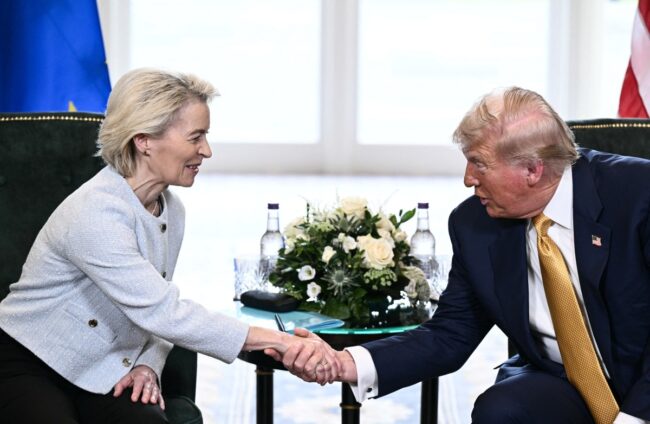

U.S President Donald Trump and European Commission President Ursula von der Leyen have struck a long-awaited agreement to end a looming trade crisis, just days before the August 1 deadline that would have triggered sweeping 30% U.S tariffs on European exports.
Speaking from his golf resort in Turnberry, Scotland, where the meeting took place, Trump hailed the outcome as a success for both sides.
“We have reached a deal. It’s a good deal for everybody,” Trump told reporters.
The agreement establishes a uniform 15% tariff on EU exports to the U.S, including the highly sensitive auto sector, replacing the existing 25% rate.
Trump framed the new arrangement as consistent with terms previously agreed to with Japan.
“We are agreeing that the tariff straight across, for automobiles and everything else, will be a straight-across tariff of 15 percent,” he said.
The U.S President also announced that the EU had agreed to a massive $750 billion energy purchase from the U.S, along with $600 billion in additional investments in the country.
Von der Leyen, speaking alongside Trump, confirmed the deal and emphasized its economic significance.
“It’s a good deal,” she said.
“It will bring stability. It will bring predictability. That’s very important for our businesses on both sides of the Atlantic.”
While the agreement may have averted a trade war, some of the EU’s key demands were left out.
Brussels had been pressing for sector-specific exemptions particularly for pharmaceuticals, aircraft, spirits, and steel but those were largely dismissed by Washington.
Trump explicitly ruled out any special treatment for the pharmaceutical sector, an industry crucial to Ireland and other EU member states.
“We have to have them built, made in the United States,” he stated, reiterating his earlier threat of a 200% tariff on drug imports to push domestic production.
Steel, another sore point for European negotiators, will also remain under the existing 50% levy, with no quota-based compromise in sight.
“Steel was staying the way it is,” Trump insisted.
Though the agreement was reached at the executive level, it still requires formal approval from all 27 EU member states.
EU ambassadors, who were briefed while on an official visit to Greenland, are expected to reconvene to assess the final terms.
Brussels had previously authorized retaliatory tariffs targeting $109 billion worth of U.S. goods, which would have gone into effect from August 7 had the negotiations failed.
The bloc had also prepared a list of potential restrictions on U.S services under its anti-coercion laws.
Countries like France had pushed the EU to be ready with a “trade bazooka” legislation allowing the bloc to restrict access to its market and public procurement in retaliation for aggressive trade tactics.