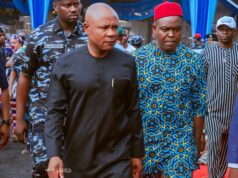
As the world marked International Youth Day, the African Democratic Congress (ADC) renewed its commitment to inclusive governance, promising Nigerian youths greater participation in national leadership.
During an event held in Abuja on Tuesday, the party’s Interim National Chairman, David Mark, and National Youth Leader, Balarabe Rufai, assured young Nigerians that the ADC is fully committed to youth inclusion in its policies and leadership structure.
David Mark, who was represented by Salihu Lukman, a former APC National Vice Chairman (North-West), stated that the party is building a structure where the voice of every member, particularly the youth, counts.
“We will uphold collective leadership at every level, ensuring every member has a voice. This is your party, truly owned by its members, without exception,” Mark said.
He emphasized that ADC’s grassroots operations will reflect modern realities, ensuring more robust engagement from the local to national level.
“Our grassroots structures will be revitalised to reflect modern realities. From polling units and wards to the national stage, every organ of our party will be re-energised for active participation.”
Mark further urged young Nigerians to see the ADC as a welcoming platform, not just in principle, but in practice.
“To our young people: ADC is your home. We are opening the doors for the next generation, not as a gesture, but as a commitment. Our policies, candidate selection, and leadership roles will ensure real inclusion of youths and women, not tokenism. That is why 35% of leadership positions are reserved for women, and leadership roles will include Nigerians under 40.”
He also reiterated the party’s ideology-driven approach, promising a break from transactional and elitist politics.
“Nigerians will know ADC as a party driven by clear ideology, progressive policies, and patriotic governance. We will not leave leadership direction to chance.”
Mark encouraged youth to join the party’s movement, saying it stands for equity, fairness, and national unity.
“On this International Youth Day, I call on all Nigerians to join us. ADC is the party of equal opportunity, where age, gender, religion, or region are never barriers. Our handshake is extended to all—across every divide, because the future we build is one we build together,” he added.
Also speaking at the event, ADC National Youth Leader Balarabe Rufai delivered a scathing critique of the current state of governance and its impact on young Nigerians.
He warned that no national transformation is possible without youth involvement at the grassroots.
“If Nigerian youths cannot transform their streets, they cannot transform the nation,” Rufai said. “Without changing Nigeria, Africa will remain at the mercy of others in shaping its future.”
Highlighting dire statistics, Rufai painted a sobering picture of youth disempowerment, poverty, and government neglect.
“The National Bureau of Statistics reports that 133 million Nigerians are living in multidimensional poverty. Food inflation is over 33%. The National Unemployment Report shows youth unemployment above 53%,” he said.
“UNESCO confirms that over 20 million Nigerian children are out of school, the highest in the world. This is not just a policy failure; it is a moral crime. How can the same leaders who boast about GDP growth ignore the fact that our classrooms are empty while our prisons and streets are full of young people without hope?”
He also cited Nigeria Security Tracker figures showing over 12,000 deaths from violent attacks in 2024 alone, many of them in youth-dominated communities.
“In Zamfara, Katsina, Niger, and Kaduna, rural youth are kidnapped for ransom while urban youth are hunted down in the name of ‘security operations.’ And yet, our so-called leaders spend more money on convoy fuel than on community policing.”
Rufai criticized the SDG framework for ignoring the local realities of African countries and called on the United Nations to take more nuanced, contextual action.
“Under the theme Local Youth Action for SDGs and Beyond, we must confront the hard truth — in Nigeria and across Africa, young people’s efforts toward achieving the SDGs are shackled by bad government policies, poor budgetary allocations, and a lack of political will.”
“With just five years left before 2030, the gap between developed and developing nations is glaring, and a one-size-fits-all SDG framework is failing to address our unique challenges.”
“The African Democratic Congress, guided by its constitution and vision beyond Nigeria, calls on the United Nations to urgently adopt differentiated goals for developed and developing countries so that the realities of poverty, unemployment, insecurity, and educational decline in our societies are not ignored but directly addressed.”
“The youth of Africa cannot continue to be judged by the standards of nations whose histories, economies, and governance structures are worlds apart from ours.”
Emphasizing that the ADC is not beholden to tribal or regional interests, Rufai said the party stands for all Nigerians.
“The ADC’s loyalty lies with Nigeria, not any tribe, region, or the selfish ambitions of a few.”
He also issued a rallying cry to Nigerian youth:
“I am not here to tell you to wait. I am here to tell you that e don reach. As the streets say, no be who first start na him dey finish race. The incumbents may have started with power, but if the youth organise, we will finish with victory.”
“I speak as someone who has queued for fuel at midnight, borrowed to pay school fees, and seen friends take dangerous journeys across the Sahara and Mediterranean because home gave them no reason to stay. These chains can break, but only if the people wearing them rise together.”
Rufai concluded by outlining ADC’s vision to empower youth through concrete actions:
“The ADC is ready to give young Nigerians a seat at the table, not as decoration, but as decision-makers. We will champion policies that create real jobs by investing in agro-processing, renewable energy, and tech startups.”
“We will fund education like our lives depend on it—because they do. We will bring security to our communities not by empty promises, but by empowering local security structures and addressing root causes.”