
The Independent National Electoral Commission (INEC) has dismissed allegations of irregularities in its online pre-registration data amid the ongoing nationwide Continuous Voter Registration (CVR) exercise, describing the figures as nothing “extraordinary.”
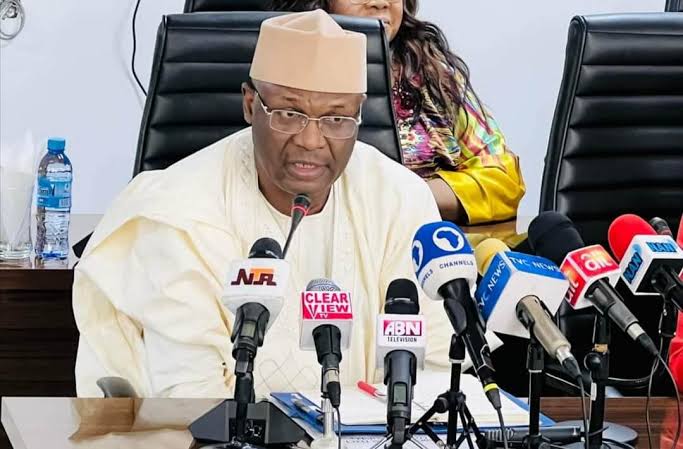
INEC’s Chief Press Secretary, Mr. Rotimi Oyekanmi, made this clarification in a statement issued in Abuja, responding to concerns raised by the African Democratic Congress (ADC).
The ADC, through its National Publicity Secretary Mallam Bolaji Abdullahi, had flagged the numbers from Osun State as “suspicious” and inconsistent with “historical patterns and demographic realities.”
Abdullahi pointed out that the nearly 400,000 new registrations recorded in Osun within just seven days exceeded the total new voters added in the state over the last four years.
He also highlighted that the South West zone accounted for an overwhelming 67 percent of all national pre-registrations.
Reacting to these claims, Oyekanmi said the allegations were unfounded, explaining that Osun’s high online registration figures were consistent with previous patterns.
He cited recent data showing that, within a week, INEC recorded 1,379,342 online pre-registrations nationwide, with Osun leading at 393,269, followed by Lagos with 222,205, and the Federal Capital Territory (FCT) with 107,682.
He further recalled data from the 2021 CVR exercise, demonstrating that Osun has consistently led in online pre-registrations:
Within the first 24 hours of portal launch on June 28, 2021, 59,331 accounts were created.
By July 12, 2021 (second week), 456,909 accounts were active, with Osun topping at 154,893.
By the third week, 752,011 persons had pre-registered, Osun leading with 232,880.
By the eighth week (Aug 23, 2021), 2,215,832 had pre-registered, Osun still leading with 365,412.
By the eleventh week (Sept 13, 2021), 2,953,094 individuals had pre-registered, Osun ahead with 402,619.
By April 18, 2022, 8,271,647 Nigerians had pre-registered, with Osun topping the list at 708,782.
Oyekanmi advised that a simple review of public records would have clarified the facts for the ADC.
He also emphasized the stringent verification procedures in place post-online registration, which require all applicants to visit designated centres for in-person registration and biometric capture.
INEC’s Automated Biometric Identification System (ABIS) screens out duplicate registrants to maintain the integrity of the voters’ register.
“Following all verification processes, over 14 million Nigerians were added to the National Register of Voters ahead of the 2019 General Election, increasing the total from nearly 70 million to 84,004,084 voters.”
“Similarly, over 9.4 million new voters were added after the 2021/2022 CVR exercise, bringing the total to 93,469,008 for the 2023 general election,” he added.
INEC reiterated its commitment to registering only genuine voters who meet the constitutional and legal requirements, regardless of their state of origin.
Oyekanmi urged citizens to rely on verified data from official INEC sources rather than speculation.
The News Agency of Nigeria (NAN) recalled Abdullahi’s skepticism about Osun’s figures, highlighting that the state recorded only 275,815 new voters between 2019 and 2023 and never had more than 823,124 votes cast in a governorship election.
He also noted the disproportionate distribution of pre-registrations, with the South West accounting for 848,359 (67%) of the national total, while the South East recorded just 1,998.
To further illustrate the disparity, Abdullahi pointed out that Osun, Lagos, and Ogun states accounted for over half (54.2%) of all pre-registrations nationwide, while Ebonyi, Imo, Enugu, Abia and Adamawa combined had only 4,153 (0.2%), and the entire North East recorded 6.1 percent.
The ADC called for a comprehensive forensic audit of the data, alleging the possibility of either a technical glitch or deliberate data manipulation.
They also urged opposition parties and electoral monitoring groups to demand transparency and accountability from INEC.