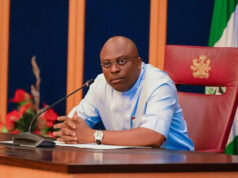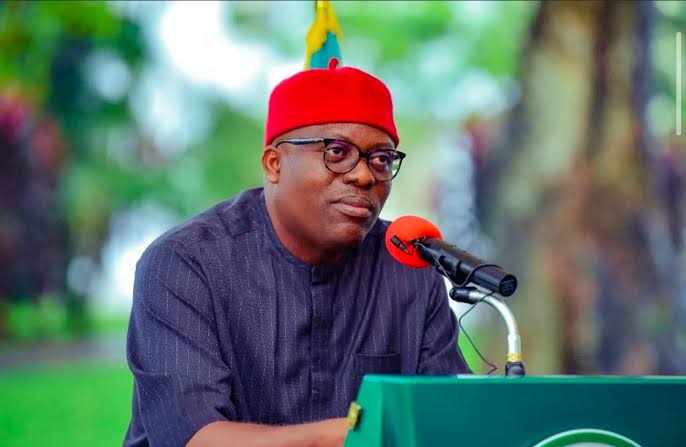

As the six-month emergency rule in Rivers State nears its end, some prominent elders in the state say the suspension of Governor Siminalayi Fubara has effectively weakened his political standing and handed control of the state to Nyesom Wike, Minister of the Federal Capital Territory and Fubara’s predecessor.
President Bola Tinubu had declared a state of emergency in the oil-rich state on March 16, 2025, citing escalating political tension and attacks on vital oil infrastructure by suspected militants.
As part of the emergency measures, Tinubu suspended Fubara, his deputy Prof. Ngozi Odu, and the Rivers State House of Assembly. He then appointed Ibok-Ete Ibas, a former Chief of Naval Staff, as interim administrator for six months.
With the emergency rule set to expire in a few days, reports suggest that Fubara has remained largely incommunicado, though an aide disclosed that he is likely to return to the state over the weekend.
“As I speak with you the governor is not back. All those pictures you see on social media are old. But he may come in today (Saturday) or tomorrow (Sunday),” said the aide, who requested anonymity.
In preparation for the handover, the state government announced plans to hold an inter-denominational thanksgiving service at the Ecumenical Centre on Abonnima Wharf Road, Port Harcourt, as part of the transition back to democratic governance.
This was confirmed in a statement by the Secretary to the State Government, Dr. Ibibia Worika.
Speaking, members of the Rivers State Elders Council expressed concern over what they described as the political subjugation of Fubara and a return to Wike-dominated politics.
“The state is captured. That is my position. We will only get back to where we were before the liberation; and now it is back to Egypt. Rivers State has been successfully captured. The future of the state would be determined by the people of the state going forward,” said High Chief Sunny Chukumele, convener of the Coalition of Rivers State Leaders of Thought.
He further claimed that the so-called political peace in the state is superficial:
“The governor has been cowed for the so-called peace to reign. But that peace is in the graveyard and it is unfortunate. Rivers people look helpless, desolate and abandoned to their fate.”
Chukumele also accused President Tinubu of using the state as a pawn in his political strategy ahead of 2027.
“The new political class has taken over. The President has sacrificed Rivers people for his interest in 2027. So it is for Rivers people to determine who to follow.”
Another elder, Asukewe Iko-Awaji, a member of the Rivers Elders Forum, argued that the prolonged suspension has eroded whatever political capital Fubara had before leaving office.
“The truth is that damage has been made. That spirit of brotherhood is no longer there. The bad seed has been sown.”
He also pointed out that the long absence may have lasting effects on political relationships and economic development.
“If Fubara returns, the cordial relationship amongst them won’t be there again. They will be suspicious of each other because the bad egg has been laid. This is what the Rivers people will face. It will take them months to blend again.”
Economically, he said, the impact has been significant.
“The man has been away from office for six months. Some of the companies working in the state have pulled out and it will take another six months to put himself together to bring back these companies.”
“Before the declaration of this emergency, a lot of projects were going on. When Ibas came, he abandoned those projects and some companies pulled out. Now he is going to appoint people.”
In contrast to the criticism, former Rivers Senator Olaka Wogu, a known ally of Nyesom Wike, said Fubara’s return might not change much politically and insisted that Wike had simply been forthright in his actions.
“Sometimes people over-speculate on Wike. The man puts things in plain sight, but people don’t listen. Wike will tell you, ‘I wasn’t for a state of emergency, I was going to impeach him. We have resolved, we are moving on, and I will be honest and I will be frank. I will say it as I want.’ That’s how Wike does things, it is pure honesty.”
Wogu also emphasized that the crisis was never about money, but about power and political structure.
“The fact is that the man fought for his structure and kept it. The governor is part of the structure.”
He argued that despite Tinubu’s intervention, Rivers people would ultimately decide the political direction of the state.