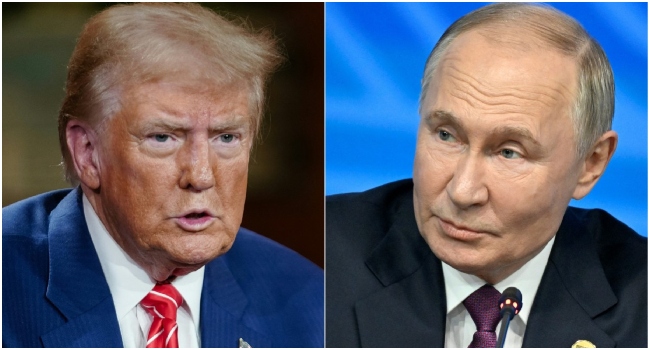

U.S President Donald Trump wrapped up his historic second UK state visit on Thursday with a sharp rebuke of Russian President Vladimir Putin, declaring that the Russian leader had “really let me down” over the ongoing war in Ukraine.
Trump made the remarks during a joint press conference with British Prime Minister Keir Starmer at the Chequers country residence, following wide-ranging talks that covered international security, trade, and migration.
“I thought Ukraine would be the easiest conflict to end because of my relationship with President Putin,” Trump said.
“But he’s let me down. He’s really let me down.”
The U.S. president, who had previously claimed he could swiftly end the Ukraine war, now appears to be aligning more closely with European leaders like Starmer, who continue to push for stronger international pressure on Moscow.
During their meeting, Starmer positioned himself as a bridge between Washington and European allies, particularly on Ukraine.
The two leaders also signed a major tech deal focused on artificial intelligence, quantum computing, and nuclear energy.
Starmer described the partnership as an example of “leaders who genuinely like each other,” while Trump praised the UK’s “unbreakable bond” with the United States.
Their shared chemistry has reportedly eased trade tensions, with Trump stating that the May trade deal between the two countries was “the best” ever signed by the U.S.
However, policy differences were still evident. Trump disagreed with Starmer’s plan to recognize a Palestinian state, calling it “one of our few disagreements.”
He also claimed he could solve the UK’s illegal migration issue “even if it meant using the military,” a remark that drew raised eyebrows from some UK observers.
The visit combined diplomatic talks with royal ceremony.
On Wednesday, Trump was honored with a full state banquet at Windsor Castle, hosted by King Charles III, who called the visit “a chance to reaffirm peace efforts and support for Ukraine.”
Calling it “one of the highest honours of my life,” Trump responded warmly to the king’s tribute, referring to Charles as “a great gentleman and a great king.”
Trump’s wife, Melania, remained at Windsor on Thursday, where she joined Princess Catherine and Queen Camilla for cultural engagements, including a viewing of Queen Mary’s Doll’s House.
The British government rolled out traditional royal pageantry, including gun salutes, horseback soldiers and bagpipes, elements reportedly chosen to appeal to Trump’s admiration for monarchy and history.
Starmer also led Trump on a private tour of Winston Churchill memorabilia at Chequers, invoking the legacy of the wartime leader whom Trump has frequently cited as a personal hero.
While Trump kept a tight schedule away from the British public, protests against his visit filled the streets of London.
Around 5,000 demonstrators marched in central London on Wednesday, criticizing both his foreign policy and domestic record.
Meanwhile, Starmer faced his own political headache: he recently dismissed UK Ambassador to Washington Peter Mandelson over connections to disgraced financier Jeffrey Epstein.
Trump has also faced renewed scrutiny over his ties to Epstein, with new revelations surfacing about their past relationship in the 1990s and early 2000s.
Despite the protests and lingering controversies, the visit delivered tangible outcomes. The UK secured an estimated £150 billion ($205 billion) in investment pledges from major U.S. companies including Microsoft, Google, and Blackstone.
The deepening of tech and defense ties, along with Trump’s increasingly critical stance on Putin, could mark a new phase in transatlantic relations.
For Starmer, whose political gamble in inviting Trump for a second state visit raised eyebrows, the results may offer vindication.
The U.S. president departed for Washington later Thursday, closing a visit that was equal parts diplomacy, drama, and royal spectacle.