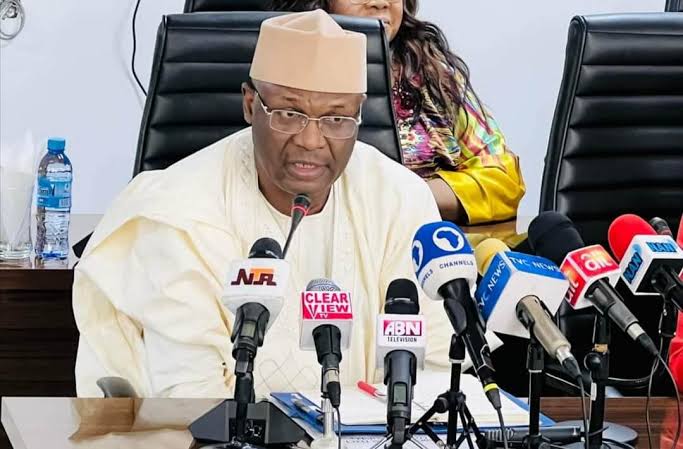

The Independent National Electoral Commission (INEC) has described the 10-year leadership of former Chairman Prof. Mahmood Yakubu as a transformative era that laid the groundwork for credible elections in Nigeria.
In two detailed reports, “Election Management in Nigeria: 2015–2025” and “Innovations in Electoral Technology: 2015–2025”, INEC credited Yakubu’s administration with major electoral reforms that improved transparency, voter access, and public trust in the electoral process.
Appointed in 2015 and reappointed in 2020, Yakubu became the first INEC chairman to serve two full terms.
His tenure oversaw two general elections (2019 and 2023), 19 off-cycle governorship polls, and hundreds of bye-elections across over 4,500 constituencies.
The Bimodal Voter Accreditation System (BIAS) introduced in 2021 ensured more secure voter authentication using fingerprints and facial recognition.
IReV Portal: Allowed real-time public access to election results.
IVED: Modernised voter registration with biometric and facial capture, replacing outdated systems.
CVR Online Portal: Enabled remote voter pre-registration for the first time in Nigeria’s history.
Electoral Act 2022: Legalised the use of technology in elections and strengthened INEC’s independence.
Yakubu acknowledged challenges such as vote buying, election violence, conflicting court orders, and logistical setbacks.
He also noted that over 50 INEC offices were attacked between 2019 and 2023.
Despite this, INEC said the Commission responded with improved coordination with security agencies, legal reforms, and continuous stakeholder engagement.
Other systems launched during the decade include: ERMS: For result management, CROMS & IOMIS: For collation officer and operations management as well as PFRAS: To enhance transparency in political finance reporting.
INEC also expanded polling units for the first time in 25 years, from 119,974 to 176,846, reducing voter congestion. It launched the INEC School and Virtual Electoral Training System (VETS) to train personnel and promoted inclusive participation of women, youth, persons with disabilities (PwDs), and internally displaced persons (IDPs) through targeted initiatives and assistive voting materials.
Yakubu described the 2015–2025 decade as a “momentous” period shaped by evidence-based, forward-looking reforms aimed at improving electoral integrity.
INEC said it will continue to collaborate with regional and international electoral bodies to improve Nigeria’s election management systems.