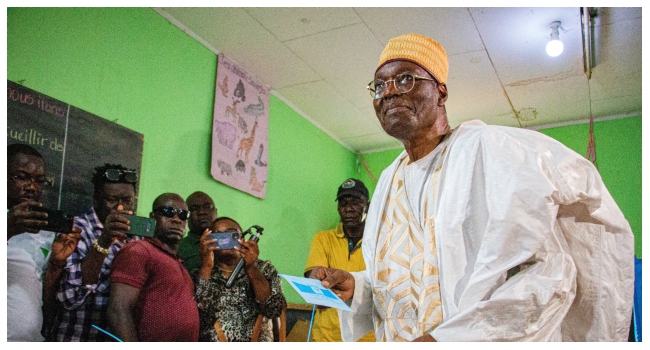

Cameroon’s political landscape is bracing for possible tensions after opposition candidate Issa Tchiroma Bakary declared himself the winner of the country’s presidential election, days ahead of the official results.
Tchiroma, the candidate of the Front for the National Salvation of Cameroon (FNSC), made the declaration on Tuesday through a Facebook post, calling on the government to acknowledge the outcome of the vote held over the weekend.
“Our victory is clear. It must be respected,” he wrote.
“The people have chosen. The government must accept the truth of the ballot box or risk plunging the country into turmoil.”
The former government minister promised to publish detailed regional results soon, in a move seen as an attempt to preempt potential manipulation of the final count.
According to Cameroonian electoral law, only the Constitutional Council has the authority to announce official results, a process expected to take up to two weeks.
The government has warned that this legal framework must not be bypassed, describing it as a “red line that must not be crossed.”
This declaration echoes a similar scenario from 2018, when opposition candidate Maurice Kamto claimed victory the day after polls closed.
Kamto was later arrested, and his supporters were violently dispersed during protests, with dozens reportedly detained.
Tchiroma’s announcement marks a significant challenge to President Paul Biya, Africa’s longest-serving head of state, who is seeking an eighth term after 43 years in power.
The 92-year-old president has ruled Cameroon since 1982, maintaining control through political repression and centralized authority.
Despite Biya’s decades-long dominance, Tchiroma’s campaign gained unexpected momentum, especially after popular opposition figure Maurice Kamto was disqualified from running by the Constitutional Council.
Tchiroma had served in Biya’s government for 20 years before resigning in June 2025 to launch his opposition bid.
Sunday’s vote, in which 11 candidates contested, has become a two-horse race, with both Biya and Tchiroma supporters sharing tally sheets and unofficial results on social media to back claims of victory.
Observers noted that the 2025 campaign was unusually energized. Stephane Akoa, a Cameroonian political analyst, commented before the vote:
“We shouldn’t be naive. The ruling system still holds enormous influence to tilt results. But this campaign has been much livelier, and that increases the chance of surprises.”
With over eight million registered voters, many Cameroonians, particularly the youth, have only ever known Biya’s rule.
The president, who took office when Ronald Reagan was U.S. president and the Cold War still raged, has overseen decades of economic inequality, separatist conflict, and political crackdowns.
Yet the energy surrounding this election suggests growing demands for change.