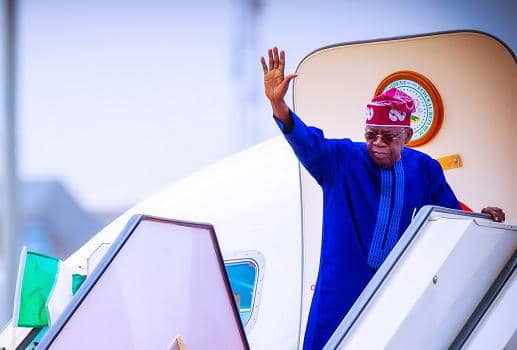

President Bola Ahmed Tinubu has returned to Abuja following his participation in the Aqaba Process Heads of State and Government Meeting held in Rome, Italy.
The summit, which took place on Wednesday, October 15, was hosted at the National Gallery of Modern and Contemporary Art and focused on enhancing regional and global cooperation in combating terrorism and violent extremism, with a strong emphasis on challenges facing West Africa.
The Aqaba Process is a strategic counter-terrorism initiative launched in 2015 by His Majesty King Abdullah II of Jordan.
The Rome session was co-chaired by the Kingdom of Jordan and the Government of Italy.
Since inception, the Aqaba Process has convened 33 sessions involving leaders, security experts, and technical professionals, all centered on prevention, coordination, and closing operational gaps in the global fight against terrorism.
This year’s meeting drew the participation of several world leaders and delegations, including: King Abdullah II of Jordan, Italian Prime Minister Giorgia Meloni, Presidents of Nigeria, Chad, Paraguay, Sierra Leone and Togo, Azouz Nasri, President of Algeria’s Upper House as well as Delegations from Côte d’Ivoire, Kazakhstan, Mauritania, Senegal, and Uzbekistan.
All proceedings were held behind closed doors to allow for confidential discussions on regional security strategies.
On the sidelines of the summit, president Tinubu held bilateral meetings with Italian Prime Minister Giorgia Meloni, Massad Boulos, U.S. President Donald Trump’s Senior Adviser on Arab and African Affairs and Cardinal Pietro Parolin, Vatican Secretary of State.
The meeting with Cardinal Parolin reportedly focused on promoting religious harmony in Nigeria, countering perceptions that the country is intolerant of religious diversity.
In a statement released by Bayo Onanuga, Special Adviser to the President on Information and Strategy, Tinubu emphasized Nigeria’s commitment to religious tolerance and peaceful coexistence.
He also addressed the need to combat disinformation campaigns that misrepresent the country’s social and religious dynamics.