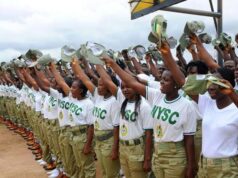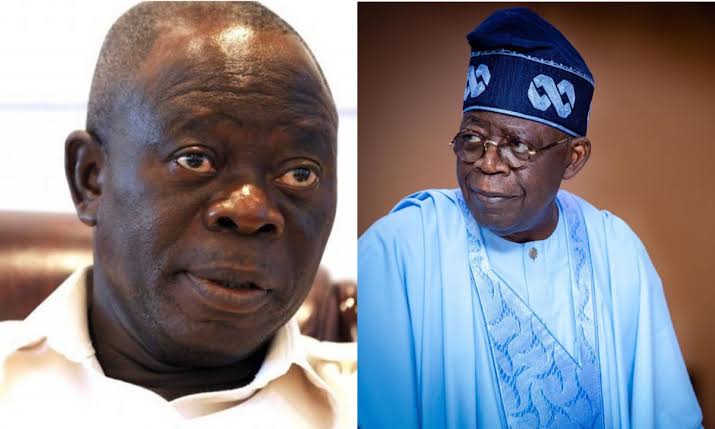

Senator Adams Oshiomhole has urged President Bola Tinubu to issue a directive compelling the military and other paramilitary organisations to patronise locally made uniforms, saying such a move would boost job creation and revive Nigeria’s dying textile industry.
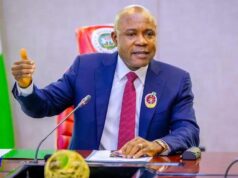
Speaking on Monday in Kaduna at the 37th Annual National Education Conference of the National Union of Textile, Garment and Tailoring Workers of Nigeria (NUTGTWN), Oshiomhole lamented the continued importation of foreign fabrics by government institutions despite the nation’s capacity to produce them locally.
“If we wear what we produce and produce what we wear, we can employ 20 million Nigerians,” he said. “That is the real meaning of putting Nigeria first.”
The conference, themed “Industry, Labour and National Development,” drew labour leaders, policymakers, and industry stakeholders from across the country.
During the event, the union renamed its five-storey headquarters in Kaduna, formerly known as the Textile Labour House, as the Adams Oshiomhole Textile Labour House in honour of the former Edo State governor, who served as the union’s Secretary-General over four decades ago.
Oshiomhole called on the president to match rhetoric with concrete action by strengthening local industries through deliberate government patronage.
“As Commander-in-Chief, the President should direct that the Nigerian Army, Navy and Air Force wear only uniforms produced and sewn in Nigeria,” he declared to loud applause from thousands of textile workers.
He recalled the golden era of Kaduna’s textile industry, when over 27,000 workers were employed across multiple shifts, blaming its collapse on “reckless government policies” and “unguarded trade liberalisation.”
“Those factories didn’t die of old age; they were murdered by bad policies,” he said.
“When we joined the World Trade Organization, we surrendered our right to protect our industries and jobs.”
The former Nigeria Labour Congress (NLC) president praised the late Premier of Northern Nigeria, Sir Ahmadu Bello, for his foresight in establishing the Kaduna Textile Mills in the 1950s, a move that, according to him, gave dignity to labour and reduced dependence on imported goods.
“Our leaders then knew it made no sense to export cotton and import clothes. That vision created jobs and built communities,” Oshiomhole added.
He linked the collapse of industries to rising insecurity, unemployment, and social unrest.
“When people had jobs, nobody cared about religion. Today, with factories shut and millions idle, we have produced anger, not cotton,” he lamented.
Commending President Tinubu’s foreign exchange reforms, Oshiomhole said they had curtailed the excesses of “emergency billionaires” who profited from currency arbitrage.
“Before Tinubu, people made money without effort, just with a phone call. Now, those distortions are being corrected,” he said.
He urged workers to remain committed to the fight for decent wages and fair treatment, describing the struggle as an act of patriotism.
“Don’t ever apologise for fighting for dignity. The primary purpose of government is the welfare of citizens, not the profit of business,” he stated.
Reaffirming his loyalty to the labour movement, Oshiomhole concluded, “I remain a labour man for life. From age 18, I’ve known no other calling. I will keep fighting until Nigeria returns to the path of production, not importation.”