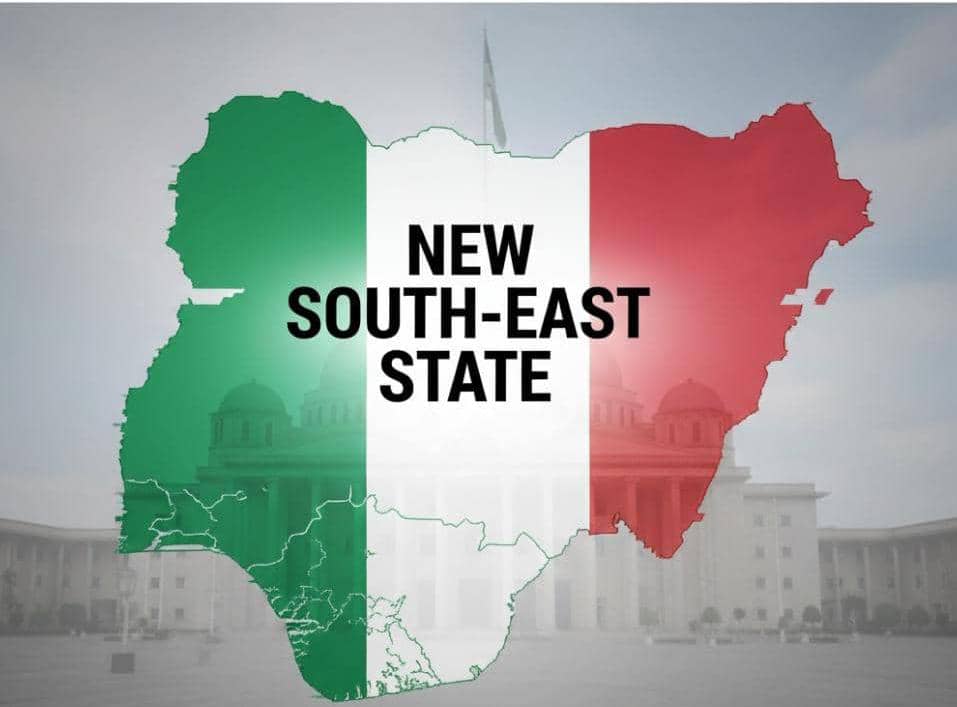

Following the National Assembly’s Joint Committee on Constitution Review approval for a new state in the Southeast, questions are emerging over its feasibility, location, and name.
The Southeast, currently the region with the fewest states, only five, has long agitated for equal representation and resources.
Since Ebonyi State’s creation in 1996 under military rule, Southeast communities have consistently pressed for more states to match other regions in resource allocation.
The National Assembly’s move, if ratified, would increase the region’s states from five to six, aligning it with regions like South-South, South-West, and North-Central.
The proposal has reignited demands for several new states:
Adada State: From Enugu North, strongly supported by community leaders and recognized in past constitutional recommendations.
Aba State: To be carved from Abia’s Ngwa axis.
Njaba, Orashi, and Etiti States: Proposed from various parts of Imo, Abia, Ebonyi, and Anambra.
Anim State: Covering parts of Anambra, Imo, and Rivers.
Anioma State: From Delta and Anambra, seeking to unify Igbo communities separated by state boundaries.
Experts warn that internal disagreements among Southeast communities, combined with political and constitutional hurdles, could slow or block the process.
Lawyer James Oko explained that creating a state requires Submission of a bill to the National Assembly, Approval by two-thirds of the House of Representatives and Senate members representing the affected areas, Presidential assent as well as Ratification by at least 24 state assemblies and a local referendum.
Civil Liberties Organisation executive, Ibuchukwu Ezike added that ethnic, political, and personal interests complicate the process, with no single agitating group willing to compromise on their proposal.
Additionally, political realities may affect the initiative.
The Southeast’s support is key in upcoming elections, and some analysts view the National Assembly’s move as a potential political strategy rather than purely a response to regional demands.
Supporters like APC founding member, Osita Okechukwu, argue a new state could promote national cohesion and heal historical marginalization.
Skeptics like elder statesman Chekwas Okorie and Rev. Okechukwu Obioha warn that constitutional obstacles and political motives may hinder implementation, noting that past civilian governments have struggled to create new states.
Despite hurdles, the current political landscape, with the APC controlling 24 of 36 states and holding a two-thirds Senate majority, could increase the chances of approval.
However, questions around the exact location, name and community consensus remain critical to whether the Southeast will finally gain its sixth state.