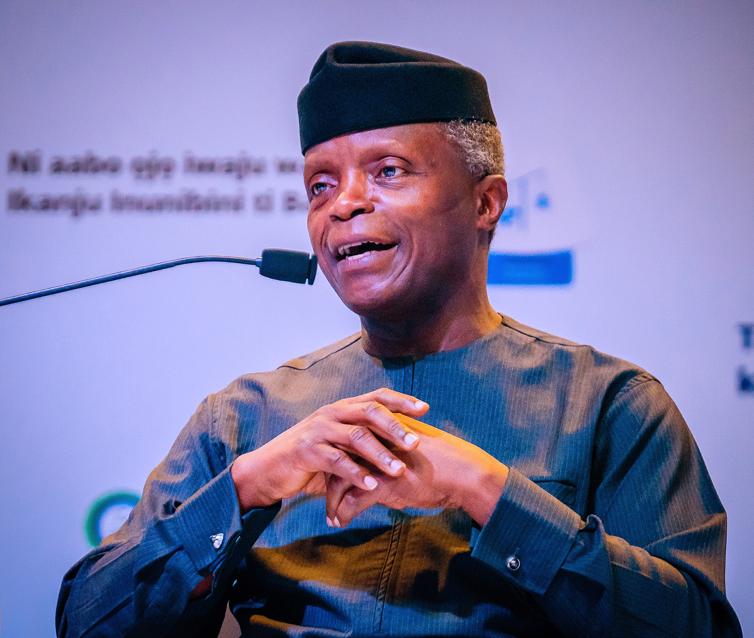

Former Vice President Yemi Osinbajo has cautioned African governments against celebrating Gross Domestic Product (GDP) growth figures that fail to translate into tangible improvements in citizens’ welfare.
Speaking at the 65th anniversary of the Ford Foundation in West Africa, held in Abuja, Osinbajo described much of Africa’s economic growth as “statistical progress without social impact.”
He noted that despite the continent’s impressive GDP numbers, millions of Africans continue to grapple with weak healthcare systems, poor education, unemployment, and poverty.
“Africa has for years recorded some of the world’s fastest GDP growth rates,” Osinbajo said.
“Yet, we remain the continent with the lowest overall quality of life, from health to education, infrastructure, and economic stability. GDP growth does not mean development. It does not automatically create jobs or provide a decent life.”
The former vice president reflected on his experience as chair of Nigeria’s economic management team between 2016 and 2019, saying it was “deeply frustrating” to see the gap between government rhetoric and the everyday realities of citizens.
“People would ask, ‘Which growth are you talking about? I can’t pay my child’s school fees or hospital bills.’ It became clear that the more government celebrated GDP figures, the more alienated citizens felt,” he said.
Osinbajo urged policymakers to reimagine economic growth through social justice and inclusion, stressing that fair access to opportunities, resources, and protections must be the foundation of every development strategy.
He called for an end to “trickle-down” policies, advocating instead for bottom-up investments that prioritise rural communities, women, youth, and informal workers who sustain the continent’s economy.
Citing success stories from other nations, Osinbajo pointed to Bangladesh’s education reforms, Rwanda’s gender inclusion policies, and the Lagos judicial reforms of 1999, which saw women judges elevated and corruption decline, as examples of how inclusivity drives national productivity.
He also described corruption as “the most severe form of social injustice,” arguing that it deprives citizens of public services and undermines development.
“Until corruption is treated as an assault on social justice, Africa will continue to measure progress in numbers that do not change lives,” he warned.
Minister of Budget and National Planning, Senator Abubakar Bagudu, lauded the Ford Foundation for its decades-long commitment to human development and inclusion in West Africa.
Dr. ChiChi Aniagolu, the Foundation’s Regional Director for West Africa, recalled that Ford began operations in Lagos in 1960 and has since supported initiatives on education, human rights, gender equality, cultural expression, and environmental justice across Nigeria, Ghana, and Senegal.
She reaffirmed the organisation’s dedication to local ownership and accountability, rather than externally imposed solutions.
Martín Abregu, the Foundation’s Senior Vice President, added that since its establishment over 80 years ago in the United States, the Ford Foundation’s mission has evolved into a global effort to advance equity and social justice.