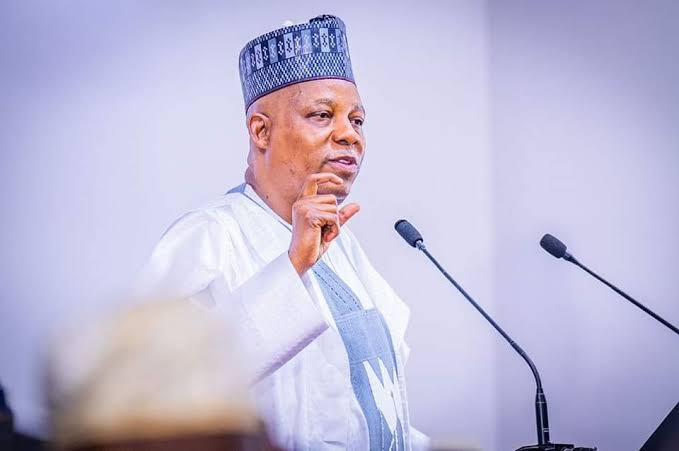

Vice President Kashim Shettima has called for unity in tackling Nigeria’s security challenges, stressing that violence and terrorism do not recognise religion, ethnicity, or social class.
Speaking at a high-level stakeholders’ meeting on regional development organised by the National Counter-Terrorism Centre (NCTC) under the Office of the National Security Adviser in Abuja on Thursday, Shettima said the government is adopting a coordinated strategy aimed at addressing both immediate security threats and the deeper issues undermining peace and stability.
Represented by the Deputy Chief of Staff to the President, Ibrahim Hadejia, the Vice President said all institutions and individuals involved in governance must contribute to rebuilding national unity and trust.
“Every person or organisation engaged in governance must play a part in this mission of national restoration,” Shettima said.
“A bullet or bomb does not recognise ethnicity or religion. When fired by enemies of peace, it kills indiscriminately, the farmer, the trader, the young, and the old. It tears apart the fabric of our multi-ethnic, multi-religious society in devastating ways.”
He warned against allowing divisive narratives to take root, saying that Nigeria’s real challenge lies not only in combating terrorists but also in overcoming the prejudice and sentiments used to divide its people.
“Our task is not only to fight those who commit these acts of violence,” he said, “but also to dismantle the ideas and sentiments that have been weaponised to divide us. We must pay attention to the power of messaging, it must be grounded in empathy and understanding.”
The Vice President noted that insecurity affects all Nigerians equally, regardless of faith or region, and urged leaders to promote messages that unite rather than inflame divisions.
He also emphasised that lasting development can only occur when every part of the country progresses together.
“We cannot claim to have achieved national progress if some parts of the federation are left behind,” Shettima said.
“We need functional institutions that ensure government presence and services in even the most remote communities.”
According to him, the administration’s decision to establish regional development commissions across the six geopolitical zones is part of a broader plan to take governance and growth closer to the people.
These commissions, he explained, are expected to both accelerate regional development and promote shared learning between different parts of the country.
He acknowledged that while previous governments have worked with private sector players and international organisations, many initiatives failed to reflect the unique realities of each region.
He therefore urged the newly created commissions to design solutions tailored to their local needs and priorities.
“Collaboration among these commissions is essential,” he added.
“We must operate with a shared sense of purpose if we are to overcome the longstanding developmental and security challenges facing our country.”