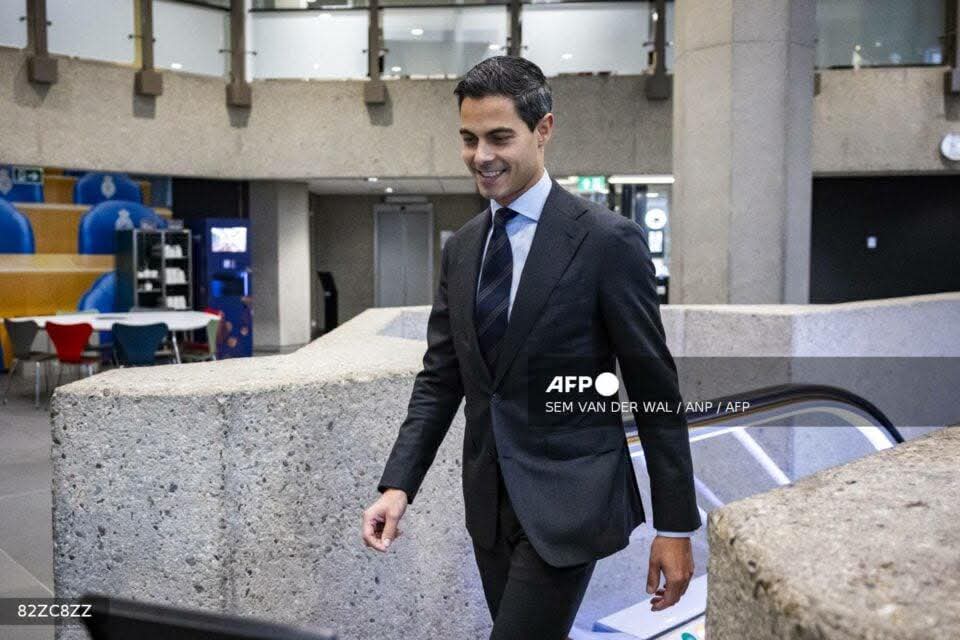

The Dutch Electoral Council has officially declared Rob Jetten, leader of the Democrats 66 (D66) party, the winner of last week’s election, positioning the 38-year-old centrist to become the Netherlands’ youngest-ever prime minister.
Jetten narrowly defeated anti-Islam politician Geert Wilders by just 29,668 votes in an election widely seen as a test for the rise of Europe’s far-right movements.
“We’ve shown that populist movements can be beaten with a positive campaign for the country,” Jetten told AFP.
Before assuming office, Jetten must form a coalition, a process that could take months.
The Dutch political system ensures no single party controls parliament, meaning compromise among multiple parties is essential.
Election Results at a Glance
- D66: 26 seats (lowest-ever number for an election winner)
- PVV (Wilders): 26 seats
- CDA (centre-right): 18 seats
- VVD (right-wing liberal): 22 seats
- Green/Labour: 20 seats
- Other parties, including animal rights and over-50 groups, also won seats
Despite losing 11 seats from his previous shock victory in 2023, Wilders’ PVV remains influential.
The far-right Forum for Democracy increased its seats from 3 to 7, while JA21 grew from 1 to 9.
Jetten prefers a four-party coalition with the CDA, VVD, and Green/Labour, which would give a stable majority of 86 seats.
However, VVD leader Dilan Yesilgoz has ruled out partnering with the Green/Labour bloc.
Other coalition options include a right-wing alliance with CDA, JA21, and D66, which would yield 75 seats but could be unstable, or a minority coalition, though Jetten has rejected this approach.
To explore possible alliances, Jetten has appointed Wouter Koolmees, head of the national rail company, as a “scout” to negotiate between parties.
A progress report is expected on Tuesday.
Wilders has conceded defeat but has posted unverified claims of voting irregularities on social media.
The Electoral Council, however, confirmed the election was conducted fairly, noting a reduction in counting errors to about 8,000 compared with 14,000 in 2021.
The snap election was triggered by Wilders pulling his PVV party from negotiations, citing slow progress toward implementing his proposed “strictest immigration policy ever.”