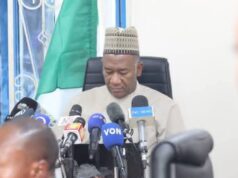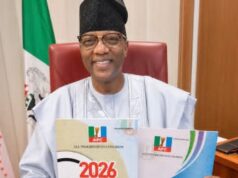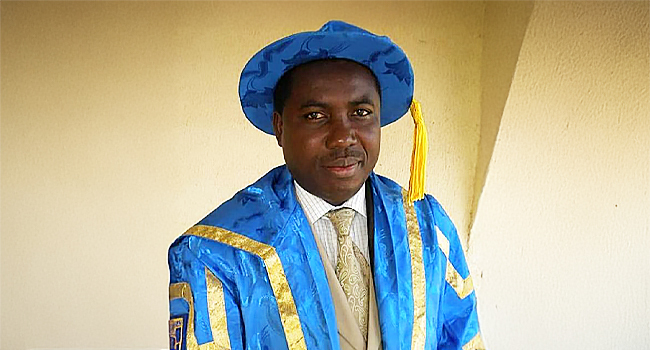

The federal government has yet to respond to growing controversy surrounding a 2020 legal brief reportedly authored by the Chairman of the Independent National Electoral Commission (INEC), Professor Joash Amupitan, which described violent attacks by Boko Haram and armed herdsmen as part of a coordinated anti-Christian campaign amounting to genocide.
Multiple calls and messages to the Minister of Information and National Orientation, Mohammed Idris, for official reaction were unanswered as of press time.
Prof. Amupitan himself has not commented publicly on the matter since it was first reported by Sahara Reporters on Friday.
Efforts to reach him and his Chief Press Secretary, Dayo Oketola, were unsuccessful.
Sources close to the INEC chairman told DAILY GAZETTE that he was occupied with preparations for the Anambra governorship election held over the weekend.
Prof. Amupitan, who was sworn in on October 23 following Senate confirmation, was listed among contributors to a 2020 publication titled “Nigeria’s Silent Slaughter: Genocide in Nigeria and the Implications for the International Community,” jointly released by the International Committee on Nigeria (ICON) and the International Organisation on Peace-building & Social Justice (PSJ).
His 80-page chapter, “Legal Brief: Genocide in Nigeria,” argued that widespread killings and displacement in the country met the threshold for genocide under international law, and accused the federal government of complicity through failure to protect victims or prosecute perpetrators.
The brief urged the United Nations, United States, and other global bodies to consider intervention, including possible legal action at the International Court of Justice (ICJ) or even military involvement under Article 42 of the UN Charter.
When contacted for comment on whether the Senate was aware of the controversial paper during Amupitan’s confirmation, the Senate spokesperson, Yemi Adaramodu, denied any knowledge of it.
“We are not privy to it. The Senate has never seen such a document,”
he said.
The controversy erupted days after the Supreme Council for Shari’ah in Nigeria (SCSN) called on President Bola Ahmed Tinubu to review Amupitan’s appointment, describing the alleged document as “toxic and divisive.”
In a statement signed by its Secretary-General, Nafiu Baba-Ahmad, the SCSN accused the INEC chairman of making “provocative and bigoted assertions” about Northern Nigeria and misrepresenting Sheikh Uthman bn Fodio’s jihad as part of a historical plot to Islamise the country.
“If indeed Prof. Amupitan authored the said document, his submissions are dangerously inimical to the unity, peace, and stability of our country,” the Council said.
The SCSN maintained that violence in Northern Nigeria affects both Muslims and Christians, dismissing any claims of targeted genocide against Christians as misleading.
It argued that Muslims have been the majority of victims in many conflict zones, including Borno, Zamfara, Katsina, and Yobe States.
The Council said Amupitan’s alleged stance was inconsistent with the neutrality and inclusivity required of an INEC chairman and questioned how such a person could have passed security screening for the sensitive role.
Legal experts have expressed differing opinions on whether Amupitan’s past writings undermine his position.
Nwoko Uwemedimo (SAN), a Uyo-based lawyer, told DAILY GAZETTE that the paper did not warrant resignation or dismissal, arguing that Amupitan’s views were personal and unrelated to his official duties.
“His position as INEC chairman has nothing to do with that legal opinion. If he were in a national security role, that would be a different matter,” Uwemedimo said.
He criticised society’s “numbing indifference” to violence, adding that it would be hypocritical for the government to punish him for “speaking the truth” about killings in Nigeria.
Similarly, Josiah Adebayo, Head of Chambers at Akin Akinsanya (SAN) in Ilorin, said the controversy should not affect Amupitan’s job performance.
“The Senate duly confirmed his appointment after due process. Unless new evidence of misconduct emerges, there is no basis for removal,”
he said.
However, others believe the brief raises questions about integrity.
Mumini Jimoh (SAN), former Kwara State Director of Public Prosecution, said Amupitan’s claims of genocide were “factually incorrect and parochial.”
“Thousands of Muslims have also been slaughtered. It is unfortunate that he held such views. If he had integrity, he would have declined an appointment under the same government he once accused of genocide,”
he said.
Former Kwara State Attorney General, Salman Jawondo (SAN), took a similar stance, suggesting that Amupitan should resign voluntarily if the allegations are true.
“His 2020 report stands against the government he now serves. It would be more honourable for him to step down,”
he told Daily Trust.
Jawondo said the incident underscores the need for stricter vetting of government appointees, warning that inadequate background checks could continue to embarrass future administrations.
“Presidents must ensure that appointees for sensitive positions are properly screened. This is about integrity and public confidence,”
he added.
Prof. Joash Amupitan, a former Dean of Law at the University of Jos, is a Senior Advocate of Nigeria with a long academic and legal career.
His appointment as INEC chairman followed the expiration of Prof. Mahmood Yakubu’s tenure in October 2025.