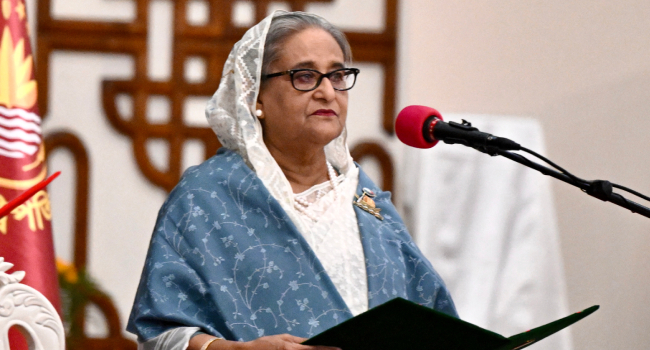

A Bangladeshi court on Monday handed former prime minister Sheikh Hasina a death sentence after finding her guilty of crimes against humanity, a verdict that drew cheers from those packed inside the courtroom.
Judge Golam Mortuza Mozumder announced that Hasina, 78, was convicted on three charges, including incitement, issuing orders to kill, and failing to prevent deadly abuses during the violent crackdown triggered by the student-led movement that toppled her government in August 2024.
She had refused to return from India to attend her trial, defying court orders.
The ruling, aired live on national television, comes just months before the country heads to the first elections since her ouster, slated for February 2026.
“All elements constituting crimes against humanity have been proven,” the judge said as he delivered the decision. “We impose a single punishment, the death penalty.”
Former interior minister Asaduzzaman Khan Kamal, who is also on the run, received the same sentence after being convicted on four counts.
Former police chief Chowdhury Abdullah Al-Mamun, who appeared in court and confessed, was given a five-year prison term.
Bangladesh has been gripped by political instability since the end of Hasina’s rule, with rising violence casting a shadow over the upcoming polls.
According to the United Nations, as many as 1,400 people were killed in security crackdowns as Hasina clung to power, deaths that formed a core part of the prosecution’s case.
Prosecutors had lodged five charges against her, including failing to prevent murder, all of which fall under Bangladesh’s definition of crimes against humanity.
The months-long trial relied heavily on testimony in her absence, with witnesses describing wide-scale killings allegedly ordered by Hasina.
She has repeatedly dismissed the proceedings as a “jurisprudential joke.”
Although the court appointed a state lawyer to represent her, Hasina rejected the court’s legitimacy and denied all allegations.
In an October interview with AFP, she claimed the outcome was predetermined and that a guilty verdict would “come as no surprise.”
Security was tightened across Dhaka ahead of the verdict.
Armoured vehicles and checkpoints were stationed around the courthouse, and nearly half of the city’s 34,000 police officers were deployed.
Authorities had already been grappling with a spate of crude bomb attacks this month, targeting sites linked to the interim administration under Muhammad Yunus, as well as buses and Christian institutions.
Hostility between Dhaka and New Delhi has also risen.
Bangladesh summoned India’s envoy, accusing the country of giving Hasina, whom they call a “notorious fugitive”, a platform to direct hostile rhetoric at the interim government.
Despite her isolation, Hasina has remained outspoken.
She has said she “mourned all lives lost” during the deadly clashes with student protesters, a remark that angered many who say she pursued power at any cost.
She has also warned that the interim government’s ban on her Awami League party is worsening the country’s political crisis ahead of the elections.