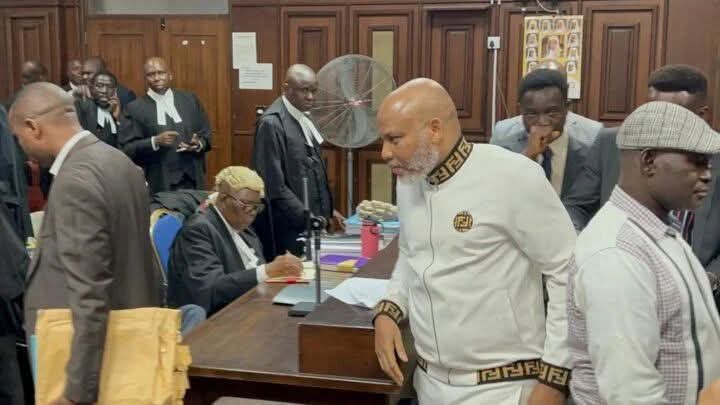

Nnamdi Kanu’s legal team has strongly rejected the life sentence issued by Justice James Omotosho of the Federal High Court, condemning the ruling as a blatant miscarriage of justice and announcing plans to file an appeal without delay.
The IPOB leader was convicted on Thursday on terrorism-related charges, but his lawyers insist the decision is fundamentally flawed.
Speaking to reporters after the judgment, Kanu’s special counsel, Barrister Aloy Ejimakor, described the ruling as one of the darkest moments in Nigeria’s judicial record.
“Today is historic for all the wrong reasons. I’ve never seen someone convicted solely for what he said, not for any action he took,”
Ejimakor stated.
He argued that the prosecution failed to present evidence linking Kanu’s statements to any act of violence.
“The verdict does not align with the evidence before the court. The sentence is excessive, disproportionate, and entirely unjust,”
he said.
Ejimakor questioned how Kanu could be convicted over broadcasts allegedly made from an unspecified location, broadcasts that prosecutors did not successfully connect to any actual incident, violent or otherwise.
He maintained that Kanu’s push for self-determination is not a crime.
“Demanding a separate nation is not terrorism. In today’s Nigeria, it seems you can be convicted simply for speaking. Kanu made broadcasts, so what? Convicting him of terrorism for mere words sets a dangerous precedent.”
The legal team said they would immediately pursue an appeal.
“We move straight to the Court of Appeal. We trust the justices there to carefully review what happened today,” Ejimakor said.
“If the appeal fails, we will go to the Supreme Court. By God’s grace, this conviction will not stand.”
Another defence lawyer, Barrister Maxwell Okpara, also criticised the ruling, accusing the court of allowing emotions rather than legal principles to dictate the outcome.
He urged residents of the South-East to remain calm and avoid violent reactions.
Okpara expressed confidence that higher courts will overturn what he described as a grave injustice.