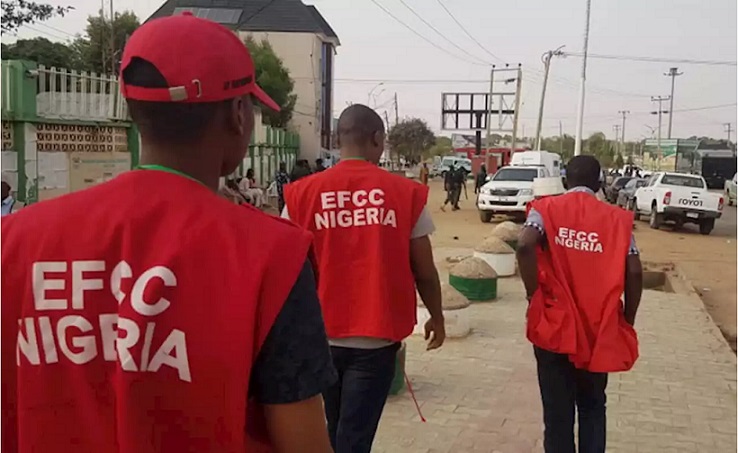

The Economic and Financial Crimes Commission has proposed to spend over ₦3.2 billion on cleaning and fumigation services, meals and refreshments, as well as energy-related costs in the 2026 fiscal year.
The expenditure is contained in the 2026 budget presented by President Bola Ahmed Tinubu to a joint session of the National Assembly on December 19 and captured under the presidency section of the appropriation bill.
A budget document obtained from the Budget Office of the Federation shows that the anti-graft agency earmarked ₦278.6 million for cleaning and fumigation services and ₦722 million for refreshments and meals.
In addition, the EFCC plans to spend ₦1.02 billion on motor vehicle fuel and ₦1.2 billion on generator fuel, bringing its total projected spending on cleaning, food and energy-related items to more than ₦3.2 billion for the year.
Further details of the budget reveal allocations of ₦170.5 million for drugs and medical supplies, ₦376.5 million for vehicle and transport equipment maintenance and ₦46 million for the maintenance of office furniture.
The commission also proposed ₦1.5 billion for the maintenance of office buildings and residential quarters, alongside ₦159.8 million for the upkeep of office and information technology equipment.
The 2026 appropriation bill projects total expenditure of ₦58.18 trillion, including ₦15.52 trillion earmarked for debt servicing.
Projected revenue stands at ₦34.33 trillion, leaving a budget deficit of ₦23.85 trillion to be financed through domestic and foreign borrowing.
The EFCC is among several government agencies whose recurrent expenditure provisions have attracted scrutiny during the ongoing budget review by the National Assembly.
Public affairs analysts have raised concerns over what they describe as excessive and repetitive recurrent spending across government agencies, warning that such patterns undermine the developmental impact of the national budget.
The Executive Director of the Centre for Anti-Corruption and Open Leadership, Comrade Debo Adeniran, described the development as a reflection of wasteful public sector budgeting, noting that the repeated appearance of similar items in annual budgets encourages profligacy.
He warned that recurrent expenditure could serve as a conduit for diversion of public funds, arguing that officials often create budgetary avenues to prioritise personal comfort over public interest.
Also commenting, political scientist Dr Kabiru Sa’id Sufi said overhead costs were consuming an increasingly large share of government spending, calling for a reduction in unnecessary expenditure.
According to him, the frequent repetition of the same budget items, often with slight adjustments in figures, suggests that many of the expenditures are either unnecessary or poorly implemented.