
Spain has begun three days of national mourning following a deadly high-speed train collision in the southern region of Andalusia that has claimed at least 41 lives, with the government pledging a full and transparent investigation into the cause of the disaster.
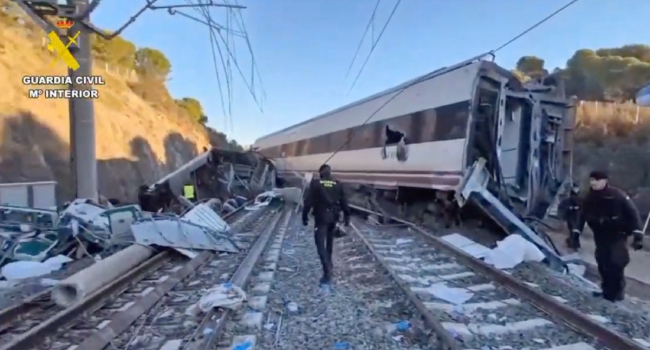
The accident occurred late Sunday near the town of Adamuz when a high-speed train operated by private rail company Iryo derailed while travelling from Malaga to Madrid and crossed onto an adjacent track, colliding with an oncoming passenger train. Both trains subsequently derailed.
Prime Minister Pedro Sánchez, who visited the crash site on Monday, described the incident as a moment of national grief and assured Spaniards that authorities would determine the cause of the tragedy and make the findings public.
“This is a day of sorrow for our entire country,” Sánchez said. “We will uncover the truth, and once the cause is established, it will be presented with absolute transparency.”
The head of Andalusia’s regional government, Juan Manuel Moreno, confirmed that the death toll had risen to 41, adding that it could take up to 48 hours to establish the final number of casualties as rescue operations continue.
More than 120 passengers were injured in the crash, with 41 people still receiving treatment in hospitals in the nearby city of Córdoba.
Heavy lifting equipment has been deployed to remove mangled carriages and allow emergency teams access to trapped areas.
Relatives and friends of missing passengers have taken to social media, sharing photographs and personal details in efforts to locate loved ones.
Initial findings have raised questions about the circumstances of the derailment.
Authorities said the accident occurred on a straight stretch of track and that both trains were travelling below the permitted speed limit.
Transport Minister Óscar Puente described the incident as “extremely strange,” noting that the derailed Iryo train was relatively new, built in 2022, and had undergone inspection just days before the crash.
Rail operator Iryo said the train inexplicably veered onto the adjacent track for reasons yet to be determined.
Renfe, operator of the second train heading to the southern city of Huelva, confirmed that 184 passengers were on board, while Iryo said about 300 people were travelling on its Malaga–Madrid service.
Renfe President Álvaro Fernández Heredia told Spanish public radio that human error and speeding had largely been ruled out, stating that both trains were travelling at just over 200 kilometres per hour, below the 250 km/h limit for that section of track. He suggested the cause was likely linked to infrastructure or rolling stock issues.
Spain operates Europe’s largest high-speed rail network, with more than 3,000 kilometres of dedicated tracks linking major cities across the country.
Survivors have described terrifying scenes. Lucas Meriako, a passenger on the derailed train, said the impact felt like something out of a horror film, with shattered glass and injured passengers throughout the carriage.
Residents of Adamuz quickly mobilised to support victims, bringing water, blankets and other supplies to local authorities as emergency services worked through the night.
Condolences have poured in from across the world, including messages from Pope Leo XIV and French President Emmanuel Macron, as Spain mourns one of its deadliest rail disasters in more than a decade.