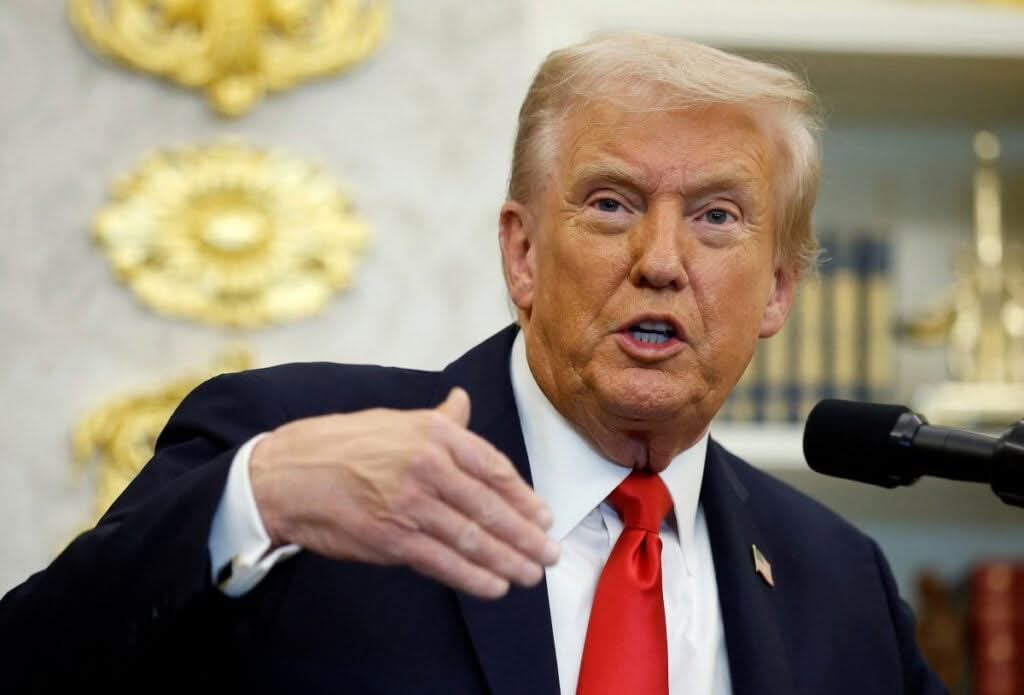

United States President Donald Trump has imposed a new 10 percent global tariff on imports into the country, just hours after the Supreme Court of the United States struck down a major legal basis for many of his previous trade duties.
The additional levy, announced at the White House and confirmed in an official factsheet, is set to take effect on February 24 and will remain in place for 150 days.
It will apply broadly to trading partners, including countries that had previously negotiated separate tariff arrangements with Washington.
However, exemptions will remain for goods covered under the United States-Mexico-Canada Agreement (USMCA) and for sectors currently subject to separate investigations, such as pharmaceuticals.
Earlier on Friday, the Supreme Court ruled 6–3 that the 1977 International Emergency Economic Powers Act (IEEPA) does not grant the president authority to impose sweeping tariffs.
The decision marked a significant setback for Mr Trump’s trade strategy, which relied heavily on emergency powers to impose duties on specific countries.
In he majority opinion, Chief Justice John Roberts stated that the law makes no reference to tariffs or duties and that Congress would have explicitly granted such extraordinary authority if it had intended to do so.
The ruling invalidated many of the country-specific tariffs introduced over the past year, though it did not affect separate sector-based duties on steel, aluminum and other goods that were imposed under different statutes.
Mr Trump reacted sharply to the judgement, criticising members of the court and insisting the decision would not weaken his trade agenda.
He argued that alternative legal pathways would allow his administration to maintain tariff revenues and even expand duties if necessary.
Treasury Secretary Scott Bessent said the administration’s revised approach would likely produce similar tariff revenue in 2026, despite the court’s restrictions.
Wall Street responded with modest gains following the ruling, as investors interpreted the decision as introducing greater legal certainty into US trade policy.
Business groups welcomed the judgement. The National Retail Federation described it as providing much-needed clarity for companies navigating fluctuating import costs.
The issue of potential refunds for previously collected tariffs remains unresolved.
While the administration had argued in court that companies would be reimbursed if the duties were deemed unlawful, the Supreme Court did not address the refund mechanism in its ruling.
Analysts at the University of Pennsylvania’s Penn Wharton Budget Model projected that refunds could total as much as $175 billion if mandated.
Meanwhile, estimates from Yale University’s Budget Lab suggest that the average effective tariff rate on consumers now stands at 9.1 percent — down from 16.9 percent before the ruling, but still among the highest levels since the mid-20th century.
Major US trading partners, including the European Union, Britain and Canada, said they were reviewing the implications of both the court decision and the newly announced blanket tariff.
Canadian business leaders warned that further trade turbulence could follow, with concerns that Washington might pursue broader or more disruptive measures to maintain pressure in ongoing trade disputes.
With legal battles likely to continue and new tariffs set to take effect within days, the latest development signals that trade tensions remain a central feature of US economic policy under Mr Trump’s administration.