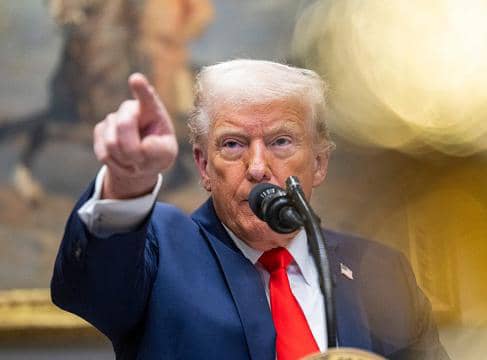

United States President Donald Trump has threatened a new wave of military strikes against Iran, while unveiling plans to impose a 20 per cent transit fee on cargo passing through the Strait of Hormuz, further escalating tensions between Washington and Tehran.
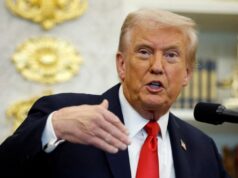
Speaking at the White House on Monday, Trump said American forces would intensify their military operations against Iran, declaring that the country would face heavy attacks over the coming days.
Shortly afterwards, the United States Central Command (CENTCOM) confirmed that fresh strikes had commenced and would continue targeting Iranian military assets in a bid to weaken Tehran’s ability to threaten commercial shipping and regional security.
CENTCOM also announced the reintroduction of a blockade on Iranian ports, a move expected to take effect on Tuesday.
The development sent global oil prices soaring by more than nine per cent amid fears of renewed instability in one of the world’s most strategic energy corridors.
In a post on Truth Social, Trump declared that the United States would become the “Guardian of the Strait of Hormuz” and announced a 20 per cent fee on all cargo transported through the vital waterway.
He added that while Iranian ports would remain under blockade, other nations would continue to enjoy unrestricted access to the strait.
Iran swiftly dismissed the proposal.
Foreign Minister Abbas Araghchi mocked the announcement, saying if safe passage deserved compensation, Tehran would charge a much lower fee.
He argued that the proposed American levy was excessive and unrealistic.
The Strait of Hormuz remains one of the world’s busiest oil transit routes, and any disruption to shipping through the channel carries significant implications for global energy markets.
The renewed confrontation comes as both countries exchange attacks on a scale not witnessed since an April ceasefire.
Iranian authorities said American strikes targeted multiple locations across the country’s southern and western regions, while Iran’s Revolutionary Guards claimed responsibility for missile attacks against US military facilities in Bahrain, Jordan, Kuwait and Oman.
Trump also renewed his threat to destroy Pickaxe Mountain, an underground nuclear site near Natanz believed by Western intelligence agencies to be linked to Iran’s uranium enrichment programme.
Despite the sharp escalation, the US President maintained that diplomatic efforts aimed at securing a long-term agreement with Tehran were still ongoing, revealing that negotiations continued over the weekend.
Iran, however, described the existing framework for negotiations as being in serious jeopardy.
Foreign Ministry spokesman Esmaeil Baqaei warned that Tehran could abandon its commitments if Washington failed to honour its own obligations, although he confirmed that mediation efforts involving Qatar, Pakistan and Oman were continuing.
Meanwhile, the United Nations Secretary-General, António Guterres, expressed deep concern over the growing hostilities, urging all parties to exercise restraint to prevent the conflict from expanding across the Middle East.
Military authorities in Bahrain, Kuwait and Jordan confirmed intercepting several Iranian missiles and drones, while Tehran warned that any Gulf nation assisting the United States militarily could be regarded as participating in the conflict.