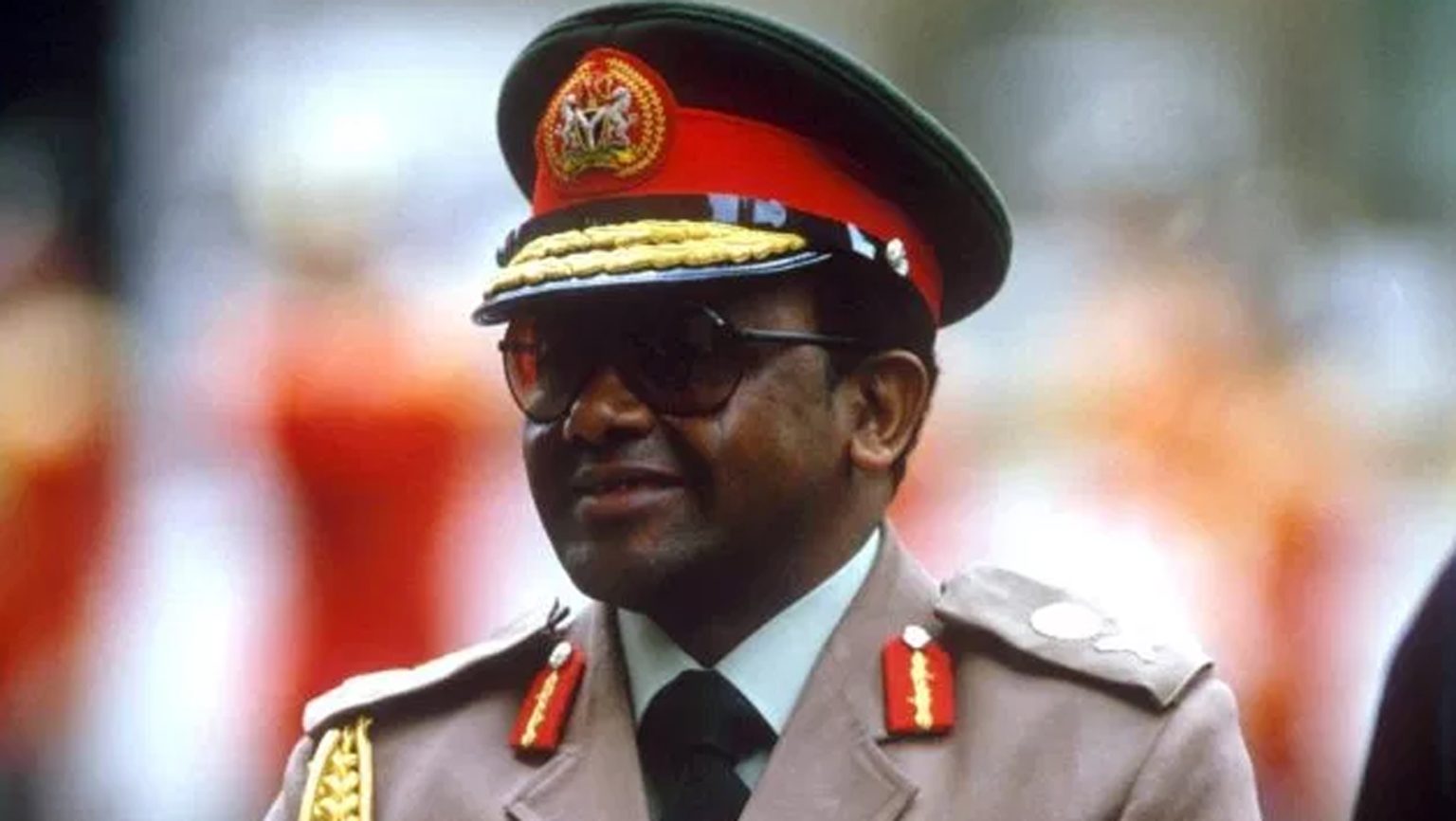

A retired Assistant Director of the Department of State Services (DSS), Dennis Amachree, has claimed that former military Head of State, General Sani Abacha, died during an intimate encounter with a woman, dismissing longstanding claims that the late Nigerian leader was assassinated or poisoned.
Amachree made the revelation in his newly published 348-page memoir, DSS @40: My Journey Behind the Shield, in which he recounted his role in the investigation into Abacha’s sudden death on June 8, 1998.
According to the former intelligence officer, Abacha suffered what he described as a coitus-induced cardiac arrest at about 4:05 am inside the Aso Rock Presidential Villa Guest House in Abuja.
He claimed that the woman involved, whom he identified only as a pharmacist, fled to Lagos shortly after the incident but was later traced and interrogated by the DSS.
Recalling the interrogation, Amachree said the woman insisted she was not responsible for Abacha’s death.
“The first thing she said to me was, ‘I did not kill him, he died on top of me,'” he wrote, adding that she was subsequently flown back to Abuja on the instruction of the DSS Director of Operations.
Amachree maintained that his account represents the true circumstances surrounding Abacha’s death and should finally put an end to decades of speculation.
He rejected several popular theories, including claims that the late military ruler was poisoned with an apple, assassinated through a poisoned handshake, or eliminated in a foreign intelligence operation, insisting that none of those narratives was supported by credible evidence.
According to the memoir, Abacha’s companion had arrived at the Presidential Villa Guest House with her younger sister, a pharmacist who was attending a conference in Abuja.
He alleged that after the companion returned to her hotel, the pharmacist remained alone with the Head of State.
Amachree claimed that when the pharmacist later discovered Abacha had become unresponsive, she checked for a pulse, found none, informed a soldier on duty that the Head of State had requested transport for her, and departed Abuja on an early morning flight to Lagos.
The retired DSS officer said investigators later tracked her to an address in Ogudu, Lagos, where she was arrested and questioned.
He also challenged the version of events previously presented by Abacha’s former Chief Security Officer, Major Hamza Al-Mustapha, who had suggested that the late ruler’s condition deteriorated after shaking hands with a member of Palestinian leader Yasser Arafat’s delegation during an official visit.
Amachree argued that Al-Mustapha’s account failed to explain what transpired in the hours leading to Abacha’s death.
He further disputed accounts by several prominent figures, including former FCT Minister Gen. Jeremiah Useni, military physician Brig.-Gen. Oviemo Ovadje, former Aviation Minister Femi Fani-Kayode, former U.S National Security Adviser Susan Rice, and various foreign media reports, insisting that none was backed by verifiable evidence.
According to him, the prolonged controversy over Abacha’s death reflects a broader culture of misinformation and secrecy in Nigeria’s political history, stressing that historical events should be documented based on facts rather than speculation.
General Sani Abacha ruled Nigeria from November 1993 until his death on June 8, 1998.
His administration was marked by allegations of human rights abuses, the detention of political opponents and the suppression of pro-democracy activists.
He died barely a month before the death in detention of the presumed winner of the annulled June 12, 1993 presidential election, Chief M.K.O. Abiola.
Amachree concluded that Abacha’s death serves as a reminder that political power is temporary and that no office or authority can shield anyone from mortality.