Home Blog Page 199

JUST IN: Nnamdi Kanu’s Judgment To Be Broadcast Live – Court


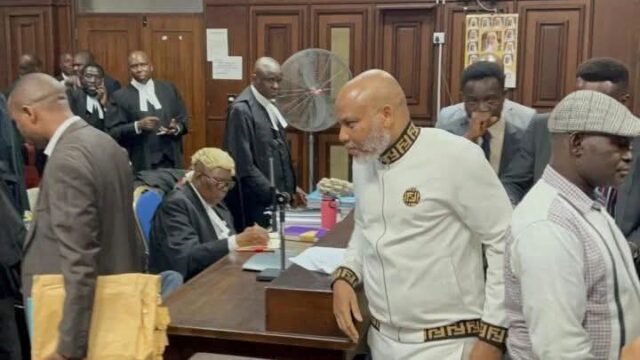
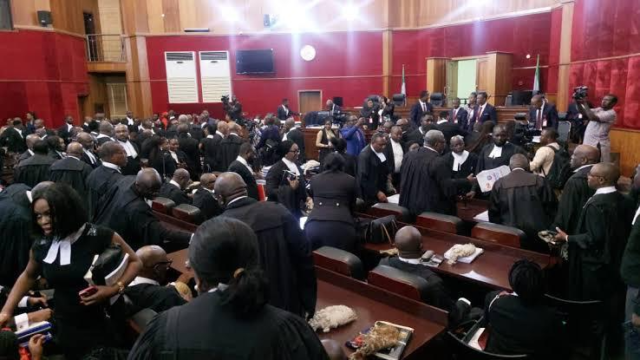
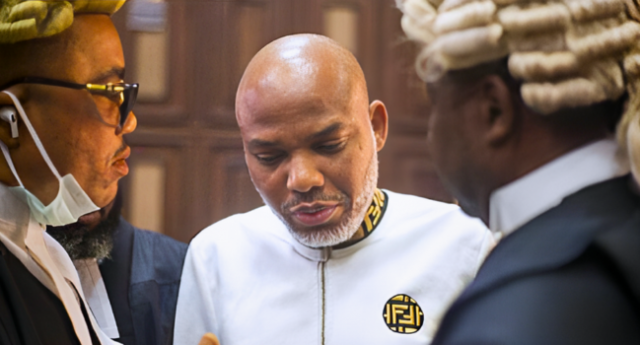
The Federal High Court in Abuja is set to deliver judgment today in the alleged terrorism trial of Nnamdi Kanu, leader of the proscribed Indigenous People of Biafra (IPOB). The proceedings will be broadcast live on television.

The court registrar confirmed the development to the News Agency of Nigeria (NAN) on Thursday morning.

Cameramen from major stations including NTA, Channels TV, AIT, and TVC are present in the courtroom with their equipment for live coverage.

Justice James Omotosho had on November 7 scheduled today for the judgment after Kanu’s defence was foreclosed.

The judge explained that Kanu chose not to present his defence under a repealed law.

According to Justice Omotosho, Kanu had six days allocated by the court to conduct his defence, which he did not fully utilise.

The judge emphasized that he would have granted an extension if Kanu had chosen to open his defence.

As a result, the court held that Kanu cannot claim he was denied his constitutionally guaranteed right to a fair hearing.

Google search engine

LIVE UPDATE: Justice Omotosho Set To Deliver Judgment In Nnamdi Kanu’s Trial


After years of legal proceedings on terrorism-related charges, Nnamdi Kanu, the leader of the Indigenous People of Biafra (IPOB), is set to learn his fate today as the court delivers judgment in his case.

Kanu’s trial has been one of the most closely followed legal battles in Nigeria in recent years.

He was first arrested in 2015 and charged with treasonable felony and terrorism, but the case has experienced multiple twists and turns.

In 2017, Kanu fled Nigeria while out on bail, following a military operation at his residence during “Operation Python Dance” in the South-East.

He was later arrested in Kenya in June 2021 under controversial circumstances and returned to Nigeria, a move his lawyers and IPOB have described as an “extraordinary rendition.”

Upon his return, additional charges were added, bringing the total to 15 counts, including terrorism and incitement to violence.

Kanu has consistently challenged the trial’s validity, citing procedural irregularities and alleged violations of international extradition and jurisdictional laws.

Adegboyega Awomolo, SAN, is representing the Federal Government, while Kanu is representing himself.

Court proceedings this morning:

  • 9:12 AM: Nnamdi Kanu begins speaking, asserting that no judgment should be delivered as he has filed all necessary legal processes.
  • 9:14 AM: Justice Omotosho opens the hearing, emphasizing decorum in the courtroom.
  • 9:20 AM: Kanu notes he has filed a motion of notice at the Court of Appeal and identifies all motions filed.
  • 9:26 AM: The judge consolidates three of Kanu’s motions.
  • 9:27 AM: Kanu argues that count 7 does not exist and that it invalidates the trial.
  • 9:33 AM: Kanu details motions filed between November 11 and 17, including a request for the prosecution to file its final written address and a plea for bail.

The court is now poised to deliver its judgment, bringing a high-profile chapter of Nigeria’s legal history to a critical moment.

Google search engine

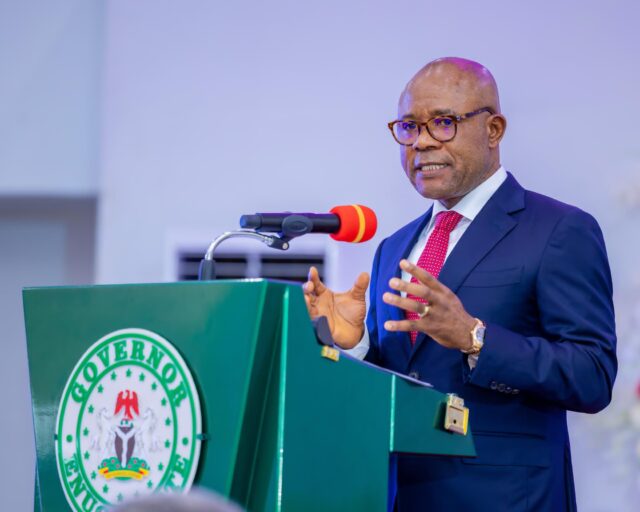
Rights Groups Decry Miscarriages Of Justice In Enugu Magistrate Courts, Petition Gov Mbah For Urgent Reform


Civil rights organisations have raised alarm over what they describe as deep-seated injustice and abuse of power within Enugu State’s Magistrate Courts, urging Governor Peter Mbah to intervene immediately.

In a petition submitted to the governor, the Civil Rights Realisation and Advancement Network (CRRAN) detailed two troubling cases it said illustrate a broader pattern of rights violations and corruption in the state’s justice system.

CRRAN President, Olu Omotayo (Esq.), said the cases of Godwin Odey and Yusuf Omotara expose serious failures in the administration of justice, including arbitrary detention, extortion, and refusal by authorities to act.

“This matter clearly shows the grave violations of citizens’ right to access justice in Enugu State and the refusal of authorities to promptly redress these violations,” the petition stated.

Case 1: Man Charged With Murder Despite Airtight Alibi

According to the petition, Godwin Odey, an OND graduate, was arrested while travelling to Abuja and charged with murder, even though he was attending a wedding in Obollo-Afor, Udenu LGA at the time of the alleged crime.

CRRAN said the case file has not been transferred to the Attorney-General’s office for legal review, despite repeated requests.

This follows an earlier joint petition by CRRAN and the Rule of Law and Accountability Advocacy Centre (RULAAC), published October 8, which alleged that the Attorney-General’s office demanded a ₦50,000 “review fee” before accepting a petition requesting a review of Odey’s case.

The then Attorney-General, Dr. Kingsley Udeh, now a Minister, denied the allegation.

Case 2: Detained for a Week, Nearly ₦5m Removed From Account

CRRAN also highlighted the case of Yusuf Omotara, who was detained for almost a week and had close to ₦5 million withdrawn from his bank account.

According to the petition, the withdrawal was carried out based on a questionable court order allegedly secured by a lawyer in collaboration with a Magistrate Court official.

The organisation described this as a blatant abuse of judicial authority and a violation of Omotara’s rights.

CRRAN argued that Magistrate Courts, being the closest courts to ordinary citizens,should offer quick, fair access to justice, but have instead become hotspots of corruption and arbitrary actions.

“If we aim to achieve an efficient justice system, these illegalities and abnormalities being perpetrated at the Magistrates Courts must be urgently addressed,” Omotayo said.

The group is calling for full investigation of all officials implicated in the abuses, Prosecution of those found culpable, Refund of money unlawfully deducted from Omotara’s account and Structural reforms to ensure justice is not denied due to corruption or administrative neglect.

Google search engine

Katsina Lawmaker Leads Negotiations With Terrorists, Secures Release Of 45 Kidnap Victims After ‘Peace Deal’


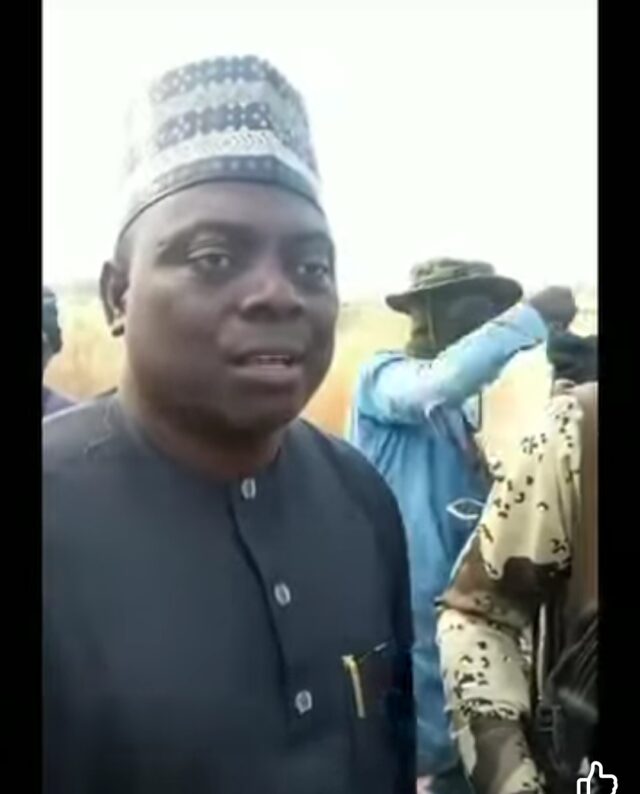
A member of the Katsina State House of Assembly, Engr. Abdurrahman Ahmad Kandarawa, has facilitated the release of 45 kidnapped victims after leading a delegation to negotiate with terrorists operating in the state.

DAILY GAZETTE gathered that the victims were freed last Friday following a renewed peace agreement between community leaders and the armed group, an arrangement aimed at reducing the region’s persistent insecurity.

A video obtained by DAILY GAZETTE shows one of the terrorists confirming that the release was carried out because both sides upheld earlier promises.

The bandit stressed that the group expects the government and security agencies not to “escalate the situation,” adding that the agreement should allow their people to return to town and resume normal activities.

Hon. Abdurrahman, who led the dialogue process, defended the controversial engagement with the terrorists, comparing it to global conflict-resolution efforts.

“Even in the world, peace agreements are made to ensure coexistence,” he said.

“There is nothing wrong in making peace to secure a lasting and peaceful future for our people.”

The development comes amid a wave of recent attacks across northern Nigeria.

Earlier on Monday, DAILY GAZETTE reported that terrorists stormed Maga Comprehensive Girls’ Secondary School in Kebbi State, abducting multiple female students and killing at least one staff member.

A school guard was also injured in the attack, which occurred at about 5:52 am, just as students were preparing for morning activities.

Residents say the attackers are still in the area and have called for urgent government intervention to rescue the girls.

In a separate incident, terrorists launched a deadly assault on Rogun Village in Kpada District, Patigi LGA of Kwara State.

According to a security source, the attackers targeted a police outpost late Sunday night, engaging security personnel in a prolonged gun battle.

By the time the shooting ended, two security operatives, a police constabulary and a vigilante officer, had been confirmed dead.

The latest releases in Katsina come against the backdrop of ongoing violence that has plagued communities across the North-West and North-Central regions.

Google search engine

‘A Patriot Of Uncommon Courage’, Edeoga Mourns Senator Okey Ezea


Former Labour Party governorship candidate in the 2023 general elections in Enugu State, Barr. Chijioke Edeoga, has joined the growing list of leaders mourning the death of Senator Okey Ezea, describing his passing as a painful blow to Nsukka, Enugu State and Nigeria at large.

Edeoga, who once represented Enugu East/Isi-Uzo Federal Constituency in the House of Representatives, said the news of Ezea’s death reached him in the early hours of the morning and left him “deeply shaken.”

In an emotional statement posted on his social media handle, Edeoga revealed that since receiving the tragic news, he had done little else besides taking calls of condolence and reflecting on his long relationship with the late senator.

According to him, Ezea’s death felt like “the quenching of an indispensable light,” one whose absence “disturbed him on a scale he did not imagine possible anymore.”

He described Senator Ezea as a patriot of uncommon courage, super-brainy, self-assured, resilient, and a complete embodiment of the Nsukka spirit.

Edeoga recalled how he assumed Ezea would recover from his recent health challenges, saying he never once thought their many unfinished conversations would now remain forever unspoken.

“Ideke my friend,” he wrote, “I took it for granted that you would recover from your indisposition and that we would talk things over. Ishima, farewell. Nzeogwu, rest in peace. Nwokeoma, we will surely miss you. Good bye.”

Google search engine

FG Blames US Remarks As Kebbi, Kwara Abductions Spark Nationwide Outrage


The Federal Government on Wednesday attributed the renewed wave of violent attacks, including the abduction of schoolgirls in Kebbi State and a deadly assault on worshippers in Eruku, Kwara, to recent statements made by the United States, as anger spread across the country.

Secretary to the Government of the Federation, George Akume, said posts by US President Donald Trump alleging a “Christian genocide” in Nigeria and threatening possible American military intervention had “inadvertently emboldened opportunistic violent groups” that now seek to justify attacks using international rhetoric.

“Recent pronouncements from the United States have inadvertently emboldened opportunistic violent groups seeking to exploit international narratives and make bold statements by attacking soft targets,” Akume said.

He noted that before Trump’s comments, insurgent operations had been significantly weakened, leaving only isolated banditry.

“This resurgence underscores the vital need for collaboration, not public labelling,” he added.

Between October 30 and November 1, Trump announced the redesignation of Nigeria as a Country of Particular Concern (CPC) and warned he could deploy US forces if Nigeria failed to stop alleged killings of Christians.

He also said he had instructed the “Department of War” to prepare for possible action and threatened to suspend US assistance.

Akume reiterated that Nigeria does not require foreign troops, stressing that the Armed Forces have reclaimed territory, degraded Boko Haram and ISWAP leadership, and carried out successful operations.

What Nigeria needs, he said, is targeted support, especially intelligence, technology, and equipment.

He also rejected any framing of Nigeria’s conflict as a “Christian genocide,” stating that verified evidence shows insurgents attack both churches and mosques, killing Muslims and Christians.

The Kebbi attack occurred early Monday at Government Girls Comprehensive Senior Secondary School, Maga, in Danko-Wasagu LGA.

Bandits killed the Vice Principal, Hassan Makuku, who reportedly attempted to shield students, and abducted dozens of schoolgirls.

The Kebbi Police Command confirmed 24 students were taken.

State officials later clarified that 26 girls were abducted, but two, Salma and Hauwa’u Liman, escaped and have been reunited with their families.

In Kwara, gunmen attacked Christ Apostolic Church, Oke Isegun, in Eruku on Tuesday night while a live-streamed service was underway.

At least two worshippers were killed and around 35 abducted, according to police and eyewitnesses.

A viral video captured churchgoers scrambling for safety as gunmen fired into the building before fleeing into the bushes.

Security forces and local vigilantes have since launched a manhunt.

President Bola Tinubu postponed his travel to the G20 Summit in South Africa and the AU–EU Summit in Angola to receive direct updates on the Kebbi and Kwara incidents.

He ordered increased security deployment and directed the police to pursue the attackers aggressively.

Kwara State Governor Abdulrahman Abdulrazaq visited Eruku on Wednesday, announcing plans to seek a Nigerian Army Forward Operating Base and a Mobile Police Squadron in the community.

He accused police personnel in the area of failing to respond during the attack, even alleging they fired tear gas at vigilantes and residents who tried to pursue the fleeing bandits.

Local youths also accused the police of negligence, insisting they had supported the division, including building houses for officers, yet received no help when the community was under attack.

Protesters later barricaded the Ilorin–Kabba highway, leaving vehicles stranded.

The Jama’atu Nasril Islam (JNI), led by the Sultan of Sokoto, condemned the Kebbi abduction as “one tragedy too many,” likening the pattern to previous mass abductions in Chibok, Dapchi, Kankara, and Kagara.

The group faulted poor surveillance around vulnerable schools and criticised weak coordination among security agencies.

The African Democratic Congress (ADC) warned that the “Christian genocide” narrative, once dismissed, was now becoming a self-fulfilling prophecy due to the government’s refusal to confront the roots of insecurity.

Former Kano governor and 2023 presidential candidate Rabiu Kwankwaso condemned the escalating crisis, calling recent killings and kidnappings, including that of Brigadier General Musa Uba in Borno, evidence of serious intelligence failures.

Former Rivers governor Rotimi Amaechi criticised the federal government’s “lack of political will,” accusing it of issuing hollow statements instead of taking decisive action.

The Nigeria Labour Congress expressed sorrow over the Kebbi abductions and warned that the ease with which bandits struck, despite existing security measures, suggests “something more worrying.”

Prominent activists and entertainers, including Omoyele Sowore, Falz, Inibehe Effiong, Debo Macaroni, Femi Adebayo, and Simi, also lambasted the government.

Many called for Tinubu’s resignation, accusing the administration of failing to protect citizens.

Falz and other public figures resurfaced Tinubu’s past criticism of former President Goodluck Jonathan, urging him to apply the same standard to himself.

Simi lamented that Nigeria has become a place where tragedies repeat while authorities remain unmoved:
“‘Sorry’ is not enough. Never has been.”

Google search engine

APC Seeks To Testify As US Congress Debates ‘Christian Genocide’ Allegations Today


The United States chapter of the All Progressives Congress (APC) has asked to appear before the US House Subcommittee on Africa on Thursday as American lawmakers prepare to review former President Donald Trump’s recent redesignation of Nigeria as a Country of Particular Concern (CPC) over alleged religious persecution.

The request was contained in a letter to the Subcommittee Chairman, Rep. Chris Smith. According to APC USA Chairman, Prof. Tai Balofin, the group is ready to send a high-level delegation capable of providing “firsthand intelligence” and verified data on Nigeria’s security realities.

His statement was made available to journalists in Abuja.

Balofin said while the party supports religious liberty for all Nigerians, the global debate often oversimplifies the country’s security challenges.

He argued that Nigeria’s crisis is shaped by banditry, climate pressures, resource conflicts and transnational crime—not merely religious hostility.

He said the delegation is prepared to appear before Congress “at short notice,” adding that APC USA intends to highlight what it sees as key security improvements under President Bola Tinubu.

These include efforts to disrupt terrorist networks, wider community-based early-warning systems, and initiatives supporting interfaith cooperation.

According to him, reductions in attacks across several hotspots have been acknowledged by both Nigerian authorities and independent monitors.

The group also plans to recommend deeper US–Nigeria cooperation in security, intelligence, and humanitarian programs, arguing that inclusive engagement is essential for protecting all religious groups.

Balofin praised Chairman Smith’s record on global religious freedom and appealed for APC USA to be granted an opportunity to contribute “accurate, fair and solution-driven insights.”

The APC USA letter comes shortly after Nigeria criticised the United States for excluding Nigerian officials from a UN event on alleged killings of Christians.

Nigeria’s chargé d’affaires to the UN, Syndoph Endoni, described the exclusion as making decisions about Nigeria “in our absence.”

Endoni said the UN programme, which was backed by the US Mission and attended by American rapper Nicki Minaj, sidelined Nigerian officials even though the allegations directly concern the country.

US officials reportedly said the event was “private” and that organisers feared “reprisals” if Nigerian government representatives were present.

The envoy warned that such unilateral actions could inflame tensions and insisted that Abuja remains committed to working with Washington to address extremist violence.

The US House Subcommittee on Africa is scheduled to convene its hearing at 11:00 am in Room 2172 of the Rayburn House Office Building. The session will also be streamed live.

Two panels of witnesses are expected:
Panel 1:

  • Jonathan Pratt, Senior Bureau Official, Bureau of African Affairs
  • Jacob McGee, Deputy Assistant Secretary, Bureau of Democracy, Human Rights and Labor

Panel 2:

  • Nina Shea, Director, Center for Religious Freedom
  • Bishop Wilfred Anagbe of the Makurdi Catholic Diocese
  • Oge Onubogu, Center for Strategic & International Studies

The hearing will examine religious freedom in Nigeria, evaluate the scope of reported persecution, and consider potential US policy responses, including sanctions, humanitarian support and security cooperation.

On October 31, 2025, President Donald Trump redesignated Nigeria a Country of Particular Concern, accusing Nigerian authorities of failing to protect Christians from extremist violence.

He claimed Christianity faces an existential threat in Nigeria, alleging thousands of Christians have been killed by “radical Islamists.”

Trump warned that the US is prepared to impose sanctions, halt all assistance, and even consider military action if Nigeria does not act decisively.

He also directed the Department of War to prepare for “possible action.”

President Bola Tinubu has strongly rejected Trump’s claims, describing them as a distortion of Nigeria’s religious situation.

In a statement on his X handle, Tinubu reaffirmed Nigeria’s constitutional protections for religious freedom and insisted the country does not encourage or tolerate religious persecution.

He stressed that Nigeria’s diversity and religious pluralism remain core national values that the government is committed to upholding.

Google search engine

Judgment Day: Police Heighten Security In South-East As Court Decides Kanu’s Fate Today


The Federal High Court in Abuja will today deliver a crucial ruling in the long-running legal battle between the Indigenous People of Biafra (IPOB) leader, Nnamdi Kanu, and the Federal Government.

Justice James Omotosho is expected to rule on multiple applications filed by both sides, including Kanu’s challenge to the validity of the terrorism charges against him and his request to be released on grounds of alleged unlawful detention and breach of fundamental rights.

Kanu has been held by the Department of State Services since June 2021 following his controversial return from Kenya, an episode his legal team insists amounted to “extraordinary rendition.”

He is currently facing seven terrorism-related counts, which include allegations of incitement, operating an unlawful organisation, and threatening national security. Kanu denies all accusations.

Justice Omotosho fixed today’s date on November 7 after Kanu failed to open his defence within the six days allocated to him.

Although the prosecution closed its case on June 19, 2025, having called five witnesses and tendered numerous exhibits, Kanu did not proceed with his defence, instead filing new motions contesting the legality of the proceedings.

He argues that the terrorism law under which he is being tried has been repealed, rendering the charges invalid.

Kanu also asked the court to strike out the plea of “not guilty” earlier recorded on his behalf, alleging it was entered under misleading circumstances and contrary to a Supreme Court decision.

He wants all subsequent court proceedings nullified.

However, Justice Omotosho ruled that Kanu was given ample opportunity to defend himself.

The judge noted that the matter, originally filed in 2015, had suffered many delays, mostly at the defendant’s request, before being transferred to his court for an accelerated hearing.

He emphasised that while the court cannot compel a defendant to present a defence, a refusal to do so amounts to waiving that right.

Having abandoned his defence, the court concluded that it would proceed to judgment.

Kanu’s legal odyssey has been marked by numerous adjournments and appeals.

In 2022, the Court of Appeal discharged him and ordered his release, declaring that his rendition from Kenya violated international law.

The Federal Government appealed, and the Supreme Court later reversed the ruling, sending the case back to the Federal High Court for trial.

The IPOB leader’s continued detention has remained deeply contentious, sparking regional, national, and international calls for his release.

Many groups in the South-East argue that freeing him would help ease rising security tensions, but the Federal Government insists he must face trial.

As anticipation builds, security agencies have increased surveillance and patrols across the South-East.

In Abia, Kanu’s home state, Police spokesperson ASP Maureen Chinaka said the Commissioner of Police, Danladi Isa, has deployed officers statewide to prevent any breakdown of law and order.

She stressed that the police, working with other security agencies, are prepared “24/7” to maintain peace regardless of the judgment’s outcome.

Despite the heightened vigilance, there was no noticeable security presence around Kanu’s hometown of Afaraukwu as of the time of reporting.

In Enugu, police spokesman Daniel Ndukwe declined to speculate, asking, “Have you seen the judgment that he is going to be convicted?”

At the national level, the Force Public Relations Officer, Benjamin Hundeyin, did not respond to inquiries.

In a related development, Kanu has submitted a criminal complaint to an Abuja Chief Magistrate’s Court accusing two DSS witnesses, known in court as TAA (PW1) and BBB (PW2), of giving false evidence during his trial.

In the complaint dated November 13, Kanu alleges that both witnesses committed perjury between May and July 2025 during proceedings concerning the admissibility of statements he made in 2015 and 2021.

He cites several laws, including sections of the Penal Code, the Administration of Criminal Justice Act, and constitutional provisions.

Kanu claims that TAA lied when he said he did not know Mr Brown Ekwoaba, a senior DSS investigator who Kanu says oversaw his detention and interviews in 2015.

He supports this with affidavits from his brother and another defendant, as well as public records showing Ekwoaba’s role at the time.

He also accuses BBB of contradicting himself, claiming in court that he had never met Kanu except during trial, despite having earlier testified that he conducted Kanu’s video interview at the DSS Headquarters in July 2021.

Kanu argues that the alleged falsehoods were used to conceal the true chain of custody behind his statements, which are central to the prosecution’s case.

Google search engine

Trump Signs Law Permitting Release Of Epstein Files


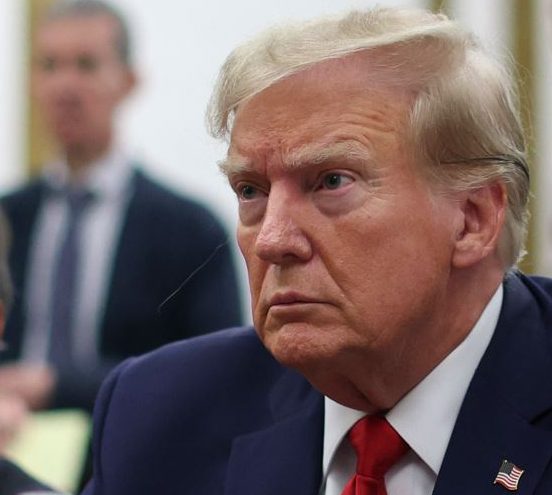
US President Donald Trump announced Wednesday that he has signed legislation compelling the Justice Department to publish all documents from its investigation into the late financier and convicted sex offender Jeffrey Epstein.

Under the new law, the department must make the files available within 30 days in a “searchable and downloadable” format.

The materials to be released include internal DOJ communications, evidence seized from Epstein’s properties, interviews with victims and witnesses, flight logs, and records of individuals and entities connected to Epstein.

Although Trump could have directed the release on his own, lawmakers in the House voted 427–1 to pass the bill, and the Senate approved it unanimously the next day.

Trump initially resisted such disclosures but shifted position after criticism from Epstein’s victims and members of the Republican Party.

In a post on Truth Social, Trump accused Democrats of championing the release to divert focus from his administration.

He suggested the documents may expose Democratic ties to Epstein, saying, “I HAVE JUST SIGNED THE BILL TO RELEASE THE EPSTEIN FILES!”

The files covered by this legislation differ from the more than 20,000 pages of Epstein estate documents released by Congress last week.

Those documents included remarks Epstein made in 2018, claiming he could “take down” Trump and suggesting he knew damaging information about him.

Trump and Epstein were once acquaintances, but Trump says they cut ties in the early 2000s and denies any involvement in Epstein’s crimes.

Speaking to reporters Monday, Trump asserted that Republicans had no connection to Epstein and argued that Democrats were more closely associated with him.

Epstein died by suicide in a New York jail in 2019 while awaiting trial on federal sex-trafficking charges.

He had previously been convicted in 2008 for soliciting a minor.

His network included numerous well-known figures across politics, academia, business, and media, including Andrew Mountbatten-Windsor, Trump, and former Trump adviser Steve Bannon.

On Wednesday, former Harvard president Larry Summers stepped back from teaching duties as the university examines his previously undisclosed communications with Epstein.

Under the new law, Attorney General Pam Bondi must release “all unclassified records, documents, communications, and investigative materials” related to both Epstein and his associate Ghislaine Maxwell, who is currently serving a 20-year sentence for sex trafficking.

Certain information, however, can be withheld to protect the privacy of victims, avoid compromising ongoing investigations, or prevent disclosure of sensitive personal material.

Representative Thomas Massie, one of the lawmakers behind the bill, cautioned that the administration might invoke new investigations to justify holding back files.

“I’m concerned they may try to use those investigations as a basis not to release the documents,” he said.

Google search engine

Tinubu To Assent Police Pension Board Bill, Retirees May Receive Up To 85% Of Emoluments – Reps


President Bola Ahmed Tinubu is expected to soon sign a landmark bill establishing the Nigeria Police Force Pension Board, a development that will remove police personnel from the Contributory Pension Scheme (CPS) under the Pension Reform Act and grant them a pension structure similar to that of the military and DSS.

The Chairman of the House of Representatives Committee on Police Affairs, Hon. Abubakar Makki Yalleman, disclosed this on Wednesday in response to the ongoing protest by retired police officers at the National Assembly.

Yalleman confirmed that the House had concluded all legislative processes on the bill and forwarded it to the Senate for concurrence.

“We have interacted with the retirees several times. All their concerns were considered. The bill passed all its readings and was transmitted to the Senate on October 28,” he stated.

“By next week, God willing, the bill will be forwarded to the President for assent. Their agitation has been fully addressed.”

He urged protesting retirees to vacate the National Assembly gate, insisting that legislative work on their demands had been completed.

Similarly, the Chairman of the House Committee on Police Pensions, Hon. Husaini Mohammed Jallo, described the legislation as a major breakthrough for police personnel who have long demanded a dedicated pension board.

“The police want out of the contributory pension scheme to run their own board like the military and DSS. That is exactly what this bill provides,” Jallo said.

He added that the Inspector General of Police, the Director General of Pension, and other stakeholders were already working on a seamless transition process.

The bill, HB 979, Nigeria Police Pension Board (Establishment) Bill, seeks to amend Section 5(1)(a) of the Pension Reform Act to exempt police personnel from the CPS.

It establishes a standalone Police Pension Board empowered to manage pensions, gratuities, and benefit payments.

Key provisions include:.

Minimum Pension: Retired police officers will earn not less than 85% of their total emoluments as pension (Section 17).

Injury Benefits: Where additional pension is granted for injury, combined benefits shall not exceed 100% of pensionable emoluments.

Funding: Pensions and gratuities will be paid from the Consolidated Revenue Fund (Section 14).

Retirement Criteria: Full benefits apply after 35 years of service or at age 60, while voluntary retirement is allowed after 10 years.

Death-in-Service Provision: If a retiree dies within five years of retirement, their next of kin will continue to receive the same pension until the five-year period lapses (Section 19).

Protection of Benefits: Pensions remain non-transferable, non-assignable, and protected from seizure except for debts owed to the Federal Government or by court order (Section 21).

With the House having completed its work, the bill now awaits Senate concurrence before being transmitted to the President.

Yalleman expressed confidence that President Tinubu would sign the bill without delay.

“Very soon, this matter will be concluded. There is no controversy. The Senate will pass it, and it will go to Mr. President for assent,” he assured.

Google search engine

MOST COMMENTED

- Advertisement -
Google search engine