Home Blog Page 202

Naira Redesign: Emefiele’s Policy Caused Hardship For Nigerians, Witness Tells Court


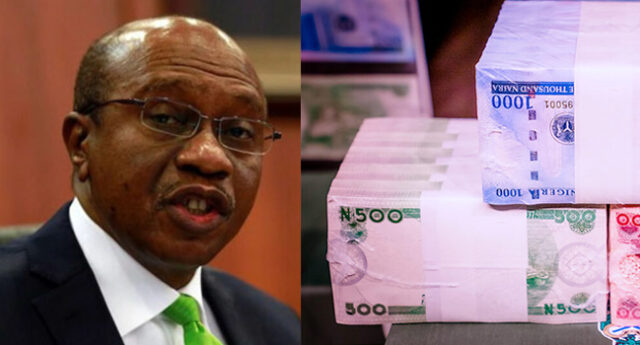
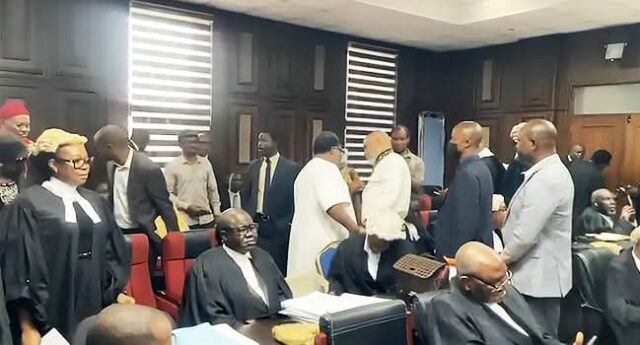
The seventh prosecution witness in the Economic and Financial Crimes Commission (EFCC) trial, Chinelo Eneanya, has told a Federal Capital Territory (FCT) High Court that the naira redesign policy introduced by the Central Bank of Nigeria (CBN) under former governor Godwin Emefiele caused severe hardship for Nigerians.

Eneanya, an EFCC investigator involved in probing the alleged unlawful redesign exercise, told the court that video evidence presented in court highlighted widespread public frustration, as many Nigerians struggled to meet daily needs and sustain their businesses during the cash crunch.

Led by prosecuting counsel Rotimi Oyedepo (SAN), Eneanya said his team examined a range of evidence, including documents, electronic records, and audiovisual materials, to assess the policy’s impact.

“We looked at the documentary, electronic, and audiovisual evidence of the effect of the naira redesign on the public,” Eneanya stated.

The court admitted multiple exhibits tendered by the prosecution, including documents, video recordings, certificates of identification, certified copies of delivery notes, and notices of meetings.

Six video clips from four national television stations were played, alongside bills of settlement relating to redesigned naira notes for 2022 and 2023.

Defence counsel Olalekan Ojo (SAN) did not object to their admission.

Eneanya added that the investigation revealed that members of the CBN Board and Committee of Governors only became aware of the president’s approval after the redesign exercise had already been implemented.

“In the course of the investigation, we sought to determine how the laws on changes to naira policy were applied or possibly abused,” the witness said.

When Eneanya attempted to comment on the Supreme Court’s ruling regarding the redesign, Ojo objected, arguing that a witness cannot testify on a public document he did not author. Justice Maryanne Anenih overruled the objection, noting that the testimony concerned giving evidence on a document, not merely submitting it.

Eneanya confirmed that Emefiele was interviewed during the investigation and that his extra-judicial statements to EFCC investigators were admitted as evidence.

The witness also said the former CBN governor was questioned on whether the Board of Governors approved the naira redesign.

Justice Anenih adjourned the proceedings to November 26, following a request from the defence for additional time to cross-examine the witness.

Google search engine

Osun Poll: I’m Too Popular To Lose Election, Not Afraid Of Federal Might – Gov Adeleke


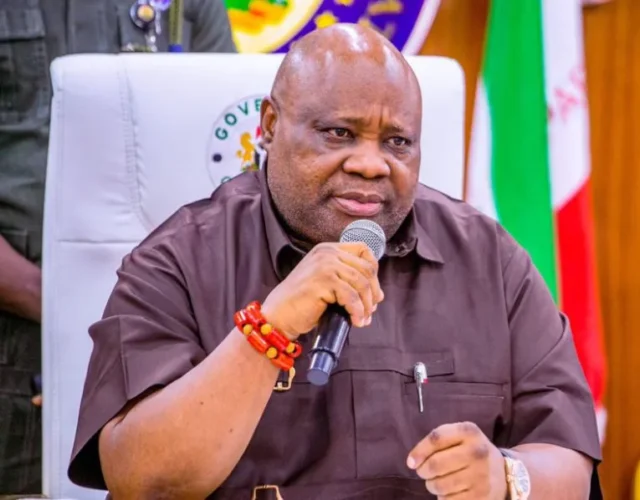
Osun State Governor, Ademola Adeleke, has expressed confidence in winning the August 8, 2026, governorship election, asserting that his performance and popularity will ensure his re-election.

Speaking with journalists on Thursday after his screening at the National Campaign Organisation Committee (NCOC) Secretariat in Maitama, Abuja, Adeleke said he had delivered “wonderfully well” in office and believed the people of Osun would reward him with a second term.

The governor, who was cleared by the Peoples Democratic Party (PDP) leadership at the party’s Legacy House in Abuja ahead of the 2026 primaries, highlighted his achievements as a key factor in his popularity.

“It is because I have performed wonderfully well. There is something called fact-checking; as journalists, you should fact-check, and you will discover that I have done so well. My people are happy with me, and that is why they want me to continue,” he said.

When asked if he feared the influence of the ruling All Progressives Congress (APC) and what is often referred to as ‘federal might,’ Adeleke dismissed such concerns, stressing that his popularity would secure his victory.

“I am very popular. Everywhere you go, you hear people call me Imole, say Imole! So, I am not afraid of federal might. The President knows my election comes before the general elections, and he will not want to mess anything up,” the governor stated confidently.

Meanwhile, the Independent National Electoral Commission (INEC) has cautioned political parties in Osun State against breaching electoral laws ahead of their primaries. Resident Electoral Commissioner (REC) Dr. Mutiu Agboke delivered the warning at a stakeholders’ meeting held at the Olusegun Agbaje Media Centre, Osogbo.

Agboke reminded parties that, according to the election timetable, primaries must take place between November 24 and December 15, 2025, in compliance with Section 84 of the Electoral Act, 2022, which mandates democratic nomination of candidates.

“We appeal to political parties in the state to allow internal democracy to guide their conduct. Free and fair elections begin with how parties conduct their primaries. A rancour-free process will not only reduce pre-election litigations but also strengthen the party’s unity and the legitimacy of candidates,” Agboke said.

He further emphasized that campaigning has not yet begun, warning that any premature political activity would constitute a violation of the law.

Google search engine

#JusticeForOchanya: Senator Natasha Offers Support To Family Of Late Teen


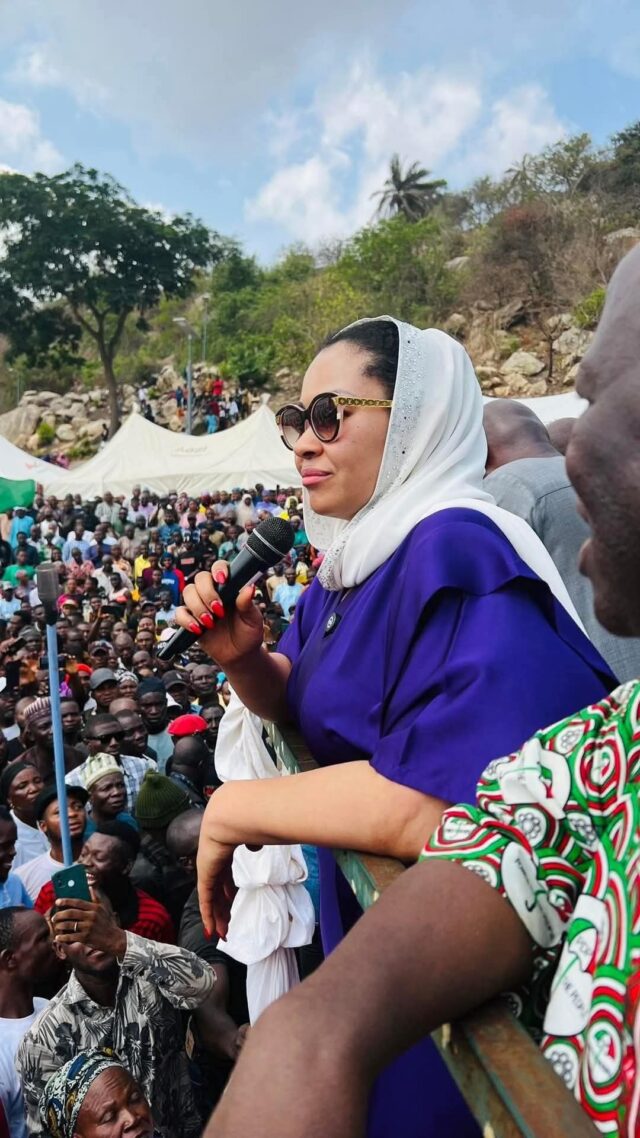
Senator Natasha Akpoti-Uduaghan, representing Kogi Central, has expressed deep concern over the tragic case of Ochanya Elizabeth Ogbanje, the 13-year-old girl who died in 2018 after reportedly suffering years of sexual abuse.

In an Instagram post, the senator revealed her heartbreak upon learning that the accused in the case had been discharged and acquitted.

She called on Ochanya’s family to submit a formal petition to her office at the National Assembly to help pursue justice.

“Years ago, the heart-wrenching story of little Ochanya devastated me. I thought the perpetrators were in jail. Alas, they were discharged and acquitted,” she wrote.

“The family of late Ochanya Ogbanje should write a petition to me: Senator Natasha Akpoti-Uduaghan, Room 2:05 Senate Wing, National Assembly Complex, Abuja. For our children, I stand for justice for Ochanya.”

Ochanya’s case remains one of the most prominent instances of child sexual abuse in Nigeria.

Reports indicate she lived with Andrew Ogbuja, a lecturer at Benue State Polytechnic, and his wife Felicia Ochiga-Ogbuja, while attending school.

According to eyewitness accounts and a video recorded by Ochanya before her death, she was allegedly sexually abused for five years by Mr. Ogbuja and his son, Victor Ogbuja.

In October 2018, Ochanya died from complications associated with Vesicovagina Fistula (vvf), a severe condition often resulting from sexual violence or prolonged childbirth that causes continuous urinary leakage.

Her death triggered nationwide outrage and fueled the social media movement #JusticeForOchanya, demanding accountability and stronger protections for minors.

However, in April 2022, the Benue State High Court in Makurdi acquitted Mr. Andrew Ogbuja of raping and causing the death of Ochanya.

On the same day, a Federal High Court in Makurdi convicted his wife, Mrs. Felicia Ochiga-Ogbuja, for neglect, sentencing her to five months in prison without the option of a fine for failing to protect the child.

The acquittal of Mr. Ogbuja reignited public anger and frustration, with many Nigerians taking to social media to revive the #JusticeForOchanya campaign.

Senator Akpoti-Uduaghan’s intervention has added another voice to the growing call for renewed legal attention to the case.

Known for her advocacy for women’s and children’s rights, the senator reaffirmed her commitment to protecting vulnerable children and ensuring justice is served.

Google search engine

Sean ‘Diddy’ Combs Transferred To Federal Prison To Serve Jail Sentence

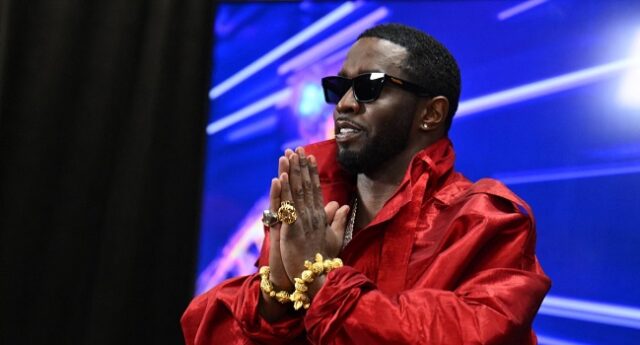
(FILES) US producer-musician Sean "Diddy" Combs gestures in the press room during the MTV Video Music Awards at the Prudential Center in Newark, New Jersey, on September 12, 2023. - Combs -- the rap mogul whose star has plunged after a wave of sex trafficking and assault lawsuits against him -- was arrested in Manhattan late on September 16, 2024, multiple US news outlets reported. The 54-year-old's arrest follows a grand jury indictment and the charges are not immediately clear, The New York Times said, citing a person familiar with the indictment. (Photo by ANGELA WEISS / AFP)


US hip-hop icon Sean “Diddy” Combs has been moved to a federal prison in New Jersey to serve a jail term of four years and two months for prostitution-related offenses, according to the Federal Bureau of Prisons.

Combs is now being held at the low-security Fort Dix facility, located roughly 130 kilometers (80 miles) south of New York, which is also known for its drug treatment programs.

His lawyers had requested the transfer, where he is expected to remain until May 8, 2028.

Arrested in September 2024, Combs was convicted in July 2025 of two counts of transporting people across state lines for prostitution, but a jury acquitted him of the more serious charges of sex trafficking and racketeering.

Before the judge delivered his sentence, Combs addressed the court, tearfully saying he was “truly sorry” for his actions.

He also apologized to his family and victims, describing his behavior as “disgusting, shameful and sick.”

Combs has appealed both his conviction and his sentence, which includes credit for the time he has already served in a notorious Brooklyn lockup.

Google search engine

Nnamdi Kanu Files Fresh Motion, Seeks Dismissal Of All Charges


The detained leader of the Indigenous People of Biafra (IPOB), Mazi Nnamdi Kanu, has filed a fresh motion at the Federal High Court in Abuja, requesting the dismissal of all charges against him and his immediate release.

The motion, dated October 30, 2025, and titled “Motion on Notice and Written Address in Support,” asserts that there is no valid charge against him under any existing Nigerian law.

Kanu described the charges before the court as “a nullity ab initio for want of any extant legal foundation.”

Representing himself, the IPOB leader filed the motion under Sections 1(3), 6(6)(b), and 36(12) of the 1999 Constitution, the Evidence Act 2011, and the Terrorism (Prevention and Prohibition) Act 2022.

He argued that the prosecution relied on repealed and non-existent laws, including the Customs and Excise Management Act (CEMA), repealed by the Nigeria Customs Service Act 2023, and the Terrorism Prevention (Amendment) Act 2013, repealed by the TPPA 2022.

Kanu said that reliance on such repealed statutes violates Section 36(12) of the Constitution, which “prohibits trial for an offence not defined under an existing law.”

He therefore asked the court to “strike out the charges in their entirety, insisting they do not constitute any offence known to law.”

Citing the Supreme Court decision in FRN v. Kanu (SC/CR/1361/2022), he maintained that lower courts are bound to take judicial notice of repealed laws under Section 122 of the Evidence Act 2011, adding that failure to do so renders all proceedings void.”

Kanu also argued that some of the alleged offences were committed in Kenya, which he said violates Section 76(1)(d)(iii) of the TPPA 2022, requiring validation by a Kenyan court before such acts can be tried in Nigeria.

He contended that “this omission nullifies the court’s extraterritorial jurisdiction and breaches Article 7(2) of the African Charter on Human and Peoples’ Rights.”

He further stressed that under Sections 1(3) and 36(12) of the Constitution, any law or judicial act inconsistent with the Constitution is void.

Kanu cited previous cases, including Aoko v. Fagbemi (1961) 1 All NLR 400 and FRN v. Ifegwu (2003) 15 NWLR (Pt 842) 113, where convictions based on non-existent laws were nullified.

The IPOB leader urged the court to “direct the prosecution to respond to his motion strictly on points of law within three days and to deliver a ruling on or before November 4, 2025.”

He added that “his application raises only constitutional and legal questions derived from existing laws and therefore does not require an affidavit.”

Google search engine

BREAKING: Court Stops PDP National Convention Over Breach Of Rules, Dismisses Preliminary Objections


The Federal High Court in Abuja has stopped the Peoples Democratic Party (PDP) from holding its planned national convention in Ibadan, Oyo State, scheduled for November 15–16.

The ruling, delivered by Justice James Omotosho, followed a case filed by three aggrieved party members who argued that the PDP failed to comply with legal and party requirements.

The court found that the party did not adhere to the provisions of the 1999 Constitution (as amended), the guidelines of the Independent National Electoral Commission (INEC), or its own constitution.

Specifically, the PDP was said to have failed in conducting valid state congresses before moving to hold the national convention to elect officers.

Justice Omotosho ordered the PDP to rectify these procedural lapses and ensure that a statutory 21-day notice is given before any future convention.

The plaintiffs in the suit (FHC/ABJ/CS/2120/2025) are: Hon. Austin Nwachukwu, Imo PDP Chairman, Hon. Amah Abraham Nnanna, Abia PDP Chairman and Turnah Alabh George, PDP Secretary, South-South

The defendants include the Independent National Electoral Commission (INEC), PDP, National Secretary Senator Samuel Anyanwu, National Organising Secretary Umar Baturrle, and national officers Ali Odefa and Emmanuel Ogidi, as well as the National Working Committee (NWC) and National Executive Committee (NEC) of the party.

The court also dismissed preliminary objections filed by the defendants, who had argued that the matter was an internal party affair and outside the court’s jurisdiction.

Details shortly…

Google search engine

Court Orders Remand Of Lawyer, Four Others For Cyberbullying Senator Umar


Justice Rita Offili Ajumogobia of the Federal High Court, Abuja, has ordered that lawyer Ahmed Abdulrahman and four others be remanded at the Force Criminal Investigation Department (FCID), Area 10, Abuja, until November 10.

This follows their arraignment on charges of cyberbullying Senator Shehu Baba Umar.

The defendants, Ahmed Abdulrahman, Daure David, Ishaq Abubakar Muhammed, Abdulrashid Abdullahi Musa, and Nasiru Usman Abubakar, were charged by the Inspector General of Police (IGP) on an 11-count charge including cyberbullying, advance fee fraud, and extortion.

When the charges were read, all five defendants pleaded not guilty.

Counsel for the prosecution, Victor Okoye, requested a trial date and urged that the defendants be remanded at Kuje Prison, Abuja.

Abdulrahman’s lawyer, Affis Matanmi, applied for bail, highlighting that his client is a Supreme Court legal practitioner and would not interfere with the investigation or witnesses.

He also noted that the police had previously granted Abdulrahman administrative bail, which he did not violate.

However, the prosecution opposed bail, arguing that the lawyer had allegedly engaged in additional cyberbullying cases and played a major role in five of the eleven charges.

Okoye emphasized that no legal practitioner should receive special treatment under the law for criminal offenses.

After considering both sides, Justice Ajumogobia ordered the defendants to remain at the Force CID until November 10, allowing Abdulrahman’s lawyer time to file a further affidavit and reply to the prosecution’s counter-affidavit.

In count one, the defendants were accused of conspiring to commit cyberstalking against Senator Umar in 2025, contrary to Section 27(1)(b) and punishable under Section 21(1)(b) of the Cybercrimes (Prohibition, Prevention, etc.) Act 2015 (as amended 2024).

In count three, Abdulrahman allegedly sent a video via his TikTok handle “Kibanna Channel” and YouTube to defame the senator by linking him to sponsorship of banditry.

The act was said to be intended to cause fear and disrupt law and order, violating Section 24(1)(5) of the same Act.

Daure David was accused of attempting to extort N5 million from Senator Umar under the pretense that the money would be used to pay protesters.

Senator Umar, Chairman of the Senate Committee on National Security and Intelligence, had earlier commended security agencies for arresting those behind a coordinated defamatory campaign targeting him.

He urged Nigerians to remain peaceful, verify information before sharing, and focus on societal issues.

“I have always stood for peace and the welfare of our people. I deny these baseless allegations and will continue to work for Bauchi South,” the senator stated.

Google search engine

Why I Invited Akpabio, Others To My Project Inauguration – Senator Natasha


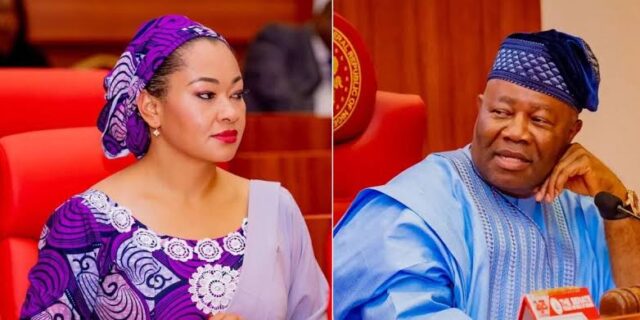
Kogi Central Senator, Natasha Akpoti-Uduaghan, has clarified why she invited Senate President Godswill Akpabio and other senators to the inauguration of her constituency projects marking her second year in office, amid speculation about a tense relationship with Senate leadership.

She described the invitation as a customary and procedural practice, noting that such notifications are standard protocol for events involving the National Assembly.

During Thursday’s plenary session, Senate President Akpabio read out Akpoti-Uduaghan’s letter, which formally invited senators to Kogi State for the project inauguration.

The letter stated:
“In marking my second anniversary as a serving senator of the Federal Republic of Nigeria, I wish to invite fellow distinguished senators to join me for the inauguration of projects in Kogi State.”

Akpoti-Uduaghan explained:
“As is customary for announcements of this nature, I submitted the invitation through the presiding officer for the Senate President to read on the floor. I didn’t want it to appear as if I were celebrating in isolation. I am committed to progress and, even with ongoing court matters, I continue to fulfill my duties diligently, following all proper procedures. That notification was part of the process.”

Reflecting on her tenure, she added that six months of her service were lost due to what she described as an “illegal suspension.”

“Some months ago, there was an attempt to declare my seat vacant, but God intervened. Today, we are celebrating two years in office with the inauguration of multiple projects,” she said.

Akpoti-Uduaghan outlined the projects, which include water facilities, streetlights, transformers, police quarters, new primary and secondary schools, and two new markets across Kogi Central Senatorial District.

The senator also announced that the inauguration events would culminate in a mega empowerment program on November 2, during which around 2,000 beneficiaries will receive items such as electric vehicles, deep freezers, gas cookers, sewing machines, shoemaking kits, fishery ponds, and farming tools.

She added:
“We are starting the inaugurations today in Ganaja, Lokoja, with a water project, then moving to Adogo and Jakuta for streetlight projects before concluding in Ihima.”

Expressing gratitude to God and her constituents, Akpoti-Uduaghan said she remains committed to delivering quality representation:

“Even though I lost six months of my tenure, I ensured my constituents did not miss out on the benefits of representation. I worked extra hard to bring the dividends of democracy to them, and I thank God for the courage to continue serving.”

Google search engine

Reforming Enugu’s Tax System: Setting The Record Straight Being A Rejoinder To Rev. Fr. Lawrence Eze’s Article

By Deacon Malachy Chuma Ochie, Ph.D

I read with keen interest the recent article by Rev. Fr. Lawrence Eze titled “Laundering the Tax Image of Enugu Government” in response to an earlier article published by Dr. Justice Chidi.

Rev. Fr. Eze’s piece was an emotive piece, driven, I assume, by a deep concern for the welfare of Enugu citizens.

However, while the Reverend Father’s compassion is undeniable, his arguments rest more on perceptions rather than on verifiable facts.

The result is a passionate but skewed interpretation of Governor Peter Mbah’s tax reforms, which deserve a more objective and contextual understanding.

The first thing to be said is that taxation, by its nature, is never a pleasant subject. No society welcomes taxes with open arms.

Yet, taxation remains the life-blood of every government that genuinely intends to deliver services, develop infrastructure, and uplift its citizens.

The real issue, therefore, is not whether taxes should exist, but whether they are fair, transparent, and properly utilized.

That is precisely where the Mbah administration has charted a new and commendable course.

Before the present government took office, Enugu State’s tax ecosystem was chaotic.

It was characterized by multiple taxation, inefficiency, and the reign of touts and middlemen who extorted traders, artisans, and transporters in the name of revenue collection.

Many citizens were forced to pay levies that never entered government coffers.

The Mbah administration confronted this anomaly by introducing a digital tax system that unified and automated all payment processes. The goal was not to increase taxes but to clean up the system, eliminate leakages, and bring sanity to revenue administration.

It is important to clarify that Governor Mbah has not introduced any new tax regime. What he has done is to enforce existing tax laws more efficiently through digitalization.

The narrative of “new and suffocating taxes” is therefore misleading. The much-talked-about “₦8 million housing tax” is not a general levy on landlords or struggling homeowners as alleged. It applies only to specific high-value developments within designated urban zones and serves as a form of development charge.

In fact, the governor personally directed a 50% downward review of the charge in response to public concerns.

This demonstrates sensitivity to citizens’ needs, not insensitivity.

Fr. Eze’s portrayal of a government bent on squeezing the poor through taxation also misses the broader economic context. Nigeria is going through a difficult macroeconomic phase following subsidy removal and exchange rate liberalization.

These are federal policies whose ripple effects have been felt in all states, Enugu inclusive. To attribute every instance of hardship to state taxes is to misunderstand basic economics.

Inflation, high transport fares, and declining purchasing power are national challenges, not Enugu-specific outcomes of taxation.

Ironically, it is through tax revenue that the Enugu government is able to mitigate some of these federal-induced pains.

The recent upward review of the minimum wage to ₦70,000, the digital skills empowerment for youths, the palliative interventions for transporters and SMEs; all of these initiatives are being funded through internally generated revenue. Without a disciplined tax framework, none of these people-oriented measures would be sustainable.

The notion that government should continually provide services without collecting taxes is economically unrealistic.

What the Mbah administration is building is a culture of fiscal responsibility where every citizen contributes fairly to the development of the state.

It is also a model that promotes equity, where the wealthy pay more and the less privileged are protected.

Market women, for instance, who were once harassed by touts and fake tax agents, now pay their levies directly to the state’s account through digital platforms, often at reduced rates. Property taxes are progressive, not punitive. They target high-value estates and commercial structures, not low-income homes.

Rev. Eze’s critique of the “smart” infrastructure projects such as the Smart Schools and Smart Parks also calls for perspective. These are not vanity projects, as he suggests.

They are part of a deliberate modernization agenda that seeks to position Enugu as a 21st-century economy driven by innovation, technology, and efficiency.

The Smart Schools are designed to transform education by integrating digital learning, science, and vocational training, thereby preparing Enugu’s children for the knowledge economy.

The Smart Parks aim to revolutionize transport infrastructure, enhance urban aesthetics, and create long-term revenue streams for the state.

The argument that such projects do not immediately put food on the table misses the developmental logic of capital investment.

No modern economy grows by handouts alone; it grows through infrastructure that stimulates productivity, attracts investors, and creates jobs.

In fact, the engagement of credible private partners in the Smart Schools project reflects a global best practice in public-private partnerships (PPP).

It is also unfair to dismiss Dr. Justice Chidi’s explanations as “image laundering.” Public enlightenment is an essential component of democratic governance.

Citizens have a right to know how their taxes are used, and government has a duty to explain. There is nothing wrong with articulate advocates explaining reforms and countering misinformation. It becomes worrisome only when such discourse is met with cynicism rather than constructive engagement.

Governor Mbah’s fiscal reforms are anchored on transparency, accountability, and inclusiveness. Enugu State now publishes quarterly budget performance reports, conducts citizen budget sessions, and operates an open access portal for revenue data.

These are not the hallmarks of an opaque administration. Indeed, BudgIT’s 2024 Subnational Transparency Index ranked Enugu among the top five most transparent states in Nigeria. This level of openness should inspire confidence, not suspicion.

At the heart of Mbah’s fiscal vision is economic independence. The governor’s ambition is to grow Enugu’s internally generated revenue to a point where the state can fund its development without over-dependence on federal allocations.

This is what drives the reforms that some have mistaken for insensitivity. The hard truth is that without expanding the tax base and ensuring fiscal discipline, no state can deliver sustainable infrastructure or social welfare.

In assessing any government’s fiscal policy, one must look beyond the noise of the moment to the long-term benefits.

What Governor Mbah is doing is laying the foundation for a financially resilient Enugu State; one capable of building its own future. The pain of reform is temporary; the prosperity it produces is lasting.

Rev. Fr. Eze’s concerns for the poor are noble and shared by many. But the solution is not to halt reforms or demonize taxation.

The solution lies in ensuring that taxes are fair, well-managed, and used for the people’s benefit. That, indeed, is what the Mbah administration is doing.

To call these efforts “image laundering” is to miss the real picture. The real story of Enugu today is that of a government finally bringing order to fiscal chaos, replacing arbitrariness with transparency, and investing the people’s money back into the people’s lives.

It is a story of a state moving from consumption to production, from dependency to sustainability.

Governor Peter Mbah’s tax reforms are not anti-people; they are pro-development. They represent a bold attempt to align Enugu with the fiscal realities of the 21st century.

Those who see only hardship should look again and see the foundation of future prosperity being laid.

Google search engine

Court Sacks Rep Member For Dumping His Party For APC, Orders INEC To Conduct Fresh Election Immediately


The Federal High Court in Abuja has removed Hon. Abubakar Suleiman Gummi, member representing Gummi/Bukkuyum Federal Constituency of Zamfara State, from the House of Representatives for defecting from the Peoples Democratic Party (PDP) to the All Progressives Congress (APC).

Delivering judgment in suit FHC/ABJ/CS/1803/2024, Justice Obiora Egwuatu ruled that Gummi’s defection violated Section 68(1)(g) of the 1999 Constitution (as amended), which mandates elected lawmakers to forfeit their seats if they leave the party on whose platform they were elected, except in cases of a proven division within that party.

The court held that Gummi failed to provide credible evidence of any division within the PDP, dismissing his claim that internal crises at the national and constituency levels forced his defection.

Justice Egwuatu consequently ordered Gummi to vacate his seat immediately and restrained the Speaker of the House of Representatives, Rt. Hon. Tajudeen Abbas, from further recognizing him as a member.

The Independent National Electoral Commission (INEC) was directed to conduct a fresh election within 30 days to fill the vacant seat.

In a strongly worded rebuke, the judge condemned what he described as the “growing culture of political prostitution” among Nigerian politicians.

“It is legally and morally wrong for a politician to abandon the party under which platform he or she was elected and move to a rival party without relinquishing the mandate of the electorates,” Justice Egwuatu stated.

“A politician has no right to transfer the votes of a political party to another. The law must punish such moves by taking away the benefits bestowed upon the decampee politician.”

The court further ordered Gummi to refund all salaries, allowances, and benefits he received from October 30, 2024, to the date of judgment. Proof of the refund must be filed with the court within 30 days.

Additionally, the court awarded ₦500,000 in costs against Gummi, the Speaker, and INEC in favour of the PDP.

The case was filed by the PDP and its Zamfara State Chairman, Jamilu Jibomagayaki, represented by Ibrahim Bawa, SAN.

The judgment has been hailed as a significant affirmation that the electoral mandate belongs to the political party and not the individual, and a clear warning to future defectors.

Google search engine

MOST COMMENTED

- Advertisement -
Google search engine