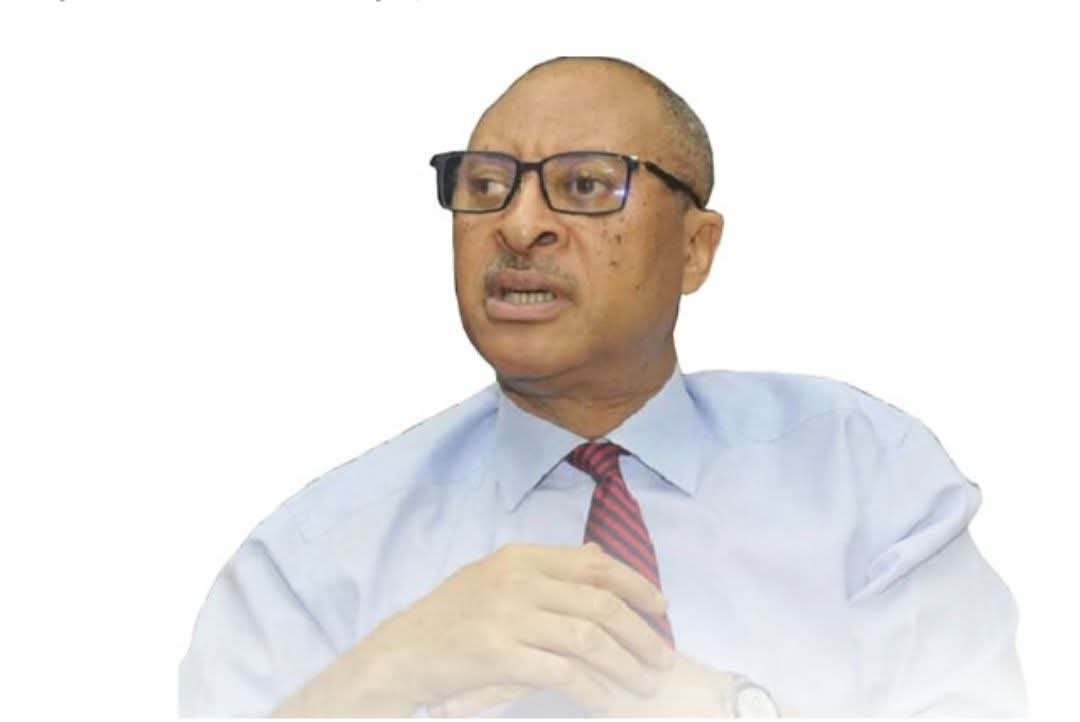

Prominent political economist and activist, Professor Pat Utomi, has unveiled a “shadow government” under the Big Tent Coalition, aimed at offering alternative governance models and holding the Bola Tinubu administration accountable.
Speaking during a virtual launch on Monday, Utomi described the coalition as a response to Nigeria’s governance crisis.
He said the shadow government, composed of technocrats and opposition figures, would engage the public with policy alternatives and ideas for reform.
“Today, I bring to this pioneer body the desperate cries of a people troubled by how their reality seems bound for serfdom,” Utomi declared.
“I challenge you to awaken these people who wrongly believe that everything is fine as long as they can manage a share of what little still trickles down from crude oil sales.”
However, the Federal Government swiftly dismissed the move, calling it unconstitutional. Minister of Information and National Orientation, Mohammed Idris, stated in an interview:
“At a time when our nation is set to celebrate 26 unbroken years of presidential democracy, the idea of a so-called ‘shadow government’ is an aberration.”
He argued that Nigeria is not a parliamentary system, adding: “There is no provision for such in our statute books… While opposition politics is a central feature of democracy, it must be practised at all times within the bounds of propriety.”
“This idea of a shadow government sadly does not pass that test. Our bicameral legislature amply features members of the opposition, and it should be the right place to contest meaningful ideas for nation-building,” he added.
Utomi, defending the coalition, attributed rising poverty, insecurity, and the flight of multinational firms to the current government’s missteps.
“The recent spate of defections to the All Progressives Congress provides further evidence that all is not well with democracy in Nigeria,” he said.
He warned that opposition silence could aid in subverting democracy.
“The imperative is that if a genuine opposition does not courageously identify the performance failures of incumbents, offer options, and influence culture in a counter direction, it will be complicit in subverting the will of the people,” he said.
Utomi emphasized the coalition’s urgency, referring to it as a response to a national emergency.
He said the shadow cabinet will hold weekly meetings to evaluate government policies and recommend viable alternatives.
Priority areas include security decentralization, constitutional reforms, economic strategy, education, healthcare, and infrastructure.
“This shadow team must also address issues of ethics, transparency, and integrity, which continue to challenge this government at every turn,” he asserted.
Utomi criticized the government’s handling of the economy, noting the exodus of multinational companies.
“Nothing is more urgent than tackling the rising poverty across the country. Multinationals are shutting down, and millions are unemployed. Just two recent company exits illustrate how poorly thought-out policies have tanked the economy,” he explained.
He likened the government’s communications strategy to propaganda, warning against authoritarian tendencies.
“The resort to propaganda as a tool of governing, by the party in power, makes rational discussion of the decisions of the APC government difficult, moving us more towards fascist conditions,” Utomi said.
Referencing history, he added: “Like Joseph Goebbels inoculated Germans to Hitler’s deadly path, a massive shower of propaganda insults seeks to prevent patriots from factually critiquing policy choices of the government, and the behaviour of its agents, which can have more negative consequences on our well-being.”
He also faulted the removal of fuel subsidy, saying it was mishandled.
“Making propaganda of most leaders being in agreement on removing the petroleum subsidy was to cover up policy errors of how to remove it without further structural damage to the economy,” he said.
“The sequencing of actions could have produced different outcomes than driving the people into penury.”
Utomi challenged his cabinet to craft implementable economic strategies: “Don’t worry if they steal your ideas and use them—the gain is for Nigeria,” he urged.
On insecurity, he said parts of Benue and Plateau have been abandoned due to terrorist attacks, with little visible state response.
“The threat to peace and the effect of uncertainty on economic activity make this such an important issue more appropriate for emergency measures than that which led to the unconstitutional ousting of Rivers state Governor Sim Fubara,” he said.
Advocating community policing, he added: “Policing for me is a local function. We will travel further if we get the communities to have their own armed and well-trained police forces, which will be layered State police and the Federal National Guard.”
He warned that “the corruption ‘benefit’ of centralisation is fanning rationalisation of centralisation.”
He also criticised the political class for focusing more on elections than governance. “So much seems rooted in politics and positioning for elections that service to the people seems to be a forgotten proposition,” Utomi said.
“This shadow team must emphasise returning to the people and enabling their pursuit of happiness. That is the purpose of the government.”
He also stressed the importance of ethical governance: “This shadow team also has to deal with matters of ethics, transparency and integrity that seem to challenge this government at every turn,” he said.
Utomi pointed to issues such as the Lagos-Calabar contract as examples of state capture and corruption.
“The policy team of the new tribe has a detailed analysis… They can provide you with quality input,” he said.
“I note also with great pain the pervasive state of corruption in current reality. All effort to showcase integrity and transparency as value must be made,” he concluded.
Among the members appointed to the shadow cabinet are human rights lawyer Dele Farotimi (Ombudsman and Good Governance), Cheta Nwanze, Oghene Momoh, Halima Ahmed, Obi Ajuga, Dr. Adefolusade Adebayo, Dr. Otive Igbuzor, Prof. Ukachukwu Awuzie, Aisha Yusuf, and many others drawn from across sectors and political affiliations.