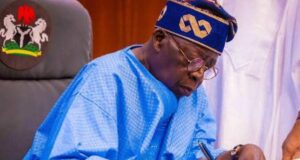
Governor Uba Sani of Kaduna State has identified poverty and economic exclusion as the primary drivers of insecurity in northern Nigeria, warning that unless these issues are addressed comprehensively, the region will continue to face unrest.
Speaking on Channels Television’s Sunday Politics programme, Sani, who shared his personal experience, stated, “I came from the trenches. I fought successive governments in the past, during the military era. I went to detention a few times, fighting for justice and equality.”
He emphasized that his administration began with a data-driven approach to tackle poverty and underdevelopment in the region.
Drawing from his experience as the former chairman of the Senate Committee on Banking, Sani revealed that upon taking office, he focused on the poverty index in the North, stating: “When I came in as governor, what I did was to look at the poverty index, not only in the state but of the entire North.”
“I was the chairman of the Committee on Banking. I had the data, the statistics from the Development Department of the Central Bank, from the SDG. I can tell you, sitting here, the poverty index as of 2023, when we came in, was alarming.”
According to Sani, between 60% to 65% of people in northern Nigeria, particularly in the North-West, were financially excluded, which made many young people vulnerable to recruitment by armed groups.
He explained, “This problem of insecurity, I can tell you, is largely an economic issue, poverty, unemployment. That is the reason why our people can easily be recruited by these bandits.”
Sani also addressed the challenge of out-of-school children in the region, revealing that over 350,000 children were out of school when he assumed office.
He noted that the North is largely responsible for the country’s high number of out-of-school children, with the figure currently standing at 18.2 million, 70% of which are from the North.
He said, “Two months ago, I sat down with the Vice President of the World Bank. We looked at the UNICEF statistics. I can tell you, out of the 18.2 million out-of-school children today, the North is responsible for about 70% of that number.”
“There are improvements in taking out-of-school children; the figure is different, and we are addressing the problem gradually.”
However, Sani cautioned that solving these issues would require a long-term commitment and realistic expectations, acknowledging that the crisis had been ignored for years.
“Things are getting better, but nobody can tell you we can address this problem even in the next ten years, and I will tell you why.”
“Because I’m a very realistic person. This problem didn’t start two years ago. It started many years back because we were docile. We did not approach the issue holistically.”
The governor stressed the need for northern leaders to unite in addressing the core issues of poverty and unemployment, saying, “The North needs to sit down and face this reality if we want to bring back the glory of our zone. But I am happy that everyone, from the ministers to the senators, House of Representatives members, and governors, we are all on the same page for the first time.”
He emphasized that a purely military or reactive approach would not suffice to address the region’s insecurity.
Instead, he called for tackling the root causes, such as economic disparity between urban and rural areas.
“We cannot win insecurity through a kinetic approach, nor through giving people palliatives. We must look at the drivers and symptoms.”
“We have to address the gap in terms of economic prosperity between our people in urban areas and those in rural communities.”
Sani also pointed out that infrastructure, education, and healthcare deficits significantly contribute to the region’s poverty.
He added, “When you look at some areas in the North-West, you’d agree that there is a lot of poverty. We have a lot of deficits in terms of infrastructure, education, healthcare, and many other basic issues.”
On the issue of local security, Sani stated that there had been noticeable improvements in Kaduna State.
He noted, “Most of the crises we used to have were farmer-herder and religious crises. In the last two years, we have not experienced any. It’s not eradicated, but it has reduced tremendously.”
However, he emphasized that citizens’ trust in the government would only be restored if there is justice and fairness.
“People will only believe in the government when there is justice and fairness. We are not saying that things are not really bad, but there is progress,” Sani concluded.