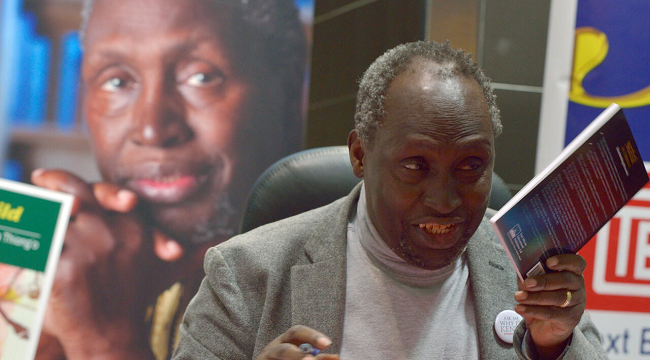

Celebrated Kenyan author and academic Ngugi wa Thiong’o, widely regarded as one of East Africa’s greatest literary minds, has passed away at the age of 87.
His daughter, Wanjiku wa Ngugi, confirmed the news in a heartfelt announcement on Facebook early Wednesday.
“It is with a heavy heart that we announce the passing of our dad, Ngugi wa Thiong’o this Wednesday morning,” she wrote.
“He lived a full life, fought a good fight,” she added.
News of his passing quickly drew tributes from across Kenya and beyond, honoring a man whose work defined post-colonial African literature and resistance.
Opposition leader Martha Karua took to X (formerly Twitter) to express her condolences.
“My condolences to the family and friends professor Ngugi wa Thiong’o, a renowned literary giant and scholar, a son of the soil and great patriot whose footprints are indelible,” she posted.
Ngugi’s influence extended far beyond literature.
In 1977, his politically charged play “Ngaahika Ndeenda” (“I Will Marry When I Want”) was deemed too provocative by authorities.
He was jailed without charge soon after its premiere, a move that drew international condemnation.
Amnesty International designated him a prisoner of conscience, and a global campaign ultimately led to his release from Kamiti Maximum Security Prison in December 1978.
“Thank you Mwalimu (teacher) for your freedom writing,” the Kenya branch of Amnesty International wrote on X.
“Having already earned his place in Kenyan history, he transitions from mortality to immortality.”
Following a government crackdown on theatre groups in 1982, Ngugi went into self-imposed exile, first in Britain and later in the United States.
There, he continued to write and teach, championing African languages and identity through his academic and literary work.
In 1986, he published one of his most influential books, “Decolonising the Mind”, a collection of essays that examined the power of language in shaping post-colonial identity and nationhood.
Ngugi wa Thiong’o’s legacy as a fierce advocate for linguistic and cultural decolonization continues to resonate in literary and political spheres alike.
His life and works remain a testament to the enduring power of words in the fight for justice and cultural pride.