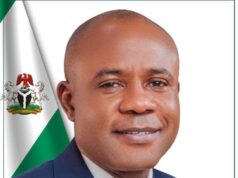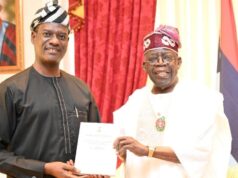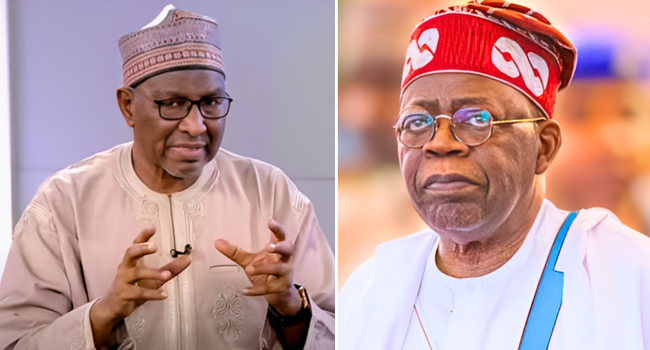

Political activist and former lawmaker Usman Bugaje has sharply criticized President Bola Tinubu, accusing him of being detached from the everyday struggles of Nigerians due to the influence of close aides who, he says, are shielding him from the country’s harsh realities.
Bugaje made the remarks during a special Democracy Day programme aired by Channels Television on Thursday, titled ‘Nigeria’s Democratic Journey: An Inter-Generational Conversation on Building a Better Nation’, marking 26 years of unbroken democratic rule.
Joining other prominent Nigerians, including former Ekiti State governor Kayode Fayemi, ex-minister Frank Nweke, social entrepreneur Toyosi Akerele-Ogunsiji, and Jamiu Abiola, son of the late MKO Abiola, Bugaje did not hold back in his critique of the current administration.
“It looks like the President has been completely encircled by sycophants.”
“They don’t allow him to see the realities, they don’t tell him the truth. But if he knew what was happening in society, he would be ashamed of himself. As far as I know him, I never thought he would allow this situation,” Bugaje said.
He went on to add:
“He is now there, wallowing in the comfort of the Villa, talking in ways that show he doesn’t even know what is happening in this country. If he knew, he would not be doing the kind of things he’s doing now.”
Bugaje lamented that the Tinubu-led administration is prioritizing image and rhetoric over substance, at a time when Nigerians are yearning for tangible change.
He criticized the disconnect between political speeches and the harsh economic conditions faced by citizens.
“We have now graduated from just listening to speeches that are meant to be politically correct and sound good.”
“What we are interested in is not the speech, but the action, the policies, the way the government is run. That is what will change the lives of the ordinary people,” he said.
Bugaje stressed that democracy, at its core, is meant to serve the people.
However, in Nigeria’s current reality, he argued, this principle has been lost.
“Democracy is about people, designed to serve the people. The real question is: are the people being served?”
“The political economy we are running now is impoverishing the people,” he said.
Turning his attention to the deepening insecurity and economic woes affecting millions, Bugaje cited real-life scenarios of suffering and hardship that, in his view, expose the government’s failure to live up to its constitutional responsibilities.
“What do you say to people whose relatives have been taken by bandits? They’ve sold everything just to get them back, now they have no land to farm, no house to live in, no money to start any business. It’s as if we don’t have a government,” he said.
“Ask the young man who has struggled through university, waiting five to ten years for a job that doesn’t exist. Ask the small business owners how they’re surviving,electricity bills are soaring, there’s no power, no profit.”
“Look at the man driving a keke NAPEP — he can’t even make ends meet. What kind of economy is this? What kind of democracy?”
Bugaje argued that the government has lost its moral and constitutional right to call itself democratic if it cannot deliver on its primary duty: the welfare and security of its citizens.
“If a democracy cannot provide for the people, it has lost its moral and constitutional credibility.”
“The purpose of government, as clearly stated in the constitution, is to provide for the security and welfare of the people. Where is the security? Where is the welfare? Where is the comfort?”
Citing economic data, he painted a bleak picture of Nigeria’s current state.
“Per capita income is now 877 dollars, the worst since 1960,” he said.
“Isn’t it a disgrace? A badge of dishonour to the politicians in government who brought us to this level and are still talking about democracy. We have to go back to the fundamentals. There’s a total disconnect between those ruling and the realities in society.”