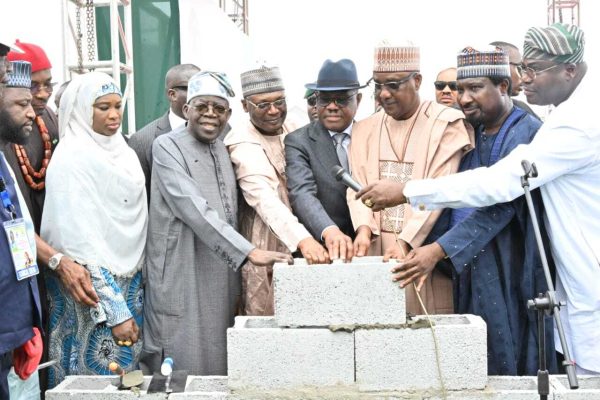

President Bola Ahmed Tinubu on Tuesday officially launched the construction of a new annex for the National Headquarters of the Independent National Electoral Commission (INEC) in Abuja.
The groundbreaking ceremony, held in Maitama District of the Federal Capital Territory (FCT), marks what the President described as a significant step toward bolstering Nigeria’s democratic infrastructure.
In his address, Tinubu emphasized the broader implications of the project, stating that it transcends mere physical development.
“Today’s ceremony is not merely about brick and mortar, it is about the strength of our democracy, the independence of our institutions, and the future of our electoral integrity,” he said.
“INEC has been and remains the backbone of Nigeria’s democratic journey.”
The President underscored the critical role INEC plays in shaping the nation’s democratic landscape, noting its central role in delivering credible elections and empowering citizens to actively participate in governance.
“Its role in conducting free, fair, and credible elections is central to the roles our people play in their government and in our democratic process,” Tinubu noted.
“For this reason, it is only right that such a pivotal institution is housed in a structure that reflects the dignity, responsibility, and national significance of that institution.”
He added that the new annex will not only offer a conducive workspace for electoral operations but also serve as a hub for innovation and transparency in election management.
“The new headquarters is a clear signal of our unwavering support for INEC’s autonomy, capacity, and growth,” he said.
“It will provide not just a conducive home, but a hub for innovation, planning, training, and transparency in electoral administration.”
The ceremony drew the attendance of key political figures and stakeholders, including FCT Minister Nyesom Wike; Speaker of the House of Representatives, Hon. Tajudeen Abbas; Deputy Senate President, Senator Barau Jibrin; Deputy Speaker, Hon. Benjamin Kalu; Minister of State for FCT, Dr. Mariya Mahmoud; and INEC Chairman, Prof. Mahmood Yakubu.
Tinubu praised the leadership and personnel of INEC for their resilience and dedication to electoral reform. He also commended Minister Wike for facilitating the project’s approval.
“We are committed to ensuring that INEC is fully equipped, not only in infrastructure, but in law, policy, and resources, to carry out its constitutional mandate with courage, fairness, and excellence,” the President affirmed.
Responding to concerns surrounding the project’s approval process, Wike clarified that the initiative was not unilaterally authorized by the Federal Capital Development Authority (FCDA), but rather ratified by the Federal Executive Council (FEC) in March 2025.
He assured the President that the building would be completed before the end of the current administration in 2027, stating that the project is one of many aimed at revitalizing Nigeria’s public institutions.
INEC Chairman Prof. Mahmood Yakubu expressed deep appreciation for the new development, which he described as a milestone in a nearly decade-long campaign to address the commission’s growing spatial needs.
Yakubu recounted how the current INEC headquarters, built in 1997, was designed for only eight commission members, 10 departments, and 500 staff, figures that have since more than doubled.
“After almost 10 years of persistent effort, the construction of the INEC Annex Building is finally a reality,” he said.
He explained that INEC now operates with 13 commissioners, 22 departments, and over 1,000 personnel, severely straining the existing facility.
The new annex, he revealed, will accommodate offices, conference rooms, a 1,000-seat auditorium, and state-of-the-art IT spaces including the Election Monitoring and Support Centre (EMSC).
“As the end user of the facility, our technical department submitted the concept of the proposed building, which is what the FCT is currently executing,” Yakubu stated.
“We made provision for offices, meeting rooms, conference rooms, a 1,000-seat auditorium and offices for some of our IT-based facilities such as the Election Monitoring and Support Centre (EMSC).”
He added that the building will also feature a museum chronicling Nigeria’s electoral history, providing students and citizens a tangible connection to the country’s democratic evolution.
“Beyond these facilities, the building plan has provision for a museum to serve as a repository for the physical and digital history of elections and electoral activities in Nigeria,” Yakubu said.
“This will afford citizens, particularly students, who regularly visit the commission on excursion, the opportunity to appreciate the evolution of our electoral history, as is the case in many jurisdictions around the world.”
While the new facility will serve as an annex, the current headquarters will remain INEC’s official central office.
The construction marks the third major intervention by FCDA in INEC’s infrastructure since the agency’s relocation from Lagos to Abuja in 1991.