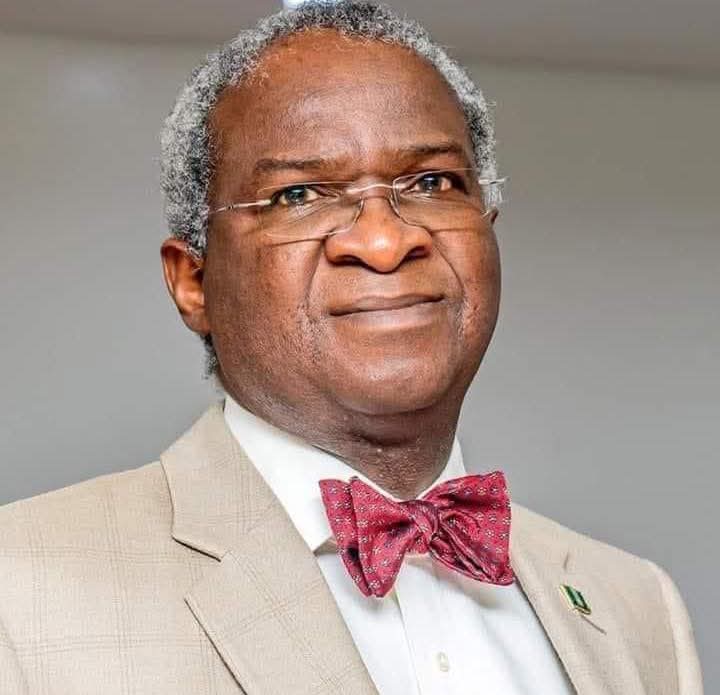

As debates over local government autonomy continue across Nigeria, former Lagos State Governor Babatunde Fashola has argued that expecting full autonomy for local councils under the present Constitution is unrealistic.
Speaking on Sunrise, a Channels Television programme aired on Saturday, Fashola, who also served as Minister of Power, Works and Housing, pointed out that the influence of state governments and state assemblies over local councils undermines the very concept of autonomy.
“I think that the debate we must have, debate we must have, is whether we really want autonomous local governments. It’s a debate that must be had. As it stands today, it is unrealistic to expect autonomy for local governments created by the Constitution,” he said.
Fashola explained that since state Houses of Assembly are empowered to make laws for local governments, this automatically imposes an external influence, contrary to the core idea of self-governance.
“They were not meant to be autonomous; that is my view after a very close reading of certain provisions of the Constitution. Some of those provisions provide, for example, that the local government in its economic activities and all of that will have laws made for it by the state House of Assembly.
“If you look at the legal and ordinary meaning of the word, autonomy, it suggests that you are acting independently without any outside influence and authority, and to that extent, a state House of Assembly making laws for what and how a local government can function is in itself an external influence that contradicts the idea of autonomy.”
He also identified land control as a practical constraint, noting that most responsibilities assigned to local councils, such as managing abattoirs, cemeteries, schools, and healthcare centres, require land, which is under the authority of state governments.
“The next thing, of course, is to look in the Fourth Schedule of the constitution and look at all of the responsibilities that are assigned to local governments… all of those responsibilities are dependent on one item, land.
“And to the extent that the state government controls land, which affects how the local governments will carry out these functions, I didn’t think that autonomy was intended. Now, if we decide that we want autonomous local governments, those are some of the things we have to free up if that is our decision.”
He added: “So we must have an agreement, but as it stands, I don’t think that autonomy was intended. What I think was intended was some sort of collaboration, some sort of supervision, some sort of an oversight of the state over the local government, and that is inherent in what you will find in Section 162, which deals with the state’s joint local government account.”
Fashola further explained that poor fiscal responsibility by many local councils in the early years of democracy led to the introduction of the state–local government joint account.
“And there’s history behind the enactment of that section because up till 1999, the local governments used to collect their money directly from the Federation account under a process that I think was known as JAAC, Joint Accounts and allocation or something.”
“But in the advent of the democratic era, it was found out that there were so many of them, or not a few of them, who had defaulted in the very basic obligation of paying staff salaries, primary healthcare workers, primary school teachers, salaries and pensions, and there was a backlog of debt, and I met some of that debt when I became Governor and we were working there.”
“And I think that is partly the history behind the creation of the state joint local government account to ensure that there was some supervision. Whether the supervisors have now become as culpable as those they were supervising is another narrative entirely.”
On the recent Supreme Court ruling which granted financial autonomy to local governments and barred governors from dissolving democratically elected councils, Fashola noted the mixed legal opinions on its constitutionality.
“No patriot would say that all was well with the state of local governments in Nigeria,” he said.
Still, he acknowledged that conducting local government elections was a step in the right direction towards improving their independence.
“The conduct of council elections was a good step towards making local governments independent.”