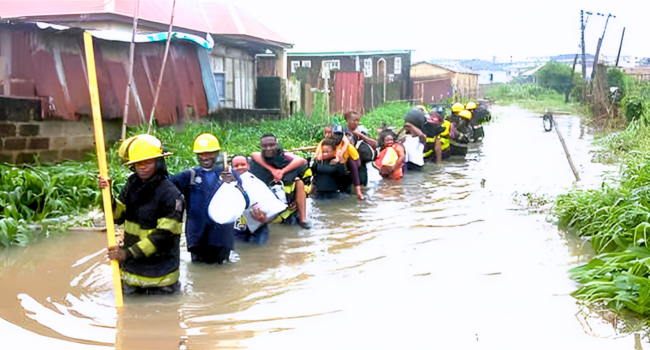

The Federal Government has issued a warning of heavy rains expected to last five days, potentially causing floods in 19 states and 76 locations.
The alert, released Tuesday by the National Flood Early Warning Systems Centre under the Ministry of Environment, urged residents and stakeholders to take urgent precautions.
The warning follows severe flooding that hit Ogun and Gombe states on Tuesday, with Lagos, Plateau, Anambra, and Delta states also affected.
According to the flood prediction shared with reporters, flooding is anticipated from August 5 to 9, 2025, in states including Akwa Ibom (Edor, Eket, Ikom, Oron, Upenekang), Bauchi (Tafawa-Balewa, Azare, Jama’are, Kari, Misau, Jama’a), Ebonyi (Abakaliki, Echara, Ezilo), Cross River (Ogoja, Edor, Obubra), Nasarawa (Keana, Keffi, Wamba), Benue (Agaku, Buruku, Gboko, Igumale, Ito, Katsina-Ala, Ugba, Vande-Ikya), Kaduna (Jaji, Kafancha, Birnin-Gwari, Zaria), and Katsina (Bindawa, Bakori, Daura, Funtua). Other affected areas include Kebbi, Kano, Niger, Plateau, Taraba, Jigawa, Yobe, Zamfara, Sokoto, Borno, and Gombe.
Flooding has become a yearly challenge in Nigeria, resulting in loss of lives and property.
Last year, floods affected 31 states, killed hundreds, injured thousands, and displaced over a million people.
A dam collapse in Borno State last September led to over 150 deaths and displaced 419,000 people, submerging 70% of the local community.
This year, flooding has already caused devastation. The deadliest flood occurred in May in Mokwa, Niger State, killing about 200 people and displacing thousands.
Torrential rains and dam failures were blamed. Rivers State also experienced floods and landslides in Okrika, where at least 25 people died.
In April, Kwara State saw at least 13 deaths after flooding from water released at the Jebba Hydroelectric Power Station, destroying rice fields and affecting 30 communities.
The National Economic Council has approved funds to support flood mitigation across Nigeria, including N3 billion for each of the 36 states and the FCT, as well as allocations to federal ministries and NEMA.
NEMA’s recent report reveals that this year’s floods have claimed 191 lives with 94 missing, mostly in Niger State (163 deaths) and Adamawa (26 deaths).
Floods have affected 134,435 people across 20 states, displaced 48,056, injured 239, and damaged thousands of houses and farmlands. Women and children have been the hardest hit.
Parts of Ogun and Gombe states were hit by floods on Tuesday after heavy overnight rains.
At Redemption City, along the Lagos-Ibadan Expressway in Mowe, Ogun, residents, schoolchildren, and church members attending the Redeemed Christian Church of God’s annual convention were trapped as floodwaters submerged the area.
In Estate 15, many vehicles were submerged. Residents abandoned their cars and used canoes to move around temporarily.
RCCG officials deployed Type D school buses to help evacuate people.
A resident named Tunde said, “I was trapped inside the RCCG camp this (Tuesday) morning and couldn’t leave for work until a special luxurious bus provided by the church came to pick me and others.”
Flooding also disrupted activities in the OPIC area of Ogun, destroying property.
In Gombe State, the Executive Secretary of the State Emergency Management Agency, Haruna Abdullahi, reported at least four deaths due to floods, windstorms, and rainfall.
He explained that “about 278 households comprising individuals and farmlands were affected,” mainly in Kwami, Dukku, Billiri, Gombe, Yalmatu-Deba, and Akko Local Government Areas.
Abdullahi said, “We received report of four dead persons, two from Gombe Local Government Area, one from Dukku and another in Kwami LG.
About 278 households were affected mostly windstorm and flooding of farmlands, and some houses. Mostly the deaths were caused by cracked walls.”
Heavy rains caused widespread flooding in Lagos starting Monday night.
Floodwaters overwhelmed drainage systems, inundating neighborhoods such as Ijede in Ikorodu, Lekki, Surulere, Agege, Ajegunle, Alimosho, and Eti-Osa. Videos showed families wading through waist-deep water.
A woman in Oko Ope cried out in Yoruba for government help, saying, “The water is everywhere. We can’t even go inside. We’ve lost everything.”
Market traders abandoned stalls, and commuters were stranded for hours. Social media hashtags #LagosFlood and #IjedeTragedy trended as residents shared images of the devastation.
Despite promises, poor urban planning and blocked drainage have made Lagos vulnerable to seasonal flooding.
In Delta State, residents in Sapele and Oko communities began relocating after flooding.
The Commissioner for Environment, Jamani Ejiro, visited and sympathized with victims, assuring prompt government response.
Ejiro announced six fully-equipped IDP camps across flood-prone areas in Kwale, Ozoro, Patani, Bomadi, Uto-Jeremi, and Asaba, designed to provide shelter and support.
He said, “Our goal is to ensure that lives are not lost due to preventable causes. When the need arises, we will evacuate affected residents to these designated camps.”
In Kebbi State, a downpour in Diggi town displaced many, flooding homes within minutes.
The state government mobilized food, bedding, and medical supplies. Community leaders urged keeping drainages clear and appealed for aid.
In Bauchi, flooding destroyed 13 houses in Bagel community, Dass LGA. Yusuf Makama, media aide to the Dass LGA chairman, said the chairman “appealed to the state and federal governments, as well as NGOs, to come to the aid of the victims.”
A violent storm in Plateau’s Shimankar District destroyed homes, schools, and a worship center. Resident Lawrence Longwalk said, “We’ve been hit seriously. Our homes, schools, and places of worship were all destroyed.”
Another resident, Mrs. Akwe Hannatu, added, “We lost everything. Our home was destroyed, and we have nowhere to go.” The state emergency agency has been notified but relief has yet to arrive.
In Imo State, NEMA confirmed that 27 villages in Oguta LGA and 7 in Ohaji/Egbema LGA, as well as flash floods in Owerri West LGA, have caused residents to relocate temporarily.
Farmer Amanze Okoro said, “We had no choice. Our farm and house were completely taken over by water.”
Rivers State continues to experience flash floods in Port Harcourt and Obio/Akpor LGAs. Environmental rights activist Dr. Fyneface Dumnamene urged the government to declare a state of emergency.
He said, “Flash floods are now a regular occurrence. What we need is emergency drainage clearing, community sensitisation, and immediate government action. We can’t stop the rain, but we can prevent the suffering.”
In Katsina, the government designated schools as temporary shelters. Binta Hussaini Dangane, SEMA Executive Secretary, said emergency committees across 34 LGAs are trained to respond.
“The government has procured food and non-food items, while awareness campaigns are ongoing,” she said, urging residents to avoid dumping refuse in waterways.
Bayelsa’s flood control efforts, such as desilting and culvert reconstruction, have helped prevent severe flooding despite heavy rains.
Chief Walson Omusu, head of the Bayelsa Flood and Erosion Control Directorate, said the state remains “ready and proactive.”
In Sokoto, SEMA and NEMA are jointly assessing flood damage across Yabo, Shagari, and Tureta LGAs, where many have been displaced.
Tureta LGA Chairman Aliyu Abubakar blamed poor drainage for the disaster. Temporary shelters have been set up, and officials promised ongoing collaboration.
Despite flood warnings, Kano State has not seen significant flooding, but residents near dams have been advised to stay alert.
Nasarawa State also reported no flooding but launched sensitization campaigns and prepared shelters.
Kaduna and Benue states remain on alert but have not reported floods.
Edo State has yet to see major flooding, but areas near River Niger, like Udaba Odemokpa, remain vulnerable. In Benin City, traders complain about blocked drainage disrupting business in flood-prone areas such as Tomline along Lagos Road.