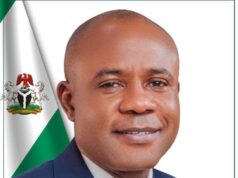

Bolaji Abdullahi, former Minister of Youth and Sports, ex-APC spokesman, and now the National Publicity Secretary of the African Democratic Congress (ADC), has stated that the ADC isn’t a so-called “third force” ahead of the 2027 general elections but the primary opposition party capable of challenging the APC-led government.
In an interview monitored by DAILY GAZETTE, Abdullahi clarified the party’s positioning, structure, internal processes and plans to select a presidential candidate, stressing that the ADC is offering Nigerians a credible alternative and building a lasting political tradition.
Responding to analysts calling the ADC a potential third force, Abdullahi dismissed the term outright.
“Which one is the first force and which is the second force? And why do you say ADC is the third force? We don’t see ourselves as a third force. We see ourselves as the only viable opposition party in Nigeria. So it’s either you are in APC, the ruling party, or you are in ADC, the opposition party.”
He argued that such political categorisations are outdated, especially given the current dynamics.
“When you are talking about a third force, how will you categorise the Labour Party and SDP? They are also forces, right? But the majority of PDP members today are in ADC from former Vice President Atiku Abubakar to Chief Dele Momodu, among others, who are more or less foundational members of the PDP. They have realised that the PDP ship has sunk and they know that the only option left for Nigerians today is the ADC.”
To Abdullahi, ADC represents more than just another political group.
“ADC is not just a political party, it’s a movement of the people.”
Abdullahi acknowledged that comparisons are often made between the formation of APC in 2015 and the growing coalition under ADC. However, he highlighted a fundamental difference.
“People try to draw a parallel between what happened in 2014-2015, that is the APC, and the emergence of ADC now. But no, that would be like comparing apples and oranges, they are not the same.”
He explained that while APC was a merger of parties like ACN, CPC, ANPP and others, the ADC is uniting individual politicians who want to rescue Nigeria from the risk of one-party dominance.
“What you find this time is not a merger of political parties, what you find is a coalition of politicians under the umbrella of ADC. What has brought this coalition is the desperate desire to save Nigeria from what is clearly becoming a descent into a one-party state.”
Addressing speculation about who will fly the ADC flag in 2027 especially names like Peter Obi and Atiku Abubakar, Abdullahi said the process will be transparent and inclusive.
“Peter Obi has not said if he is not a candidate, then this coalition will end. No, same for Atiku. Obi has been part of this coalition from day one. And these are the exact things that we want to correct as a party. The leadership of ADC will not do anybody any favour. We don’t have any preconceived agenda. ADC does not have a candidate in mind.”
He emphasized that the party will pursue consensus where possible, but if necessary, a competitive primary will be held.
“ADC is not going to twist the system to favour anybody, because we want to hold our party together. We are going to take care to make sure that everything is done transparently in a way that gives confidence to everybody. And there are two options. If we are able to engineer a consensus, that is fine. If not able to engineer a consensus, then we’ll go to the field and the party will back whoever emerges.”
“But to say you will now say to somebody, don’t contest, because we want to give it to somebody, that’s the PDP way, that’s not the ADC way.”
On the issue of political structure, critics argue that ADC lacks presence across all states. Abdullahi rejected that notion.
“If they say ADC has no structure, that means it’s inconsequential, politically speaking, and it does not pose any threat to anybody. So, why are they worried that we are poaching members? Is it not a contradiction?”
He explained that structures come from people, not just physical presence.
“Structure is the people on ground even if a person has like 20 people following him, that is structure, even if it’s just his family. All of them vote in one polling unit or the other. What other structure are you talking about?”
Still, he admitted the party has a long road ahead.
“We are aware that we are a new party. We know we have a lot of work to do, and we are committed to doing it. We are trying to build a party that is not just trying to win the election in 2027, but a party that will endure for a very long time and become a tradition.”
Abdullahi addressed the lack of internal democracy that has plagued many Nigerian political parties and promised that ADC would be different.
“Nigerians have the right to be cynical because of the failure of the past. But what we are saying is that with the ADC, we are asking Nigerians, especially the youths, to have the courage to believe.”
He positioned the party as an opportunity for reform and credibility in Nigerian politics.
“Because every politician today knows that the political class entirely is discredited, there are many people who are also seeing this as an opportunity for redemption. Can we at least do something differently? Can we at least build a real political party? Where did these other parties get it wrong?”
He concluded by stressing the integrity of the ADC’s leadership and their commitment to enforcing discipline.
“The caliber of people in the leadership, yes, they have been around; you cannot impeach their integrity. Whether it’s the national chairman or the national secretary, you may disagree with them, you can say that you don’t like them, but you cannot say these are corrupt people.”
“The way and manner we are going about this is to set a new standard for Nigerian politics and to set a rule that everybody will abide by. To build a political party that is capable of disciplining its own membership, not the other way round.”