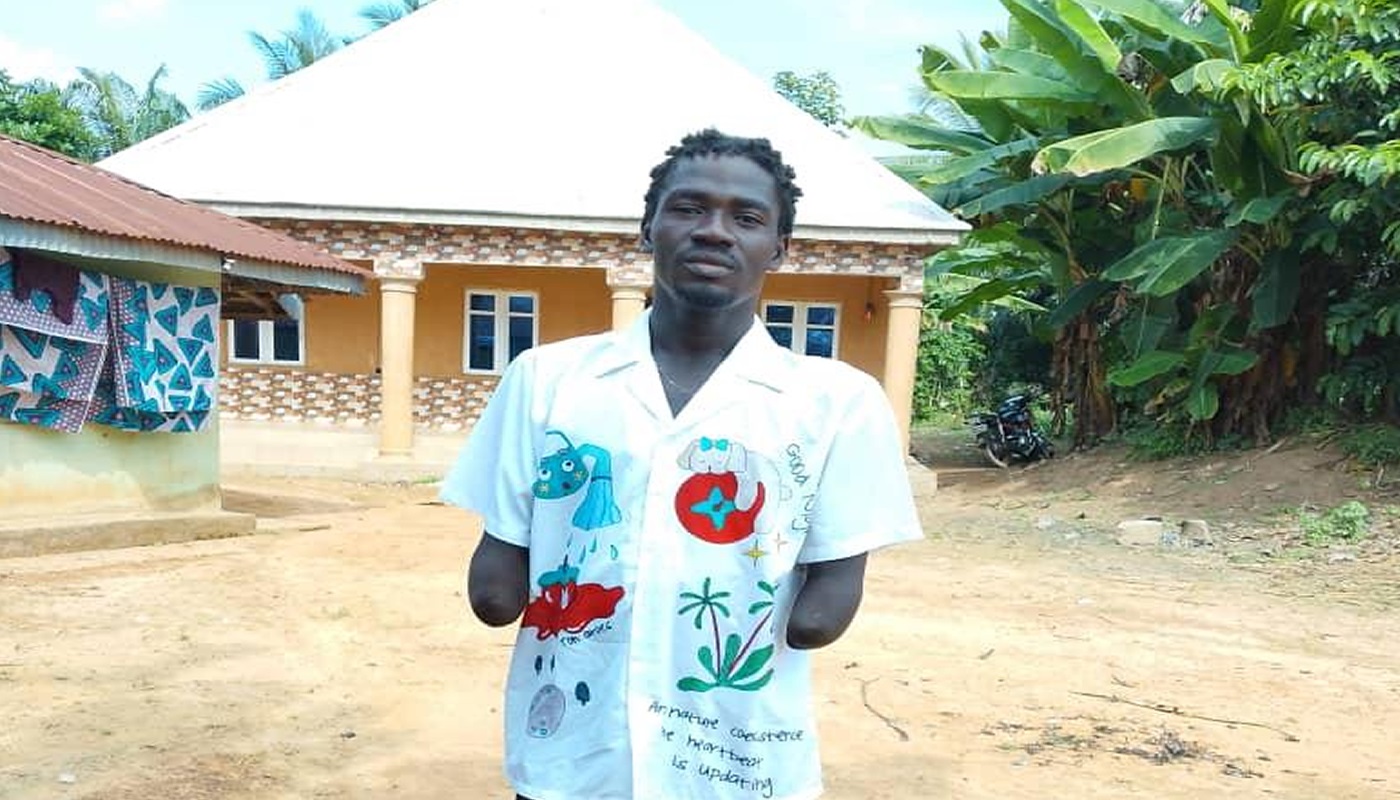

David Simon, a native of Onicha Igboeze in Onicha Local Government Area of Ebonyi State, has shared the painful story of how he lost both arms as a teenager in 2014 while trying to help a friend salvage his shop from demolition.
Now 29 years old, Simon recalled that he was just 18 when the tragic incident occurred at Apo Mechanical Village in Abuja, where he was working as a general apprentice learning how to repair Peugeot vehicles.
According to him, the shop in question, owned by a spare parts dealer, was marked for demolition alongside others.
“I lost my two arms in February 2014 while trying to assist somebody to save his shop from being demolished because the shop was among those that were marked for demolition at Apo Mechanical Village in Abuja,” he explained.
“The shop owner asked me to bring a metal pole from outside to the entrance. While trying to raise it from my right-hand side to a secure side at my left, without knowing that there was a high-tension wire above us, the pole touched the high-tension wire, and it caused me a lot of damage. I was shocked by electricity and had severe burns on my hands and legs.”
Simon was rushed to multiple medical centres before finally being treated at the Asokoro General Hospital in Abuja, where he underwent two surgeries.
Unfortunately, one of his arms became severely damaged and blackened, prompting doctors to recommend amputation.
“The doctor said there was no other option than to amputate the affected parts, and my arms had to be cut off,” he said.
However, his family was reluctant and sought a traditional alternative.
“We were discharged from the hospital and got admitted to a traditional centre where herbs and roots are used for treatment. I stayed there for only one day and some hours before the hand became more infected,” he recounted.
The worsening condition led to a referral to the National Orthopaedic Hospital in Enugu, where both arms were amputated.
Despite the trauma, Simon has managed to develop ways to carry out daily tasks independently.
“It’s not really easy, but I don’t allow it to bring me down,” he said.
“There are other methods I tried that failed, but I got the particular one that I’m now used to, even washing my clothes and shoes, bathing myself or picking up my bag.”
He explained that necessity pushed him to adapt.
“There were people who would volunteer to do it for me at that time. But they will not continue to do it for me… So, I had to start developing myself on my own.”
Simon says that living with a disability has exposed him to stigma and judgement.
“Losing my arms made me see life in a very different way. I got to know a certain kind of life or the behaviours of some other people in terms of discrimination and stigmatisation… It is sad that I faced all this.”
“Within the first year and a few months when it happened… I found it difficult going out because of the kind of looks I got from people. They stared at me differently as if I looked different,” he said
“Even when I go out now, there are some people who still see me and give me some kind of weird look.”
Simon said he draws strength from within.
“My motivation is myself and what I want to become in life. Knowing that this particular thing I want to do, if I call Mr A to help me do it, he or she may be in a good mood at that time… So, I motivate myself to do those things by myself before anyone else even tries to help me.”
Although he has learned to cope, certain challenges persist.
“There are some things I know that at my age, I am supposed to know how to do… but due to being conscious of my arms and not to cause more injuries or harm myself, I will be restricted.”
One of the most painful parts of his journey was the betrayal by the man he had tried to help.
“The man I went to help the other time, when the incident happened, later denied ever calling me to assist him,” Simon said.
“When he was asked what really happened, he denied ever calling me. He said he didn’t even know I was there. The whole issue became like a drama between him and my family members.”
“So, I had to send for him, and when he came, I asked him the same question as my dad, but he didn’t say a word and left.”
“Whenever I remember his action, sometimes I feel like if I had known or foreseen what would happen, I wouldn’t have been there in the first place.”
He also described how misinformation and assumptions about his condition continue to follow him.
“I don’t have the time to explain myself too much because no matter how many times I explain myself, I still get those comments,” he said.
“Sometimes on my TikTok page, whenever I post, I get comments like ‘Don’t help him o.’”
“Most people come up with negative words. I just leave them to their thoughts because I believe one day, they will realise that, truly, it wasn’t what they were thinking.”
Simon expressed interest in getting prosthetic arms but said financial limitations have been a barrier.
“I’m interested in getting prosthetics, but I don’t have the money to get them,” he said. “Some people I know call and make videos of me… promise, but they never fulfill.”
“Someone got my video from my TikTok page and posted it on his Facebook page… he didn’t post my account number; rather, he posted his.”
Currently, Simon runs a business selling cold pure water in bulk at a market that operates once every four days.
“After selling, I may realise a gain of N20,000 to N30,000, depending on the fuel consumption,” he explained.
“We don’t have electricity here, and I can’t afford solar lights at the moment.”