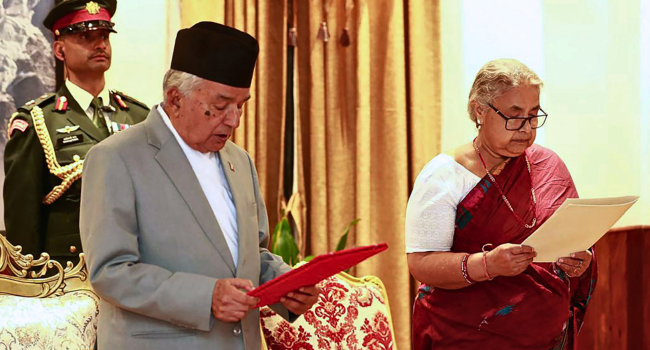

Nepal’s newly appointed interim Prime Minister, Sushila Karki, has pledged to serve a six-month transitional term, focusing on restoring stability, tackling corruption, and preparing the country for fresh elections.
The 73-year-old former Chief Justice took office on Friday, following weeks of intense youth-led protests that toppled the previous government.
In her first public address on Sunday, Karki made it clear that her administration would not exceed its six-month mandate.
“We will not remain in office beyond six months under any circumstance. Our duty is to stabilize the country and hand over to a new parliament and government,” she said in a televised speech to the nation.
Karki’s appointment follows the most violent unrest in Nepal since the end of its civil war and the abolition of the monarchy in 2008.
Protests began earlier this month after the government banned social media, quickly escalating into nationwide riots amid broader frustrations over corruption, unemployment, and economic stagnation.
On Tuesday, protesters set fire to government buildings in Singha Durbar, the heart of Nepal’s administrative complex.
On Sunday, Karki observed a minute’s silence for the 72 people killed during the protests. Over 190 others were injured, according to the government’s updated casualty figures.
“The situation that brought me here was not of my making. My name was called from the streets,” Karki said, acknowledging that she was nominated by the Gen Z protest movement, which organized much of its action via platforms like Discord.
Appointed through emergency negotiations led by Army Chief General Ashok Raj Sigdel and President Ram Chandra Paudel, Karki is widely viewed as a neutral and reform-minded figure.
Her selection was endorsed by both the military and representatives of the protest movement.
“We must govern with the mindset of the Gen Z generation,” Karki said.
“They demand an end to corruption, good governance, and economic opportunity and we are committed to delivering that.”
According to the World Bank, nearly 20% of Nepali youth aged 15-24 are unemployed, while GDP per capita remains low at $1,447.
These economic pressures have fuelled discontent among young citizens.
Nepal’s parliament has been dissolved, and new elections are scheduled for March 5, 2026.
In the meantime, the interim administration is expected to restore order, launch anti-corruption initiatives, and prepare the groundwork for credible democratic elections.
President Paudel praised the formation of the interim government as a peaceful resolution to a volatile crisis.
“This is a very difficult, complicated, and grave situation,” he said.
“But we have found a peaceful path forward, and I urge all citizens to ensure the success of the March 5 elections.”
Although the military presence on the streets has been reduced, Nepal still faces serious security challenges.
Over 12,500 inmates reportedly escaped from various prisons during the protests and remain at large, posing a continued threat to public safety.
The international community has reacted swiftly to Karki’s appointment. Both India and China, Nepal’s immediate neighbours, issued statements of support.
Indian Prime Minister Narendra Modi expressed hope for “peace, progress, and prosperity” in Nepal, while China’s foreign ministry emphasized strengthening bilateral relations.
Exiled Tibetan spiritual leader the Dalai Lama also sent his congratulations, wishing Karki “every success in fulfilling the hopes and aspirations of the people of Nepal in these challenging times.”