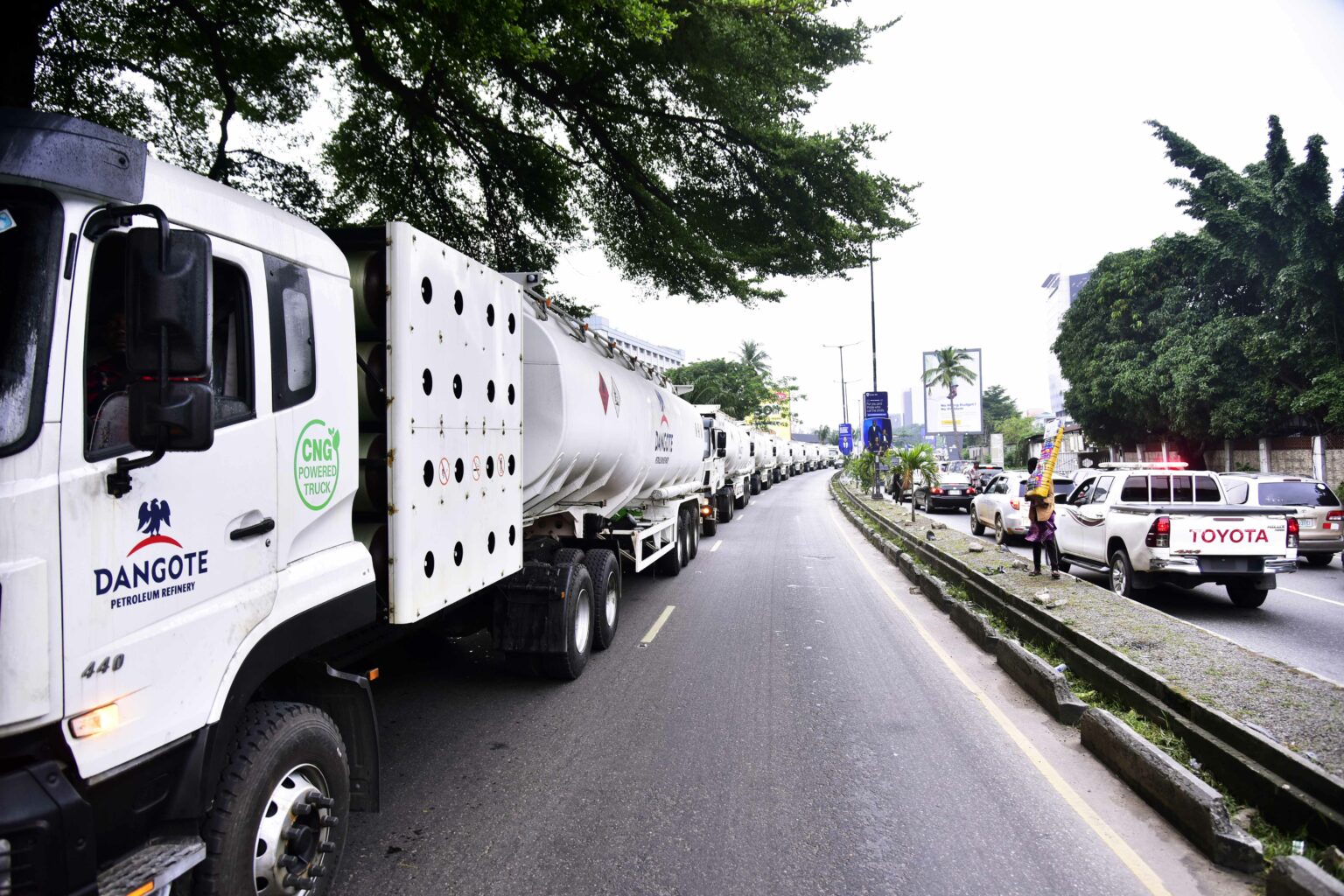

The Dangote Refinery has officially begun the deployment of its newly acquired fleet of Compressed Natural Gas (CNG) trucks, which on Monday commenced the loading of petroleum products at the Lagos facility for nationwide distribution.
The development marks a major step in Dangote Group’s strategy to handle its own fuel logistics through a 4,000-truck programme, valued at over ₦720 billion.
According to reports from the launch event, the first batch of CNG-powered trucks are now actively loading fuel from the refinery’s gantry for direct delivery to retail filling stations.
The refinery had earlier announced in August that it had taken delivery of the first set of trucks, with distribution initially scheduled to begin by August 15.
During a meeting with officials from the AfricaRice Centre on Sunday in Lagos, Aliko Dangote, Chairman of the Dangote Group, explained that the shift to direct fuel distribution was a deliberate and strategic decision to reduce reliance on third-party transporters and enhance efficiency in the supply chain.
“This is not just a business decision but a national imperative,” Dangote stated.
However, the move has not gone without criticism.
The Depot and Petroleum Products Marketers Association of Nigeria (DAPPMAN) recently accused the refinery of prioritising exports with lower pricing, while offering higher rates to local buyers.
The group also alleged that the refinery’s pricing model and direct distribution strategy could edge out existing players in the downstream sector.
They claimed that while the refinery supplies about 30–35% of the national demand, it does not offer free delivery to local off-takers and often bypasses marketers, a move they described as “unpatriotic” and monopolistic.
In response, the Dangote Group defended its operational choices, especially the decision to abandon the Single Point Mooring (SPM) fuel loading system.
According to the company, continuing with SPM would result in unnecessary expenses of ₦75 per litre, amounting to ₦1.5 trillion annually in avoidable handling charges.
“Relying on SPM to load 40 million litres of petrol and 15 million litres of diesel daily would impose a massive financial burden,” a company statement said.
Instead, the refinery will rely on gantry-based loading and its own CNG trucks, which the company argues will drastically reduce costs, ensure direct product delivery, and prevent market manipulation by intermediaries.
“Rather than losing ₦75 per litre to middlemen who may not guarantee delivery to consumers, we’re choosing transparency, efficiency, and affordability. These savings can be redirected to vital infrastructure projects,” Dangote added.
The company also reaffirmed its commitment to working with credible local distributors and expanding humanitarian efforts to ensure broad and equitable access to petroleum products.