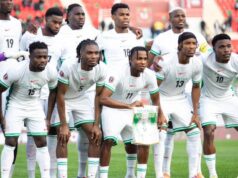

Nigeria’s Super Eagles have recorded a significant rise in the latest FIFA World Ranking, climbing to 26th position following their impressive performance at the 2025 Africa Cup of Nations in Morocco.
The ranking, released on Monday by world football’s governing body, reflects a 12-place jump from Nigeria’s previous position of 38th, alongside a points increase of 79.09. The leap underscores the team’s growing influence on the global football stage.
Nigeria’s upward movement was driven by a strong AFCON campaign that saw the Super Eagles finish third after defeating Egypt in the bronze medal match.
The team lost only one of their seven matches during the tournament, bowing out in the semi-finals after a penalty shootout defeat to host nation Morocco.
Under the guidance of head coach Eric Chelle, the Eagles displayed cohesion, tactical discipline and teamwork throughout the competition, earning praise from fans and analysts across the continent.
The latest FIFA rankings maintain familiar names at the top of the global chart, with Spain leading the pack, followed by Argentina, France, England and Brazil. Portugal, the Netherlands, Morocco, Belgium and Germany complete the top 10.
Within Africa, Morocco remains the highest-ranked nation, while Senegal, Nigeria, Algeria and Egypt round out the continent’s top five. Côte d’Ivoire, Cameroon, Tunisia, DR Congo and Mali complete Africa’s top 10.
Nigeria’s resurgence has not gone unnoticed at home. The Federal Government commended the Super Eagles for their resilience and fighting spirit, describing their AFCON performance as a reflection of discipline, unity and determination.
In a statement, the Minister of Information and National Orientation, Mohammed Idris, praised the team for inspiring Nigerians at home and abroad, urging the players to build on the experience and return stronger in future competitions.
The 2025 AFCON campaign has reinforced the Super Eagles’ status as one of Africa’s leading football nations and signalled a renewed confidence ahead of upcoming international challenges.