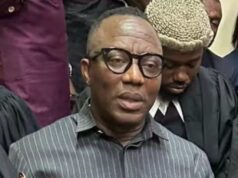

Prof. Ibrahim Gambari, former Chief of Staff to the late President Muhammadu Buhari, has detailed how certain influential figures in the former president’s circle covertly bypassed official channels to deliver memos directly to him.
Reflecting on his time at the Presidential Villa during a guest appearance on Inside Sources yesterday, Gambari explained that those in Buhari’s inner circle “knew his weak moment, they knew when to smuggle (memos) because they knew him as they interacted with him informally.”
When Gambari assumed the role of Chief of Staff on May 13, 2020, Buhari publicly made a clear directive: “All memos must go through the Chief of Staff before coming to him.”
He praised Vice President Yemi Osinbajo for adhering to this rule.
However, Gambari acknowledged that “our people still got their memos to him from behind because they knew his weak point and who to use and he never stopped them, but the advantage I had was that the memos came back to me.”
Gambari also spoke warmly of Buhari’s leadership style, noting that the octogenarian admired his appointees and was reluctant to dismiss members of the cabinet despite public pressure.
Commenting on the concept of a presidential cabal, Gambari said it is inherent to the office.
“They say there was a cabal, there was. Every government has a cabal. They may call them a kitchen cabinet; they may call them a think tank.” He explained that this unofficial advisory group allowed the president to “let their guard down to and talk to freely.”
He elaborated on Buhari’s inner advisory circle: “Some have more powers than others, but I’m bold to say that every government has a cabal of some kind or another, whatever name it is called. So, there was (a cabal under Buhari).”
Gambari also pointed to precedent in previous administrations: “(Former President Olusegun) Obasanjo had a group of people. The Aboyades of this world and others, a small group of people.”
Recalling his own experiences in government, he cited that even during the military era, unofficial advisors existed.
“I was a minister 1884–1985 but I wasn’t privy to why he was removed by his colleagues… but one of the reasons I’m told was the military people were resenting the fact that Head of State Buhari was now getting a lot of advice and second‑guessing the decision of his military colleagues.”
Born on December 17, 1942, Buhari held power as Nigeria’s head of state from January 1984 to August 1985, and later served two elected terms from 2015 to 2023.