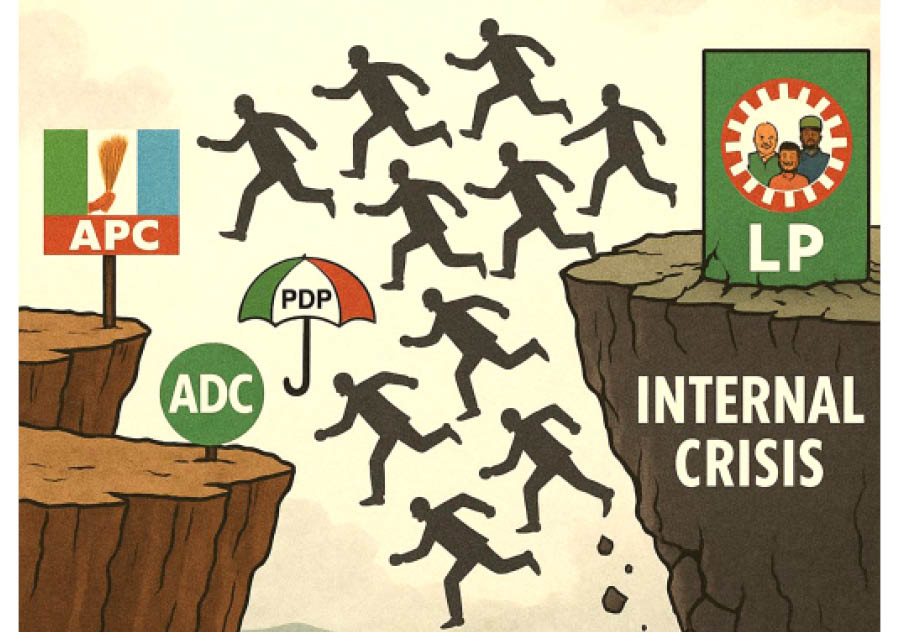

Within the past year, Nigeria’s Labour Party (LP) has witnessed a sharp decline in its ranks, losing at least 21 lawmakers across the Senate, House of Representatives and state assemblies.
This exodus comes amid escalating internal discord and structural weaknesses, raising doubts about the party’s trajectory ahead of the 2027 elections.
LP, once celebrated as a rising third force following the 2023 elections has endured a cascade of defections beginning in 2024.
Senator Ezenwa Francis Onyewuchi (Imo East) kicked off the first wave by joining the All Progressives Congress (APC) in July, soon followed by five House members from Imo, Kaduna, Cross River, Edo, and Plateau.
It didn’t stop there. Representative Dalyop Chollom (Plateau) resigned later the same year.
In Enugu, six State Assembly members including Ejike Eze, Johnson Ani and Princess Obiajulu Ugwu defected to the Peoples Democratic Party (PDP), citing “loss of faith in the party’s direction.”
By early 2025, more defections occurred. Representatives Dennis Agbo, Chidi Obetta, Sunday Umeha and state lawmaker Malachi‑Okey Onyechi all switched allegiances, along with FCT Senator Ireti Kingibe and Senator Neda Imasuen (Edo South).
Mid‑2025 saw two more resignations by federal legislators; Chimaobi Atu and Prof. Paul Nnamchi.
Observers attribute the defections to unresolved internal disputes, most notably over the legitimacy of National Chairman Julius Abure, whose authority has been contested by Senator Nenadi Usman and a lack of coherent ideology or structural foundation.
“It has nothing to do with the party itself,” said National Publicity Secretary Obiorah Ifoh, dismissing claims that LP’s collapse stems from internal failure.
“It has much to do with the survival strategy of most politicians. Most of them believe that the party at the centre will give them more opportunity for reelection.”
Ifoh also warned that defectors could face legal repercussions:
“The party has decided to open a ‘Hall of Shame’ register for these lawmakers or any elected official of the party who engages in fraudulent defection without first relinquishing the mandate obtained under the party’s ticket.”
He explained the challenge of legal redress: “You know the status of the judiciary in Nigeria. As to when judgement will come, we do not know. That is beyond our powers.”
And unless Nigeria’s political culture shifts, party loyalty may remain secondary to political survival:
“In Nigeria, where there are politicians without a clear ideology, their only ideology is survival.”
Political analyst Professor Kamilu Sani Fage linked the LP’s decline to its overreliance on the personality of Peter Obi.
“Labour Party is one of Nigeria’s oldest parties, but it was Peter Obi’s entry in 2022 that made it relevant at the national stage,” Fage explained.
“Without a strong structure or unifying ideology, the party is vulnerable to external influence and internal sabotage.”
He cautioned that cross-party migration may involve coercion as well as inducements:
“This wave of defection from opposition parties to the ruling party is not a natural political movement. Some are being enticed, others are being threatened.”
With the 2027 elections less than two years away and the ADC gaining traction as the opposition’s coalition platform, the LP faces a critical juncture.
Its future now hinges on rebuilding internal coherence, arresting defections (especially that of Peter Obi and Governor Alex Otti of Abia), and reconnecting with disillusioned voters or risk fading into political irrelevance.