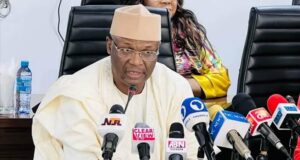

Former Anambra State Governor and ex-Minister of Labour and Employment, Senator Chris Ngige, has opened up about the circumstances surrounding his controversial removal from office in 2006.
In a recent interview, he claimed that his refusal to appoint Chris Uba, a powerful political figure in Anambra at the time, as his deputy was the main reason for his ousting.
Ngige, who remains a member of the All Progressives Congress (APC), though currently on sabbatical, said he holds no regrets about how events unfolded, attributing it all to divine will.
“I know those who were removing me. They showed their hands. They gave me conditions, and I said I won’t do them,” Ngige said.
He recalled that the late Senator Ibrahim Mantu served as a mediator, bringing him the list of demands from political powerbrokers.
“Mantu came to me and told me the things I was supposed to do. He said somebody sent him. I said, ‘Tell the person I would not do it.’ He came back and said, ‘Let us go and see the person.’ And the person told me the major condition would be that I should make Chris Uba my deputy governor.”
Ngige said he declined the condition for two key reasons:
“First, if I made him deputy governor, he would have immunity and could walk into my office and shoot me. If he shot me, nothing would happen. Stories would be told that my orderly did it by accident.
Second, the people of Anambra would revolt against me. That’s the even more important reason because the Anambra people have seen all those people and they didn’t hide themselves. They came and burnt down the state.”
According to him, the violence was intense and targeted at critical institutions:
“They burned down the House of Assembly, burned down the governor’s office, burned down the Anambra Broadcasting Service, burned down the Anambra Education Commission headquarters, and so many things. And the people did not hide themselves.”
Ngige added that the takeover attempt was even broadcast on national television:
“They even made a broadcast on AIT and said that I should not enter the state again, that they have taken over. So I said that these people who said they are taking over and burnt the place are not the people who should come and govern you. I said no. You can take my seat. No problem. God is in charge.”
As a devout Catholic, Ngige said he accepted his removal as part of a divine plan:
“I’m happy with all that transpired because that is how God willed it. When I was removed from government, somebody came to me crying, saying if it were him, he would commit suicide. I told him, ‘I can go and get a rope for you.’ Because this is what God wants.”
He explained that he refused to challenge the court ruling that removed him because he didn’t want further violence in the state:
“I wasn’t born a governor. I was born Nwabueze Ngige, son of a carpenter, my father was a foreman of works at PWD.”
Despite his current absence from active politics, Ngige reaffirmed his loyalty to the APC:
“I am still in APC. I am just on sabbatical.”
Ngige, a trained medical doctor, also addressed his controversial decision to employ so-called “bad boys” during his time as governor. According to him, it was a strategic move to fight insecurity and restore order in the state.
“To secure your place is money, and that is why the originators of budgets did what they call security votes. But many governors and Chief Executive of states and even their deputy think that security money is pocket money, no.”
He gave an example of how he introduced vigilante services across communities in Anambra with full legislative backing:
“I took a bill to Anambra State House of Assembly in 2003 as I come for vigilante services in every community, AVS bill, they passed it… We bond together now, we eat together. We eat dinner together two times a month, and we discuss everything about the state. So they passed it.”
He then described how communities were told to identify both candidates for employment and local troublemakers:
“So each community in Anambra State then we told them to go and give us men, as a matter of fact, give us those who are bad boys, write out the names of the bad boys separately, and then write out the names of those you want us to employ.”
“They wrote them, so we gave employment to all of them and brought the bad boys and said, look, you people are bad boys, look at the list, any false movement, you are dead, but you owe us a duty to show us other bad boys, even those who have committed crime here and run out of the state.”
The program reportedly had high incentives and tight monitoring:
“And they complied, and we paid them handsome amount of money, 30,000 Naira in 2003, 2004, 2005. That 30,000 Naira is the equivalent of about three million now. We paid, we gave them food two times a day. We provided them busses. We provided them recharge card money, so the people were ready to defend their state.”
He claimed the vigilantes even extended their operations outside Anambra:
“In fact, when my police were withdrawn, they made their security available for me. They did. They secured their state. Sometimes they go on operation to Aba (Abia State) to hotel and we go and catch people who have committed one offense in Anambra before.”
Ngige concluded by emphasizing the true purpose of security votes, noting that most governors misuse the funds:
“That is what security fund is all about. But many governors don’t spend security votes. It’s pocket money for them, it’s money for buying property.”