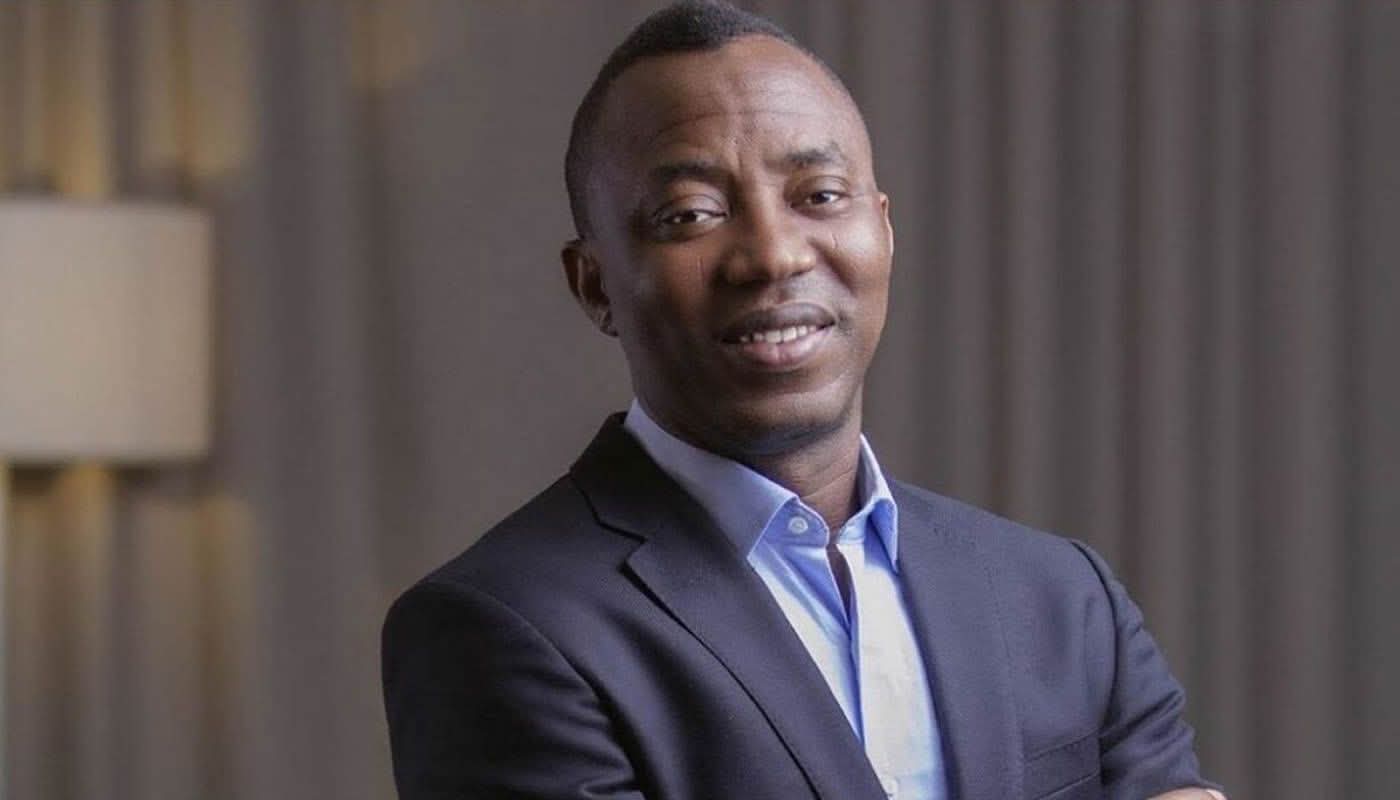

Former African Action Congress (AAC) presidential candidate, Omoyele Sowore, has firmly responded to the Department of State Security Services (DSS), asserting that they cannot dictate how he criticizes President Bola Tinubu.
On Friday, Sowore posted a statement on his official X account addressing the DSS’s demand that he delete a tweet and Facebook post where he referred to President Tinubu as a “criminal.”
“The @OfficialDSSNG has finally sent me a letter asking me to delete my tweet and @facebook posting against Tinubu. Here is their letter and my response to their DG,” Sowore wrote.
In his response, Sowore criticized the DSS’s letter, which was reportedly delivered covertly through a security guard at his lawyers’ Abuja office.
“Re: Demand for Retraction of Criminal, False, and Malicious Post Publication: I acknowledge receipt of your letter, which you stealthily dumped with a security guard at the office of my attorneys in Abuja, addressed to Abubakar Marshal. I find your horrendous attempt at holding an unwarranted brief for the President not only insidious but fundamentally defective, flawed in principle, and absolutely unlawful.”
Sowore emphasized that only a defamed individual has the legal right to sue for defamation, making the DSS’s demand for a retraction unlawful and beyond their authority.
He further cited Section 22 of the 1999 Constitution, which mandates the press to uphold government accountability, and Section 39, guaranteeing citizens freedom of expression.
“Even Article 9 of the African Charter on Human and Peoples’ Rights provides the same protection,” Sowore noted.
The activist highlighted that sedition and libel laws have been repealed in places like the UK, and the UN Human Rights Committee’s General Comment No. 34 affirms the necessity of a free, uncensored media for democracy.
Sowore also referenced multiple court rulings across Africa that reject criminal defamation as incompatible with democratic principles, including Nigeria’s Court of Appeal decision in Arthur Nwankwo v. State (1985), which struck down sedition laws.
“Criticism is indispensable in a democracy. Freedom of speech includes the right to say what those in power find uncomfortable. Justice Olatawura reminded us that citizens must defend their hard-won freedom of expression, and that those in public office must not be intolerant of criticism. Where boundaries are crossed, the remedy is civil libel, not unlawful repression,” he argued.
He questioned the DSS’s track record in protecting powerful figures, pointing out that such loyalty to authority often weakens institutions.
“But where are those strong men today, after your service broke laws and trampled rights to protect them?” he asked.
Sowore concluded by affirming his constitutional duty to hold leaders accountable and reiterated his commitment to political change.
“You have no business telling me how to criticise the President. But, knowing the nature of your service, it is clear you have not learnt your lessons. Let me state it clearly once again: the determination of the Nigerian people to reclaim their country from thieves in power is unwavering. And it shall be achieved. Freedom cometh by struggle. Aluta continua, victoria ascerta.”