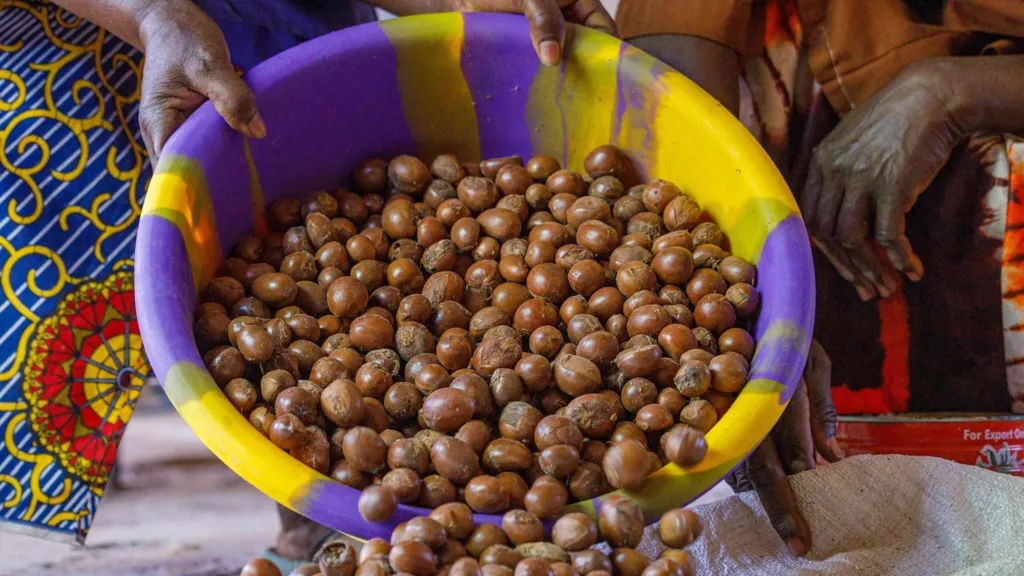

The Federal Government’s sudden ban on the export of raw shea nuts is sending shockwaves across Nigeria’s agricultural value chain, causing prices to plunge by more than 30% and throwing exporters, farmers, and aggregators into economic uncertainty.
Since the six-month ban was enacted on August 26, 2025, market disruptions have intensified.
Contracts worth millions of naira are at risk, with exporters facing possible legal and reputational fallout due to default.
For many, the situation is made worse by pending loan repayments taken out to fund procurement and aggregation.
The policy, approved by President Bola Tinubu and announced by Vice President Kashim Shettima, aims to clamp down on informal trade, boost local processing and strengthen Nigeria’s position in the global shea value chain.
At the announcement in Abuja, Shettima described the decision as “not an anti-trade policy, but a pro-value addition policy” aimed at supporting domestic processors and creating jobs.
However, the immediate enforcement of the ban has drawn sharp criticism from stakeholders, who argue that the move has undermined confidence in the sector.
Industry experts agree that while boosting local processing is a step in the right direction, the abrupt nature of the ban has done more harm than good.
Farmers, aggregators, exporters, and logistics providers, key players in the shea nut ecosystem, are reeling from the shock.
Nigeria is a global leader in shea production, accounting for nearly 40% of world output.
Analysts say local processing has the potential to generate up to $300 million annually through job creation, foreign exchange, and industrial capacity.
But the road to value addition, they warn, must be carefully managed.
The Centre for the Promotion of Private Enterprise (CPPE) has voiced serious concerns about the ban’s economic implications.
In a statement titled “Managing Nigeria’s Shea Nut Export Ban: Balancing Value Addition With Economic Inclusion,” CPPE CEO Dr. Muda Yusuf highlighted the dangers of sudden policy changes.
According to Yusuf, “The sudden ban with immediate effect introduces uncertainty, heightens risk, and undermines investor confidence, deterring investment not just in shea, but across the broader non-oil export sector.”
He warned that “abrupt policy shifts send negative signals to investors,” and could reverse the gains recorded in non-oil exports, which exceeded $3 billion in Q1 2025 alone.
Yusuf added that the policy risks massive job losses across the shea value chain, cultivation, aggregation, logistics, and trade, while disproportionately benefiting processors at the expense of rural producers.
“The policy effectively penalises primary producers to benefit processors, creating a zero-sum scenario rather than a shared-growth model,” he stated.
To mitigate the fallout, CPPE recommends a strategic, phased approach to the export ban that includes:
- Clear timelines for ending raw exports, giving businesses time to adapt.
- Permits for fulfilling existing contracts to avoid defaults and protect Nigeria’s trade reputation.
- Addressing structural bottlenecks such as power, logistics, financing, and infrastructure.
- Ensuring fair market prices for farmers to protect rural livelihoods.
- Encouraging innovation and efficiency in local processing over reliance on subsidised raw materials.
- Inclusive dialogue, through regular stakeholder engagement involving farmers, exporters, processors, and financiers.
- Improved policy predictability, to foster investor trust and long-term commitment.
Yusuf acknowledged that value addition is crucial for economic diversification but stressed that it must be handled with caution.
“A phased transition, supported by structural reforms, will protect rural incomes, sustain non-oil export growth, and ensure that processors thrive on competitiveness rather than on a regime of subsidised raw materials,” he said.
“Policy stability and stakeholder engagement are essential to achieving a win-win outcome for farmers, processors, and the broader economy.”
As Nigeria seeks to industrialise its agricultural exports, the outcome of this ban could set a precedent, either as a model of effective value, chain development or a cautionary tale of rushed economic policy.