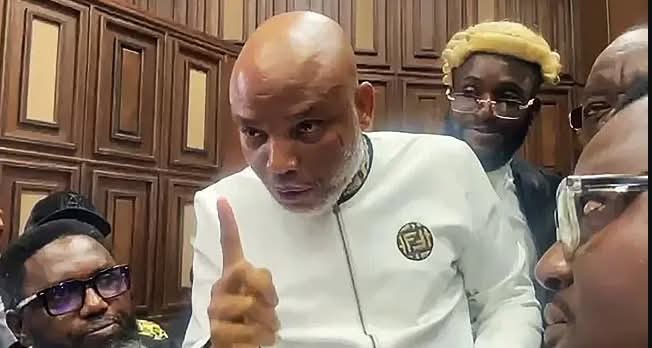

Security operations have intensified at the Sokoto Custodial Centre following the transfer of the Indigenous People of Biafra leader, Nnamdi Kanu, who was relocated there shortly after receiving a life sentence on terrorism-related charges.
Kanu was sentenced on Thursday by Justice James Omotosho of the Federal High Court in Abuja, who also directed that he be kept in a “protective prison.”
The judge stressed that the Kuje facility, where Kanu was previously held, was unsafe due to past jailbreaks and security vulnerabilities.
Although prison authorities refused to confirm the exact location of the IPOB leader, his lawyer, Aloy Ejimakor, told DAILY GAZETTE that his client had indeed been moved to Sokoto.
Ejimakor criticised the transfer, arguing that it isolated Kanu from his legal team, family members, and supporters.
He urged the public, especially the Igbo community, to remain calm.
When our correspondent visited the Sokoto Custodial Centre, the usually quiet environment had changed dramatically.
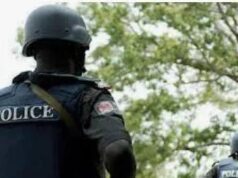
Armed officers were seen stationed around the prison, and residents reported spotting military trucks entering the compound, a rare sight in the area.
One resident, who requested anonymity, said, “This evening, we saw trucks carrying soldiers driving inside. We’ve never seen security this heavy here.”
The spokesperson for the Nigerian Correctional Service, Jane Osuji, confirmed that Kanu remained in state custody but refused to reveal his location due to the sensitivity of the case.
Kanu’s wife, Uchechi Okwu-Kanu, later announced on X that he had indeed arrived in Sokoto.
She expressed displeasure that some supporters circulated the news publicly before she was informed.
Activist Omoyele Sowore also stated that Kanu was “secretly” moved, raising concerns that the relocation could compromise his safety.
Minister of State for Foreign Affairs, Bianca Odumegwu-Ojukwu, appealed for restraint, describing the development as unexpected and urging leaders from the South-East to avoid actions that could heighten tensions.
She emphasised that resolving the crisis required dialogue involving political, religious, and traditional stakeholders.
Prominent Igbo organisations, including Ohanaeze Ndigbo, the Igbo National Council, and MASSOB, condemned the life sentence, calling it unjust and politically motivated.
Ohanaeze’s spokesperson, Ezechi Chukwu, warned that the verdict could worsen instability in the South-East, while the group’s President-General, John Azuta-Mbata, appealed to President Bola Tinubu to initiate a political solution.
The Igbo National Council’s president, Chilos Godsent, described the ruling as part of an “ethno-political war” against the Igbo, urging President Tinubu to pardon Kanu.
Ohanaeze’s Youth Wing and MASSOB leader Uchenna Madu issued similar condemnations.
Kanu was first arrested in 2015 over treason-related accusations, fled the country, and was later re-arrested in Kenya and returned to Nigeria in 2021.