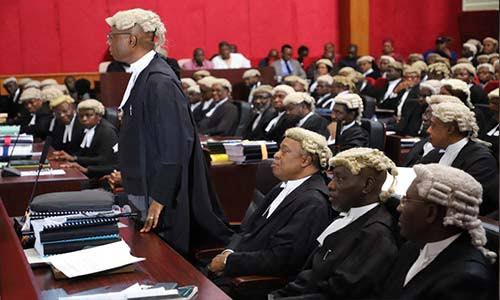

A Federal High Court sitting in Kaduna has ordered the Economic and Financial Crimes Commission to issue a public apology to a Dubai-based businessman, Alhaji Rabiu Tijjani, for unlawfully declaring him wanted.
The court also awarded ₦5 million in damages against the anti-graft agency.
In a judgment delivered by Justice H. Buhari, the court held that the EFCC acted outside the law by publishing Tijjani’s photograph and personal details on its official website without first obtaining a valid court order authorising such action.
According to the judge, an arrest warrant issued by a Magistrate’s Court does not confer the power to publicly brand a citizen as wanted.
He ruled that the EFCC’s action was unlawful, unconstitutional, and a violation of Tijjani’s fundamental rights.
Justice Buhari stressed that due process must be followed before any law-enforcement agency can take such a step, warning against arbitrary use of investigative powers.
The case arose from a commercial dispute involving a multimillion-dollar gold transaction between Tijjani, a Kano-born gold merchant based in Dubai, and businessman Ifeanyi Ezeokoli.
Court records showed that the parties initially resolved an overpayment of ₦26 million. However, a subsequent audit allegedly revealed an additional discrepancy of more than $2 million in Tijjani’s favour.
Tijjani reported the matter to the Department of State Services, where investigations were ongoing, including document submissions and independent audits by both parties.
Despite the DSS inquiry, Ezeokoli later petitioned the EFCC.
Tijjani told the court that the Commission contacted him only once via WhatsApp, after which he sent a representative, and that no further invitation was extended to him before he was declared wanted.
He argued that the EFCC’s action caused serious reputational damage, particularly at the international level.
In faulting the EFCC’s conduct, Justice Buhari noted that while the Commission has the authority to declare suspects wanted, such powers must be exercised strictly in line with the law.
He cautioned that security agencies should not be used to resolve commercial or civil disputes.
The court further reiterated established judicial precedents that prohibit law-enforcement agencies from being deployed for debt recovery or business disagreements.
Among the reliefs granted by the court were an order directing the EFCC to remove Tijjani’s details from its website, issue a public apology, and pay ₦5 million in damages.
Although Tijjani had sought ₦1.5 billion in damages and other reliefs, the court granted only part of his claims.
Reacting to the judgment through his lawyer, Tijjani described the ruling as a victory for justice, saying it reaffirmed the need for agencies to act within the bounds of the law.
As of the time of filing this report, the EFCC had not issued any public statement on the ruling.