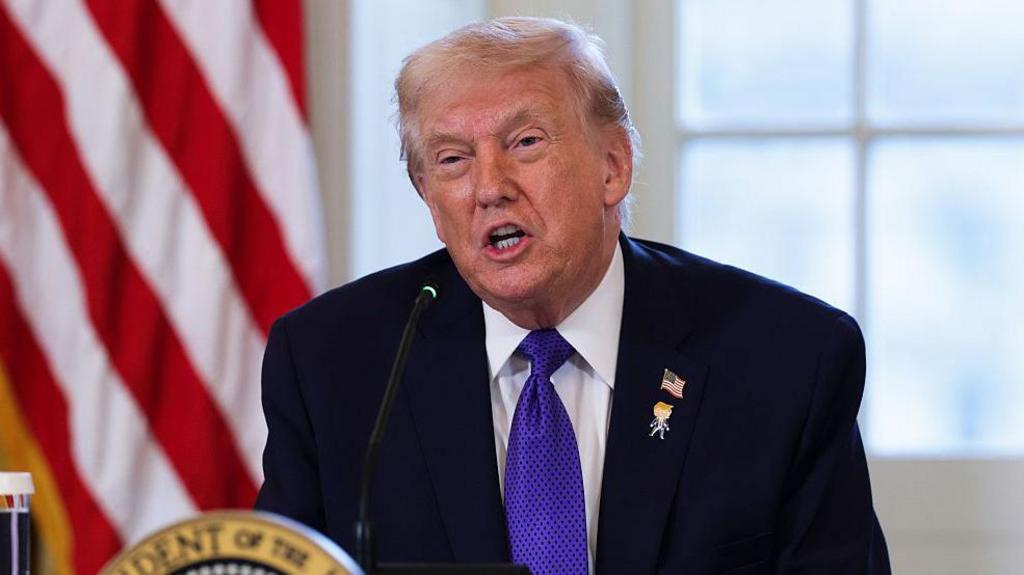

Greenland and Denmark have temporarily set aside decades of unresolved historical grievances to present a united front against renewed pressure from United States President Donald Trump over the strategic Arctic territory.
The vast island, ruled by Denmark as an autonomous territory but home to strong pro-independence sentiments, has found common cause with Copenhagen amid Washington’s renewed interest in its strategic and security significance.
Greenland’s major political parties, which all support independence in principle but differ on the pace and method, formed a coalition government in March 2025 largely in response to Trump’s repeated expressions of interest in taking control of the island.
Only the Naleraq party, which advocates a rapid path to independence, remained outside the coalition.
Last week, Greenland’s leaders firmly rejected Trump’s bid, reiterating that the island was not for sale.
Although Trump later said he had reached a framework agreement on Arctic security with NATO Secretary-General Mark Rutte, Greenland and Denmark stressed that decisions concerning the territory rest solely with them.
At the height of the diplomatic standoff, Greenland’s Prime Minister, Jens-Frederik Nielsen, declared that if forced to choose between the United States and Denmark, Greenland would stand with Denmark.
According to Ulrik Pram Gad of the Danish Institute for International Studies, Trump’s pressure has pushed most of Greenland’s political spectrum to shelve immediate independence preparations in favour of collective resistance.
He said broader European backing had eased long-standing tensions with Denmark, making the relationship feel less restrictive in the face of external pressure.
Over the past month, Greenland and Denmark have coordinated diplomatic engagements, appearing jointly in Washington and Brussels to reinforce their shared position.
Greenland’s Foreign Minister, Vivian Motzfeldt, and Denmark’s Foreign Minister, Lars Lokke Rasmussen, met senior US officials in Washington before holding further talks with NATO leaders in Brussels.
Despite the current unity, analysts note that the relationship is shaped by a painful colonial legacy.
Greenland was a Danish colony for more than three centuries before becoming an autonomous territory in 1979, with expanded self-rule granted in 2009.
Historians and researchers point to a series of injustices, including forced assimilation policies, the removal of Inuit children from their families in the 1950s, and decades-long birth control programmes that saw thousands of Greenlandic women fitted with contraceptive devices without consent.
Denmark has formally apologised for some of these actions and begun compensation processes, but the scars remain.
Experts say the renewed focus on Greenland’s strategic value has, for now, pushed these unresolved issues into the background.
“There is a broad sense that the immediate challenge is external,” said Astrid Andersen, a specialist in Danish-Greenlandic relations.
“For the moment, the common opponent is Trump, and that has created a fragile but significant unity.”