Home Blog Page 350

2027: Obi Has No Place In Labour Party Again, Won’t Get Our PresidentialTicket – Spokesman
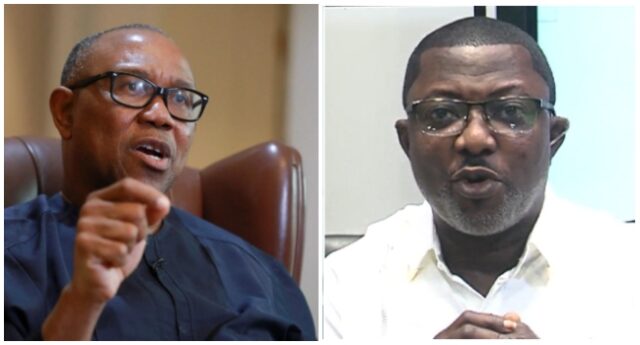
 

The internal crisis within the Labour Party (LP) deepened on Monday as the party’s National Publicity Secretary, Abayomi Arabambi, declared that Peter Obi will not be the party’s presidential flagbearer in the 2027 general elections.

Speaking during an interview on Lunchtime Politics on Channels Television, Arabambi said the LP is already preparing for 2027 without Obi in the picture.

“We are going to do our 2027 without Peter Obi; he will not have our ticket,” Arabambi stated bluntly.

The party spokesman accused Obi of aligning with opposition figures including former Vice President Atiku Abubakar, suggesting that the former LP candidate is no longer committed to the party’s ideals.

He also criticized LP’s acting National Chairperson, Nenadi Usman, and activist Aisha Yesufu, alleging that both were working behind the scenes with Obi to push an agenda not sanctioned by the party.

“Obi has one leg in Labour Party, one in PDP, and another in ADC,” Arabambi claimed. “He should just come out and officially announce his exit.”

Arabambi further argued that the support Obi enjoyed during the 2023 election was not due to his personal popularity, but rather a product of the EndSARS movement and public discontent with the administration of former President Muhammadu Buhari.

“Obi only found Labour Party as a vehicle for change and happened to be in the right place at the right time,” he added.

Arabambi revealed that the party is taking steps to expel individuals he described as “political extremists,” whom he says are damaging the party’s credibility.

“Our plan is to get rid of these elements. We don’t want them in Labour Party,” he said.

He wished Obi and his alleged allies well in their new political alignments, including the African Democratic Congress (ADC), which Obi has reportedly been engaging with as part of a broader coalition.

Google search engine

Fuel Scarcity Looms As NUPENG Shuts Filling Stations


Residents of Sokoto State are bracing for a possible fuel crisis after members of the Nigeria Union of Petroleum and Natural Gas Workers (NUPENG) began enforcing a shutdown of filling stations across the state capital.

As of Monday, several petrol stations were observed to have been closed, with NUPENG officials halting tanker movements along key routes, including Gusau Road and highways connecting Sokoto to neighboring states.

Eyewitnesses described scenes of barricades and palm fronds used by union members to seal off access to fuel depots and stations, effectively cutting off supply and disrupting normal transportation activities in the metropolis.

Though no official statement has been released by NUPENG’s national body, an enforcement official who spoke anonymously confirmed that the directive came from the union’s national leadership.

“We got the order around midnight to shut down operations, and we are simply following instructions,” the official told newsmen.

The sudden development has already begun to impact daily life. Commercial transporters, particularly tricycle (keke) operators, are facing operational challenges.

One operator, Bello Musa, shared his frustration:

“I came out early to work and found that most filling stations are closed. If this continues, transport fares will rise, and everyone will feel it. We don’t even know why they’re striking.”

Commuters are also worried about the likely ripple effects of the shutdown, including inflated transport costs and broader economic disruption if fuel scarcity sets in.

As of the time of this report, no clear reason has been given by NUPENG’s national executives for the sudden enforcement action in Sokoto.

This has only heightened speculation and concern among residents, who are uncertain how long the situation will last.

Google search engine

JUST IN: Nursing Council Abolishes Policy Of Dismissing Students After Three Failed Exams


The Nursing and Midwifery Council of Nigeria (NMCN) has officially abolished its long-standing policy that disqualified students from nursing training after three failed attempts at the Council’s professional examinations.

In a circular dated September 1, 2025, and signed by the Registrar and CEO, Ndagi Alhassan, the Council announced that affected students will now be allowed unlimited re-sits of any failed exam component, provided they maintain a minimum of 80% attendance in both lectures and clinical postings.

The notice, titled “Nursing Education Reform: Elimination of Students After Three Professional Examination Attempts”, was addressed to stakeholders across the nursing education and healthcare sector, including state health commissioners, university nursing faculties, and hospital administrators.

According to the Council, this change is part of a broader push to make nursing education in Nigeria more inclusive, student-friendly, and globally aligned.

The aim is to move away from punitive academic policies and toward a model that encourages resilience, lifelong learning, and academic support.

“Our mission to uphold excellence in nursing education demands flexibility and inclusivity,” the circular reads.

“We must shift from eliminating struggling students to supporting their success.”

NMCN emphasized that while standards must remain high to ensure quality healthcare professionals, it is possible to balance that with compassion and practical support.

While students can now re-sit failed components indefinitely, there are strict conditions:

– Candidates must remain enrolled in the training institution.

– They must maintain at least 80% attendance in academic and clinical activities.

– Institutions will be held accountable for repeated failures, as each unsuccessful attempt will be counted against the school’s overall performance metrics.

The Council urged heads of nursing schools and program directors to implement academic support systems for students struggling to pass.

These might include tutoring programs, remedial classes, additional clinical exposure and mentorship opportunities.

“Heads of institutions must put systems in place to support all students especially those who need more time or help to meet the required standards.”

Previously, the NMCN policy removed candidates from the nursing program after three failed professional exam attempts, a rule that had been criticized for being overly harsh and counterproductive.

Google search engine

National Grid Faces N5.6 Trillion Revenue Loss Amid Mass Exodus Of Premium Customers

Nigeria’s power sector is facing a deepening financial crisis as the national electricity grid stands to lose approximately ₦5.6 trillion in revenue by the end of 2025.

This is due to the ongoing exit of premium customers, industries and high-income households who are shifting to off-grid and alternative power solutions.

Currently, the Federal Government is grappling with a 4 trillion legacy debt to electricity generation companies (GenCos). New arrears have ballooned to ₦1.6 trillion as of August 2025 and are projected to reach ₦2.2 trillion by December.

Combined, total sector liabilities are now at ₦5.6 trillion.

According to sources at the Nigerian Electricity Regulatory Commission (NERC), only 13% of commercial customers now rely on the national grid, a sharp decline from 20%.

Rising electricity tariffs, poor supply reliability, and frequent grid failures have pushed businesses and elite households to invest in solar, gas, and other decentralized energy systems.

In 2024 alone, manufacturers spent ₦1 trillion on self-generation.

– NERC licensed 24 bulk consumers and 22 off-grid projects, adding nearly 289MW of capacity outside the national grid.

– Several states including Lagos, Jigawa, Delta, Zamfara and Katsina signed renewable energy deals.

The Federal Government is also planning to remove its agencies from the national grid, further shrinking the customer base.

With fewer premium customers paying higher rates, the government now faces an estimated ₦200 billion monthly tariff shortfall.

Despite promises to settle debts and stabilize the sector, the Tinubu administration has yet to provide a clear roadmap.

Though a promissory note program and ₦900 billion in subsidies were included in the 2025 budget, stakeholders argue this is inadequate, given that yearly subsidy needs average ₦2 trillion.

Efforts to enforce NERC’s newly issued Free Governor Control (FGC) regulation meant to stabilize grid frequency could add another ₦1.059 trillion annually in liabilities.

Most power plants are unable or unwilling to comply with the FGC order due to lack of compensation for idle or available capacity.

Industry leaders argue that without proper funding, GenCos will continue to disable stabilizing controls to avoid revenue losses, Grid instability will worsen and More customers will abandon the grid.

Dr. Joy Ogaji, Executive Secretary of the Association of Power Generation Companies (APGC), emphasized the urgent need for immediate settlement of GenCos’ receivables, transparent reconciliation of power supply invoices and enforcement of quarterly reviews.

She warned that continued instability is damaging equipment, increasing operational costs and deterring private sector participation.

Unless the Federal Government urgently intervenes with a sustainable financial and operational framework, Nigeria’s electricity market may face further collapse leaving the national grid to serve only the poorest citizens, while the wealthiest fully transition to alternative energy.

Google search engine

Court Hears Suit Against CBN, AGF On Alleged Diversion Of Osun LG Allocations


The Federal High Court in Abuja on Monday began hearing a lawsuit filed by the Osun State Government against the Central Bank of Nigeria (CBN) and the Accountant General of the Federation (AGF) over the alleged mishandling of local government (LG) funds.

Presided over by Justice Emeka Nwite, the case centers on accusations that federal financial authorities are attempting to divert LG allocations intended for Osun into unauthorised private accounts.

In its submissions, the Osun State Government alleged that the CBN and the AGF are working together to channel statutory allocations for local councils into accounts operated by individuals posing as government officials.

According to the state, this would violate both public finance regulations and the 1999 Constitution, particularly regarding fiscal transparency and accountability.

The state also claimed that the disbursement scheme is being executed without the involvement of legally designated accounting officers, a practice it described as both illegal and an affront to due process.

Osun State further argued that the alleged actions of the CBN and AGF are an attempt to preempt and undermine pending proceedings before the Supreme Court regarding the constitutionality and legality of the administration of local government funds in the state.

This development follows ongoing political tensions between elected officials from the All Progressives Congress (APC) and the ruling Peoples Democratic Party (PDP) in Osun, stemming from disputes over the October 2022 local government elections and subsequent conflicting court rulings.

The case raises significant constitutional questions about fiscal federalism, local government autonomy and the limits of executive power in handling public funds.

The court has adjourned the matter for further hearing, with both parties expected to present additional arguments.

Google search engine

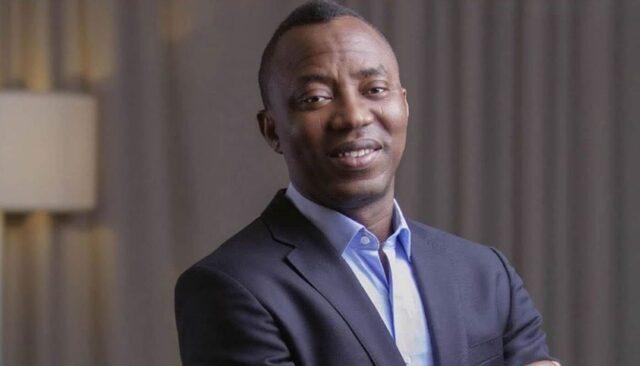
Calling Tinubu A Criminal Unacceptable, Joe Igbokwe Demands Apology From Sowore


Joe Igbokwe, a prominent chieftain of the All Progressives Congress (APC), has called on activist and publisher of Sahara Reporters, Omoyele Sowore, to publicly retract and apologise for calling President Bola Ahmed Tinubu a “criminal.”

Igbokwe made the demand in a strongly worded opinion piece titled “My 10 Kobo Advice to Sowore,” where he expressed shock and disappointment over the activist’s remarks directed at the sitting President.

“I was stunned into disbelief and in total shock when he called a sitting President of the Federal Republic of Nigeria a criminal,” Igbokwe wrote.

“I advised him to withdraw the shameful, scurrilous drivels and apologise to the President. Up till now, he has not found the need to apologise.”

He warned that such accusations, coming from someone of Sowore’s public standing, were not only disrespectful to the President but also to the millions of Nigerians who elected him.

Igbokwe went on to defend Tinubu’s public service record, describing him as “an international Chartered Accountant, a distinguished scholar in the best tradition, former Senator and two-term Governor of Lagos State and now the President of the Federal Republic of Nigeria”

He argued that labeling the President a criminal was equivalent to insulting over 200 million Nigerians who participated in the democratic process.

“When you call a President we all elected a criminal, it is at once telling us that more than 200 million Nigerians are criminals. This is unacceptable,” he stated.

Igbokwe also questioned Sowore’s post-student activism trajectory, saying his relevance has declined since his days as President of the University of Lagos Students’ Union.

“These activities are getting diminished every day and do not make sense to people like us anymore,” he added.

Reaffirming his personal relationship with Sowore, Igbokwe said his appeal was not just political but also personal.

“I have asked you as a friend to retract these nonsensical effusions and openly apologise to the President and Nigeria. This is our irreducible minimum demand,” he concluded.

This exchange comes amid ongoing friction between Sowore and Nigeria’s Department of State Services (DSS).

The security agency recently asked X (formerly Twitter) to remove a tweet in which Sowore referred to President Tinubu as a criminal, a demand Sowore’s legal team has rejected as unconstitutional.

Google search engine

FG Engaging PETROAN As Association Plans Three-Day Nationwide Fuel Shutdown


The Petroleum Products Retail Outlets Owners Association of Nigeria (PETROAN) has confirmed that the Federal Government has initiated talks aimed at resolving the issues behind the association’s planned three-day nationwide suspension of fuel distribution, set to begin at midnight on Tuesday, September 9, 2025.

The update was given by PETROAN National President, Billy Gillis-Harry, during an interview on The Morning Brief, a Channels Television programme aired on Monday.

Gillis-Harry explained that the proposed shutdown was primarily a response to alleged monopolistic practices by the Dangote Refinery, which he claims is attempting to dominate the downstream petroleum sector from refining and logistics to retail distribution.

“This isn’t a fight, we want Dangote Refinery to succeed. But the industry must function with clearly defined roles for all stakeholders. What we’re insisting on is fairness and efficiency,” he said.

According to PETROAN’s Public Relations Officer, Joseph Obele, the association had given the government until Monday night to engage stakeholders and avert the shutdown, which is aimed at resisting monopolistic control and defending workers’ rights.

In a related development, the Nigeria Union of Petroleum and Natural Gas Workers (NUPENG) also issued a strike notice, effective Monday, September 8, citing what it described as exploitative labour practices by Dangote Refinery.

The union, in a statement signed by President Williams Akporeha and General Secretary Afolabi Olufemi, likened the treatment of workers to “modern-day slavery.”

While NUPENG has not yet fully downed tools, the union issued a warning strike notice, alerting the public of an impending disruption if concerns are not addressed.

“Our retail outlets staff are union members. So, if NUPENG proceeds with the strike, our operations will be automatically grounded,” Gillis-Harry explained.

The Dangote Group has not responded publicly to the accusations.

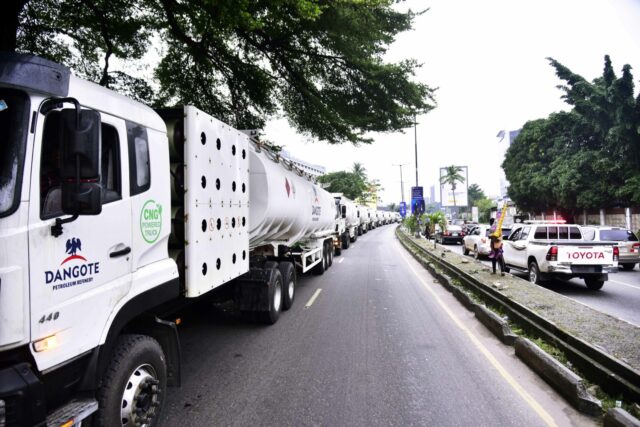
However, tensions are reportedly being fueled by the refinery’s recent move to import 4,000 CNG-powered trucks to handle direct distribution, bypassing traditional logistics players in the industry.

PETROAN and NUPENG argue that such vertical integration undermines existing structures and could lead to unregulated pricing, poor labour standards, and a potential crisis in fuel supply chain management.

Meanwhile, the Federal Government has urged restraint from all parties.

Minister of State for Labour and Employment, Muhammad Maigari Dingyadi, in a statement issued by ministry spokesperson Patience Onuobia, appealed to both PETROAN and NUPENG to suspend any planned industrial action.

The ministry also called on the Nigeria Labour Congress (NLC) to withdraw its red alert, which had urged affiliate unions to prepare for solidarity action.

“We are actively engaging all stakeholders to ensure the sector remains stable,” Dingyadi said.

“A disruption in the petroleum distribution chain at this time could have significant economic consequences.”

Consultations between the government and stakeholders reportedly intensified over the weekend and continued into Monday.

Both PETROAN and NUPENG expressed cautious optimism that a resolution could be reached before the Tuesday deadline.

Google search engine

FG Engaging PETROAN As Association Plans Three-Day Nationwide Fuel Shutdown


The Petroleum Products Retail Outlets Owners Association of Nigeria (PETROAN) has confirmed that the Federal Government has initiated talks aimed at resolving the issues behind the association’s planned three-day nationwide suspension of fuel distribution, set to begin at midnight on Tuesday, September 9, 2025.

The update was given by PETROAN National President, Billy Gillis-Harry, during an interview on The Morning Brief, a Channels Television programme aired on Monday.

Gillis-Harry explained that the proposed shutdown was primarily a response to alleged monopolistic practices by the Dangote Refinery, which he claims is attempting to dominate the downstream petroleum sector from refining and logistics to retail distribution.

“This isn’t a fight, we want Dangote Refinery to succeed. But the industry must function with clearly defined roles for all stakeholders. What we’re insisting on is fairness and efficiency,” he said.

According to PETROAN’s Public Relations Officer, Joseph Obele, the association had given the government until Monday night to engage stakeholders and avert the shutdown, which is aimed at resisting monopolistic control and defending workers’ rights.

In a related development, the Nigeria Union of Petroleum and Natural Gas Workers (NUPENG) also issued a strike notice, effective Monday, September 8, citing what it described as exploitative labour practices by Dangote Refinery.

The union, in a statement signed by President Williams Akporeha and General Secretary Afolabi Olufemi, likened the treatment of workers to “modern-day slavery.”

While NUPENG has not yet fully downed tools, the union issued a warning strike notice, alerting the public of an impending disruption if concerns are not addressed.

“Our retail outlets staff are union members. So, if NUPENG proceeds with the strike, our operations will be automatically grounded,” Gillis-Harry explained.

The Dangote Group has not responded publicly to the accusations.

However, tensions are reportedly being fueled by the refinery’s recent move to import 4,000 CNG-powered trucks to handle direct distribution, bypassing traditional logistics players in the industry.

PETROAN and NUPENG argue that such vertical integration undermines existing structures and could lead to unregulated pricing, poor labour standards, and a potential crisis in fuel supply chain management.

Meanwhile, the Federal Government has urged restraint from all parties.

Minister of State for Labour and Employment, Muhammad Maigari Dingyadi, in a statement issued by ministry spokesperson Patience Onuobia, appealed to both PETROAN and NUPENG to suspend any planned industrial action.

The ministry also called on the Nigeria Labour Congress (NLC) to withdraw its red alert, which had urged affiliate unions to prepare for solidarity action.

“We are actively engaging all stakeholders to ensure the sector remains stable,” Dingyadi said.

“A disruption in the petroleum distribution chain at this time could have significant economic consequences.”

Consultations between the government and stakeholders reportedly intensified over the weekend and continued into Monday.

Both PETROAN and NUPENG expressed cautious optimism that a resolution could be reached before the Tuesday deadline.

Google search engine

JUST IN: FCT Resident Doctors Begin Seven-Day Strike Over Systemic Health Failures


The Association of Resident Doctors, Federal Capital Territory (ARD-FCT), has officially commenced a seven-day warning strike, citing deep-rooted issues plaguing the FCT healthcare system.

In a communique signed by ARD-FCT President, Dr. George Ebong, alongside other executive members, the association described the FCT health sector as suffering from a long-standing systemic failure in urgent need of comprehensive reform.

Dr. Ebong lamented that doctors in the nation’s capital are overburdened, often forced to cover multiple departments due to severe manpower shortages.

He warned that continued neglect of these issues could trigger a collapse of the entire system.

“We are stretched beyond capacity. The current state of the FCT health system is not sustainable,” he said.

Key Demands of ARD-FCT include immediate recruitment to address manpower shortages, provision and repair of non-functional medical equipment, improvement of working conditions across FCT hospitals, settlement of unpaid allowances and salaries as well as prompt promotion and fair remuneration for promoted staff.

The association also stressed that reforms must include input from frontline healthcare workers, warning that top-down decision-making often leads to ineffective policies.

To drive home their point, the doctors have given the FCT administration one week to initiate meaningful reforms, particularly in the areas of staffing and welfare.

Failure to meet these demands, they warned, could result in extended industrial action.

Reacting to the strike action, the Minister of State for Health, Dr. Isaq Salako, expressed optimism that ongoing talks with the National Association of Resident Doctors (NARD) could forestall the planned disruption.

“Yes, NARD has issued an ultimatum, but with the level of engagement so far, I believe we’re making progress,” Salako said during a live appearance on Channels Television’s Sunrise Daily.

He acknowledged that the major contention revolves around the outstanding residency training allowance, with about 40% of the 2025 allocation still unpaid.

“That is my hope, and that is what we are working on,” the Minister responded when asked if the issue would be resolved before the deadline.

Google search engine

Enugu Governor Approves N80,000 Minimum Wage For Forest Guards


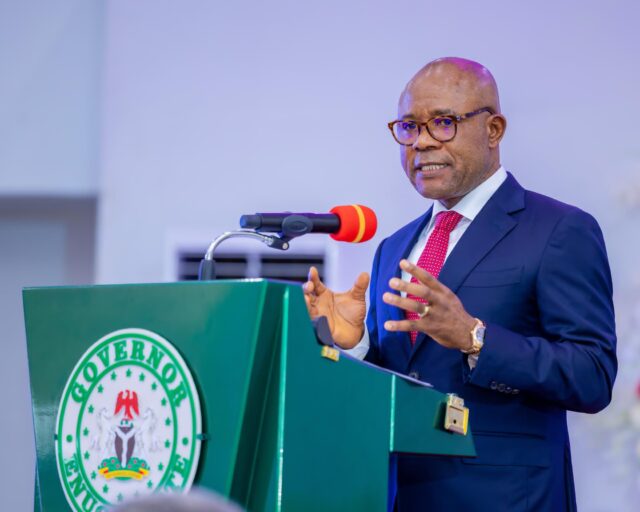
In a major step to bolster forest security and environmental protection, Enugu State Governor, Dr. Peter Mbah, has approved the restructuring of the state’s Forest Guard system, including a new minimum wage of ₦80,000 for personnel.

This development aligns with the newly adopted state-wide minimum wage and is part of a broader initiative to enhance the operational capacity and welfare of forest security operatives.

According to a statement by the Governor’s media aide, Uche Anichukwu, the reform also includes a directive to clamp down on illegal logging activities across the state.

Governor Mbah has ordered the immediate arrest and prosecution of anyone found engaging in deforestation or felling immature trees.

The restructuring was detailed by the State Commander of the Forest Guard, Akinbayo Olasoji, during a series of stakeholder engagements held across Enugu’s three senatorial zones.

The consultations involved local government chairmen, traditional rulers, town union leaders, farmers, hunters, youth groups, and vigilantes.

The aim, according to Olasoji, is to promote community involvement and transparency in the recruitment of forest guards.

“We are prioritizing candidates with proven integrity. All applicants must be endorsed by their traditional rulers and town unions,” Olasoji stated.

He also disclosed that training for the first batch of newly recruited personnel will commence later this month, under the supervision of the Office of the National Security Adviser.

Google search engine

MOST COMMENTED

- Advertisement -
Google search engine