Home Blog Page 697

Gunmen Attack Governor’s Family, Police Escort Accidentally Shoots Sister During Chaos

On Thursday, unidentified gunmen attacked the family of Taraba State Governor Agbu Kefas along Kente Road in the Wukari Local Government Area.

The attackers targeted the governor’s mother, Jumai Kefas, and his sister, Atsi Kefas, while they were traveling.

During the chaotic attack, a police officer assigned to protect the family accidentally shot Atsi Kefas while trying to defend them from the gunmen.

Security expert, Zagazola Makama revealed that the area has been experiencing an uptick in bandit activity, which may have contributed to the attack.

Thanks to the quick response of military personnel, the situation was averted from becoming even more tragic.

The troops rescued the victims, airlifting Jumai and Atsi Kefas to safety.

Atsi was immediately taken to the hospital for medical attention, though her condition remains uncertain.

Authorities recovered the vehicle involved in the incident, and an empty magazine, along with passenger luggage, was found inside.

Google search engine

Nigerian Army Reopens Imo’s Rescue Market After Soldiers’ Killing

The Nigerian Army has reopened the Rescue Market, also known as Malaysia Market, in Onuimo, Obowo Local Government Area (LGA) of Imo State.

This follows a closure three weeks ago after an attack by suspected members of the Indigenous People of Biafra (IPOB) on a military checkpoint, which led to the death of two soldiers.

During a visit to the market on Friday, Major General Hassan Dada, the General Officer Commanding (GOC) 82 Division, emphasized the importance of community support for security agencies in ensuring safety.

He urged traders and residents to take responsibility for the protection of their communities.

“It is our duty as the military to protect you, but we will not tolerate attacks on our soldiers,” Dada stated, adding that ignoring wrongdoings can have serious consequences for everyone.

Dada also highlighted the army’s ongoing efforts to engage with local communities and address their security concerns, stating that commanders in Imo and Abia states have been instructed to maintain close contact with the people.

In addition, Dada expressed concern over the low number of Igbo youths participating in the Army’s recruitment process.

He encouraged the people to view joining the military as a prestigious career.

As part of his visit, the GOC distributed palliative items, including 10-kg bags of rice and vegetable oil, to elderly traders affected by the market’s closure.

Google search engine

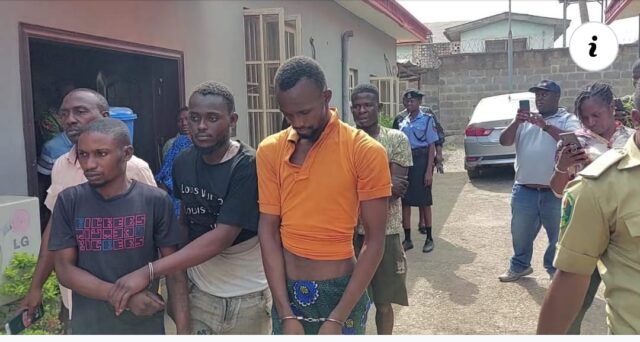
Enugu Police Bust Interstate Armed Robbery Syndicate, Arrest Dismissed Soldier, Others

The Enugu State Police Command has successfully dismantled an interstate criminal syndicate engaged in armed robbery and financial fraud, following a series of coordinated operations.

The crackdown led to the arrest of eight male suspects, including a dismissed soldier, and the recovery of firearms, ammunition, cash, and other stolen valuables.

The operation, which began on November 12, 2024, at around 3:30 am, involved the Emene Division, Crack and Octopus Tactical Squads, and the Neighbourhood Watch Group.

A statement made available to DAILY GAZETTE on Saturday by the Police Public Relations Officer, Enugu State Command, Daniel Ndukwe, revealed that officers responded to a distress call about an armed robbery at an estate in Emene.

One suspect, Ismaila Isah, 23, was arrested at the scene, with a locally made pistol, ₦300,450 in cash, and several stolen items in his possession.

Following Isah’s arrest, investigations led to the identification and capture of additional members of the syndicate, including Sadik Ahmed, 28, a dismissed soldier; Abbas Usman, 33; Mubarak Garba, 24; Abubakar Haruna, 23; Abubakar Sani, 32; Obiri Chukwuebuka, 22; and Bright Omeniru, 22.

The statement added that the police recovered two more locally made pistols, ten laptops, ten mobile phones, assorted jewelry and watches, one MP3 player, power banks, and various personal items.

According to Ndukwe, the syndicate had been involved in multiple armed robberies across Enugu, using stolen SIM cards to fraudulently withdraw funds from victims’ bank accounts.

The syndicate operated not only within Enugu but also across state lines, including Imo State, where two members were apprehended in Owerri.

Sadik Ahmed, the dismissed soldier, reportedly used his security background to bypass checkpoints during the transportation of stolen goods across state borders.

The suspects further confessed to selling the stolen proceeds in different states, including Imo.

The police are continuing their investigation and will soon arraign the suspects in court.

Enugu State’s Commissioner of Police, Kanayo Uzuegbu, commended the operatives for their diligent work and urged them to continue their efforts in combating crime, especially during the festive season.

Google search engine

Tinubu Makes U-Turn, Removes Atuma As Chairman of Southeast Development Commission, Submits New Nominees To Senate

President Bola Tinubu has made fresh changes to the leadership of the South East Development Commission (SEDC), submitting a revised list of nominees to the Senate for approval on December 6, 2024.

The adjustments are aimed at strengthening the Commission’s ability to foster development in the South East region.

As part of the reshuffle, Dr. Emeka Nworgu has replaced Emeka Atuma as the Chairman of the Commission.

Initially, Atuma had been nominated alongside other key figures, including those for the North West Development Commission, but the new changes focus on enhancing the leadership of the South East body.

The reshuffled board also sees significant adjustments to the executive directors. Stanley Ohajuruka is now the new Executive Director of Finance, replacing Anthony Ugbo.

Toby Okechukwu has been appointed Executive Director of Projects, taking over from Obinna Obiekweihe, while Chief Sylvester Okonkwo assumes the role of Executive Director of Corporate Services, succeeding Dr. Daniel Ikechukwu Ugwuja.

Two additional executive directors without specific portfolios have been introduced: Chidi Echeazu and Dr. Clifford Ogbede.

Despite the changes, Mark C. Okoye remains as the Managing Director/CEO of the Commission, ensuring continuity in its leadership.

The updated list also removes Donatus Eyinnah Nwankpa from the board, but several of the original nominees have been retained.

These include Ugochukwu H. Agballah, Okey Ezenwa, Chief Hyacinth Ikpor, Ifeanyi Agwu, Nasiru Usman, Hamma Adama Ali Kumo, Edward David Onoja, Orure Kufre Inima, and Chief (Mrs.) Joke Adebayo-Chukwuma.

The reshuffle expands the Commission’s board from 15 to 16 members.

In a statement by the President’s Special Adviser on Information and Strategy, Bayo Onanuga, the administration expressed confidence that the new nominees, with their expertise, will help realize the SEDC’s mandate and drive growth in the South East region.

All nominations are now subject to Senate confirmation, marking an important step towards making the SEDC a catalyst for regional development.

Google search engine

PSC Dismisses 19 Senior Police Officers, Reduces Ranks of 19 Others Over Misconduct

The Police Service Commission (PSC) has dismissed 19 senior police officers following the conclusion of disciplinary proceedings.

The officers, including two Chief Superintendents of Police, one Superintendent, four Deputy Superintendents, and 10 Assistant Superintendents of Police, were found guilty of misconduct.

In addition, two Assistant Inspectors General of Police received sanctions: one was reprimanded for failing to carry out lawful instructions, while the other was issued a warning letter for negligence.

Ikechukwu Ani, the PSC spokesman, confirmed that the Commission also reduced the ranks of 19 other senior officers, including one Assistant Commissioner of Police, one Chief Superintendent, two Superintendents, two Deputy Superintendents, and 13 Assistant Superintendents. Several other officers were given severe reprimands and warnings.

The Commission noted that the officers dismissed will face prosecution by the Legal Unit of the Nigeria Police Force.

Additionally, three pending disciplinary cases were deferred pending further information from the Inspector General of Police.

The PSC also reviewed 23 appeals, petitions, and nine legal matters, including court judgments.

In total, the Commission made decisions on 110 disciplinary cases and 23 appeals, ensuring compliance with 13 court rulings.

Earlier, the Commission had approved recommendations for police promotions, which were forwarded to the Inspector General of Police for implementation.

During the meeting, the PSC Chairman, DIG Hashimu Argungu, emphasized that the Commission would prioritize the swift resolution of disciplinary matters, enabling officers who are not culpable to progress in their careers.

He also warned officers against involvement in civil matters such as land disputes, marital issues, and rent-related conflicts, stressing that the police should focus on criminal activities and matters of life-threatening nature.

The meeting, chaired by DIG Argungu, was attended by DIG Taiwo Lakanu (rtd), the Honorable Commissioner and Secretary to the Commission, and Chief Onyemuche Nnamani.

Google search engine

Poland Unveils First LGBTQ Museum In History

Poland has opened its first-ever LGBTQ museum, marking a significant step forward for the community in a country where full legal rights are still a work in progress.

Situated on one of Warsaw’s busiest streets, nestled between a kebab shop and a second-hand store, the museum showcases nearly 150 artifacts that chronicle the struggles of Poland’s LGBTQ movement.

The museum’s minimalist design offers a somber yet powerful backdrop to its exhibits, which span several centuries, reflecting the LGBTQ community’s history in Poland, often hidden due to fear of repression.

The museum was established by Lambda, a nonprofit rights group, and is described as a first for post-communist Europe.

Krzysztof Kliszczynski, the museum’s director, expressed his joy at seeing the institution come to life.

The exhibits detail the history of LGBTQ people in Poland, starting in the 16th century, and include letters, photographs, and early examples of activism, much of which was conducted secretly due to the fear of persecution.

Among the featured objects is a 1956 magazine, rediscovered and now a rare piece of LGBTQ history.

At the museum’s ribbon-cutting ceremony, dozens of LGBTQ campaigners from across Poland gathered to celebrate the museum’s opening.

Many of these activists, such as Andrzej Selerowicz, who in 1983 launched Poland’s first gay men’s newsletter, have dedicated decades to fighting for equal rights.

Selerowicz, 76, attended the event and pointed to a cherished photo of himself and his partner taken 45 years ago.

Another key figure, Ryszard Kisiel, also in his 70s, contributed items to the museum, including a leaflet he created almost 40 years ago on safe sex.

The two men, recognized as pioneers in Poland’s LGBTQ rights movement, were honored by the staff and other attendees at the event.

Historians note the difficulty in collecting artifacts that document this often-overlooked history, as many items were lost or intentionally destroyed after the death of their owners.

Piotr Laskowski, a historian at the University of Warsaw, highlighted the personal and often hidden nature of LGBTQ history, which has led to the loss of important memories and objects over the years.

In addition to celebrating the museum’s opening, attendees also pointed to the ongoing challenges faced by the LGBTQ community in Poland.

Despite promises from the ruling party to legalize civil unions, same-sex couples still do not have the right to marry or register partnerships.

Selerowicz expressed frustration at Poland’s slow pace of reform, especially as other European countries, even those considered more conservative, have already introduced civil unions.

As the museum became a symbol of hope for the future, Kliszczynski and other campaigners vowed not to be intimidated by potential homophobic attacks.

“Enough of being afraid… We can no longer be afraid,” Kliszczynski declared, emphasizing their resolve to protect the space at all costs.

Google search engine

BREAKING: Burkina Faso Junta Leader Dismisses Prime Minister, Dissolves Government

Burkina Faso’s military leader, Captain Ibrahim Traore, has dismissed the country’s prime minister, Apollinaire Joachim Kyelem de Tambela, and dissolved the government, according to a decree issued on Friday.

The prime minister, who had served in three consecutive governments, was removed without explanation.

The decree stated that the prime minister’s functions were officially terminated, and the members of the dissolved government would continue managing ongoing matters until a new government is formed.

Tambela had been appointed as prime minister in October 2022 following the coup that brought Traore to power.

Burkina Faso has experienced significant political turmoil since a coup in January 2022, when Lieutenant-Colonel Paul-Henri Sandaogo Damiba ousted the democratically elected president, Roch Marc Christian Kabore.

However, just eight months later, Damiba was overthrown by Traore, who is now leading the country’s junta. Damiba is currently exiled in neighboring Togo.

The junta has made restoring national sovereignty a key priority, and it has been critical of Western influence, particularly from former colonial power France.

Burkina Faso, along with Mali and Niger, has pivoted toward Russia, severing ties with France and joining forces under the Alliance of Sahel States (AES) in September 2023.

The three countries, all led by military juntas, have also distanced themselves from the Economic Community of West African States (ECOWAS), accusing the organization of being manipulated by Paris.

The Sahel region, where Burkina Faso is located, has been grappling with escalating jihadist violence that began in northern Mali in 2012 and spread to neighboring countries, including Burkina Faso and Niger.

In Burkina Faso, the conflict has displaced around two million people and resulted in more than 26,000 deaths since 2015, including both civilians and military personnel, according to the Armed Conflict Location & Event Data Project (ACLED).

Moscow has been sending military instructors to Burkina Faso, along with other African nations, to assist in the fight against Islamist insurgents.

Google search engine

South Korean President Likely To Survive Impeachment Vote After Party Boycotts

South Korean President Yoon Suk-yeol seems set to survive an impeachment vote on Saturday, despite large-scale protests outside parliament calling for his removal.

His party’s lawmakers boycotted the vote, preventing the opposition from securing the necessary votes for his impeachment.

Yoon had sparked nationwide and international outrage by imposing martial law on Tuesday night, suspending civilian rule.

However, after significant backlash, including from lawmakers, he quickly reversed the decision.

The opposition parties, which control 192 of the 300 seats in parliament, filed the impeachment motion, which required 200 votes to pass.

Ahead of the vote, Yoon, 63, apologized for the turmoil caused by his actions but stopped short of resigning.

In a televised address, he acknowledged the public anxiety and inconvenience caused but said he would leave the decision on his future to his party.

“I sincerely apologize,” Yoon said, adding he would trust his party to handle the political situation and any potential measures, including his resignation.

Despite Yoon’s apology, his People Power Party (PPP) stuck to its position of blocking the impeachment.

Party leader, Han Dong-hoon, however, suggested that Yoon should step down to prevent further political instability.

“The president’s duties cannot be carried out under the current circumstances,” Han said. “An early resignation is inevitable.”

Had the motion passed, Yoon would have been temporarily suspended from his duties while the Constitutional Court reviewed the case.

But with most of the PPP’s lawmakers walking out of the chamber, the motion failed to meet the required quorum.

The decision is likely to anger the tens of thousands of South Koreans who have taken to the streets to demand Yoon’s resignation.

Opposition leader, Lee Jae-myung criticized Yoon’s comments as “disappointing,” pointing to widespread public anger and calling for Yoon’s immediate resignation or impeachment.

A recent opinion poll showed Yoon’s approval rating had dropped to a historic low of 13%, and many South Koreans, including retirees and housewives interviewed before the vote, expressed frustration with his leadership and demanded his resignation.

In addition to the political turmoil, police have launched an investigation into Yoon and other officials for alleged insurrection.

The martial law declaration included controversial orders to detain key political figures, leading to clashes between soldiers and parliament staffers, who barricaded themselves to block the military’s entrance.

Some lawmakers even had to climb over walls to access the parliamentary chamber and vote down Yoon’s decree.

The episode, which evoked memories of South Korea’s authoritarian past, has raised concerns internationally, with the U.S. State Department calling for the democratic process to be upheld.

Secretary of State Antony Blinken expressed his hope for a return to normalcy in the country’s political landscape.

Google search engine

Just In: PDP Expels Ugochinyere Over Gross Indiscipline

Ikenga Imo Ugochinyere, the lawmaker representing Ideato North/Ideato South Federal Constituency of Imo State and spokesperson for the Coalition of United Political Parties (CUPP), has been expelled from the Peoples Democratic Party (PDP) due to gross indiscipline, insubordination, and anti-party activities.

A statement from the Imo PDP Publicity Secretary, Lancelot Obiak, confirmed the expulsion on Friday, following a decision by the PDP executive in Ideato LGA.

The expulsion letter, dated December 5, 2024, was signed by the LGA Chairman, ThankGod Okeke, and the Secretary, Onyebuchi Umeh.

According to the statement, the expulsion was based on a report from the party’s disciplinary committee, which had investigated allegations of misconduct against Ugochinyere.

The investigation, which adhered to Section 57 (1-4) of the PDP constitution (2017 as amended), found that the lawmaker had violated multiple party rules.

Ugochinyere had been suspended by his Umuopia/Umukegwu ward on October 14, 2024, after he failed to attend a meeting called by the ward Executive Committee on October 5, 2024, despite multiple reminders.

The report from the disciplinary committee, which was submitted to the Ideato LGA Executive Committee, highlighted several violations by Ugochinyere.

These included failing to attend party meetings, engaging in unauthorized publicity of internal disputes, and establishing parallel party structures at the ward, LGA, and national levels.

The report also condemned his derogatory and provocative public statements, which the committee found had brought the party into disrepute.

The LGA Executive Committee, meeting on December 5, 2024, unanimously adopted the disciplinary report, leading to Ugochinyere’s expulsion from the PDP, effective immediately.

Ugochinyere’s reaction to the expulsion could not be obtained as at the time of this report.

Google search engine

Why Tinubu Might Be a One-Term President – Ologbondiyan

Kola Ologbondiyan, former National Publicity Secretary of the Peoples Democratic Party (PDP), has spoken candidly about the current state of the party and the performance of President Bola Tinubu’s administration.

Ologbondiyan dismissed claims that the PDP is dead, acknowledging, however, that the party is currently “comatose” and ineffective.

He criticized the party’s leadership for allowing internal crises, such as contested congress outcomes and ongoing litigations, to undermine its strength as the leading opposition party.

According to him, while the PDP is not dead, it needs revitalization to regain its former prominence and relevance in Nigerian politics.

Ologbondiyan disagreed with those who argue that the PDP was not built to function as an opposition party.

He emphasized that political parties are formed to mobilize support, win elections, and govern, regardless of whether they are in power or not.

He argued that the PDP’s inability to function effectively as an opposition is due to leadership failures and a deviation from the core principles of fairness and equity established by the party’s founding members.

Reflecting on the PDP’s loss of power to the All Progressives Congress (APC) after 16 years in office, Ologbondiyan blamed leadership missteps within the party.

He pointed out that the PDP’s internal challenges, such as the handling of the party’s succession issues, led to its eventual downfall.

He highlighted the failure to respect the party’s constitution during leadership transitions, particularly after the resignation of former National Chairman Dr. Iyiorchia Ayu, as a significant factor in the party’s decline.

While acknowledging that some of the party’s founding fathers have distanced themselves from active partisan politics, Ologbondiyan stated that many continue to offer advice and support the party’s future.

He stressed the importance of re-engaging experienced party members and respecting the constitution to restore PDP’s strength.

Ologbondiyan also criticized PDP members serving in the APC government, such as former Rivers State Governor Nyesom Wike, who currently holds a ministerial position.

He argued that such contradictions harm the PDP’s prospects, as party members in government are naturally inclined to support the ruling APC, even if they retain their membership in the opposition.

On President Tinubu’s leadership, Ologbondiyan suggested that Tinubu’s tenure could be cut short, potentially making him a one-term president.

He pointed to rising economic challenges, hunger, insecurity, and corruption under the APC administration as signs that the current government may not last.

Ologbondiyan asserted that Nigerians have historically moved away from ineffective governments, citing the PDP’s loss of power in 2015 as an example of how voters may shift allegiance when dissatisfied with their leaders.

Ologbondiyan expressed confidence that Nigerians are not stuck with the APC and that change is possible, despite claims of state capture by the ruling elite.

He referenced past examples in Nigerian history where political outcomes defied expectations, suggesting that with the right leadership, the APC’s rule could be brought to an end in 2027.

Regarding President Tinubu’s economic policies, Ologbondiyan criticized the sudden removal of petrol subsidies and the floating of the Naira without adequate preparation.

He argued that these moves, which were introduced without proper consultation or safeguards, have caused significant hardship for Nigerians.

He also compared Tinubu’s administration unfavorably to that of former President Olusegun Obasanjo, who, when faced with similar issues, provided palliative measures to mitigate the effects of subsidy removal.

Ologbondiyan took issue with President Tinubu’s recent remarks, where he claimed Nigerians were living “fake lives” before his administration.

Ologbondiyan questioned the president’s hypocrisy, pointing out the lavish lifestyle of the government, including the purchase of a new presidential aircraft, while Nigerians struggle to afford basic needs.

He criticized the government for living extravagantly while imposing austerity measures on the general population.

On the controversy surrounding new tax bills, Ologbondiyan expressed concern over the ethnic undertones in the debate.

He pointed out that taxes, such as VAT, are paid by all Nigerians regardless of their ethnicity or location, and that introducing ethnic divisions into the discussion could be damaging for national unity.

Finally, Ologbondiyan dismissed the notion that Nigeria is “jinxed” when it comes to leadership.

He argued that the real issue is the failure to build strong institutions, which has allowed leaders to rule in ways that benefit themselves rather than the broader society.

He stressed the need for a governance system that prioritizes the welfare of the people over personal or party interests.

Google search engine

MOST COMMENTED

- Advertisement -
Google search engine